Posts Tagged ‘Chaucer’
“Valentine’s Day is a gentle reminder that Christmas decorations must come down”*…

Today is, of course, Valentine’s Day– a celebration overseen by Cupid. Jacqueline Mansky explains how that rascally cherub has been part of Valentine’s Day lore since Chaucer’s time…
Despite a long list of Valentines and Valentinas that included emperors, martyrs-turned-saints, and a pope, there is no evidence that Saint Valentine’s Day as a holiday about love existed before Chaucer’s time. But as soon as it was, Cupid was part of it.
As the late University of Kansas English professor Jack B. Oruch wrote in “St. Valentine, Chaucer, and Spring in February,” it was the English literary giant and a circle of contemporaries, including John Gower, Oton de Grandson, and John Lydgate, who, building on the courtly love tradition, were the original “mythmaker[s]”of Valentine’s Day as a holiday focused on love and fertility. Cupid’s association with the day was present from the start, says Oruch. “At the time of Chaucer’s death in 1400, the transformation of Valentine into an auxiliary or parallel to Cupid as sponsor of lovers was well under way.”
But Cupid’s image did not stay the same in Valentine’s lore. By the mid-1800s, Cupid was looking less literary and more marketable.
As Leigh Eric Schmidt, a professor of religion and politics at Washington University in St. Louis, writes in “The Fashioning of a Modern Holiday: St. Valentine’s Day, 1840-1870,” Americans in the mid 1800s repurposed the holiday, and Cupid’s image shifted. Valentine’s Day had such a hold over the public, Schmidt writes, that it amounted to a “mania, craze, rage, or epidemic—a ‘social disease’ that seemed to recrudesce annually with ever heightening interest and anticipation.”
Naturally, Schmidt writes, merchants were eager to capitalize on this phenomenon even more by bringing children into the fold, so they created “lines of ‘juvenile valentines’.” Cupid came to have a new visual. Middle-class Americans of the nineteenth century had a “sentimental devotion to the child,” Schmidt writes, so the “piety of the angelic youngster” was reflected in a wide range of Valentine’s Day cards. The repackaging, Schmidt contends, was “very much a new image for the holiday”:
A refashioned image of Cupid as an innocent cherub indicated a redirection toward children and familial devotion. Merchants helped create a darling infant Cupid who bore only a faint resemblance to the often capricious Roman Cupid, who was said, among other things, to have sharpened his arrows on a grindstone whetted with blood.
Cupid’s image continues to be repurposed to this day in the pursuit of profit. Take the 2001 slasher flick Valentine. As film theorist and historian Richard Nowell writes in his essay “‘There’s More Than One Way to Lose Your Heart’: The American Film Industry, Early Teen Slasher Films, and Female Youth Author(s),” Cupid was reimagined as a “cherub-masked killer” to target teenage girls and young women, America’s “second-largest theatergoing demographic.” Clearly no longer playing for the children in the room, the trailer asks: “Why is it that the one day of the year that everyone’s afraid to be alone is Valentine’s Day?” The answer, Nowell writes, is the film’s tagline: “Love Hurts.”
It’s certainly a stretch from where Chaucer started with springtime and lovers, but considering that planned Valentine’s Day sales in the U.S. are expected to rake in approximately $27.4 billion this year—an increase of $6.7 billion since 2019—unless we collectively agree to quit celebrating Valentine’s Day, it’s a sure bet there’s more of this waiting in the, well, wings…
“Why Cupid Rules Valentine’s Day,” from @jstordaily.bsky.social.
* anonymous
###
As we celebrate, we might recall that it was on this date in 1977 that The B-52s performed their first live show at a Valentine’s Day party in their hometown of Athens, Georgia.
“Our social tools are not an improvement to modern society, they are a challenge to it”*…

Jonathan Haidt ponders the poisonous impact of social media, arguing that “It’s not just a phase,” and what considers we might do about it…
… It’s been clear for quite a while now that red America and blue America are becoming like two different countries claiming the same territory, with two different versions of the Constitution, economics, and American history. But Babel is not a story about tribalism; it’s a story about the fragmentation of everything. It’s about the shattering of all that had seemed solid, the scattering of people who had been a community. It’s a metaphor for what is happening not only between red and blue, but within the left and within the right, as well as within universities, companies, professional associations, museums, and even families.
Babel is a metaphor for what some forms of social media have done to nearly all of the groups and institutions most important to the country’s future—and to us as a people. How did this happen? And what does it portend for American life?
…
The high point of techno-democratic optimism was arguably 2011, a year that began with the Arab Spring and ended with the global Occupy movement. That is also when Google Translate became available on virtually all smartphones, so you could say that 2011 was the year that humanity rebuilt the Tower of Babel. We were closer than we had ever been to being “one people,” and we had effectively overcome the curse of division by language. For techno-democratic optimists, it seemed to be only the beginning of what humanity could do.
In February 2012, as he prepared to take Facebook public, Mark Zuckerberg reflected on those extraordinary times and set forth his plans. “Today, our society has reached another tipping point,” he wrote in a letter to investors. Facebook hoped “to rewire the way people spread and consume information.” By giving them “the power to share,” it would help them to “once again transform many of our core institutions and industries.”
In the 10 years since then, Zuckerberg did exactly what he said he would do. He did rewire the way we spread and consume information; he did transform our institutions, and he pushed us past the tipping point. It has not worked out as he expected…
Social media and society: “Why the Past 10 Years of American Life Have Been Uniquely Stupid,” from @JonHaidt in @TheAtlantic. Eminently worth reading in full.
See also: “The big idea: how to win the fight against disinformation.”
* Clay Shirky
###
As we follow Jaron Lanier‘s advice to “go to where you are kindest,” we might recall that it was on this date 1397 that Geoffrey Chaucer “told” (read aloud) The Canterbury Tales for the first time at the court of Richard II.
“I got stood up by the letter Y, he was hanging around with his X”*…

It’s perhaps not pornography’s fault that it’s cashing in on a global crisis. As, around the world, whole societies confine themselves to their quarters, traffic to major porn sites has been spiking everywhere, telling us all we need to know about how humans with a broadband connection tend to deal with exceptional levels of boredom and anxiety. From the point-of-view of page views, the season of self-isolation might well be the porn industry’s historical high point — but in terms of reputational damage, it also marks a new low for one of Western culture’s most enigmatic figures.
Once, the letter X was the holiest of all alphabetic symbols, standing for nothing less than the triumph of Christendom itself. The Roman emperor Constantine I imposed his adopted religion on Europe and the Middle East, with armies marching under the banner of an “X,” and for centuries, Latin scribes used it as shorthand for “Christ.”
But at the present moment… the 24th letter of the English alphabet is synonymous not even with professionally lit kissy porn, but rather the explicitier, extremier world of hardcore sharing platforms.
It’s a remarkably stratospheric fall from grace, especially for such a shy and retiring character — X is the second-least-common letter in written English (after Z), and the one that begins by far the fewest number of words. Oh X, what happened to you? Where did it all go so badly wrong that you’re hanging out in NSFW corners of the internet…?
From holiest hallmark to horniest sex symbol — the X-treme, X-haustive story of how the wild child of the alphabet lost its way: “How Did X Become the Edgiest Letter?”
See also: “What’s So Fascinating About the Letter X?” and “Before X Was X: The Dark Horse Story Of The 24th Letter.”
* Norah Jones
###
As we mark the spot, we might recall that it was on this date 1397 that Geoffrey Chaucer “told” (read aloud his ribald, if not X-rated) The Canterbury Tales for the first time at the court of Richard II.
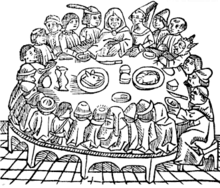
A woodcut from William Caxton‘s second edition of The Canterbury Tales, printed in 1483
“We don’t just borrow words; on occasion, English has pursued other languages down alleyways to beat them unconscious and rifle their pockets for new vocabulary”*…

In the early history of international trade, when exotic goods traveled to new regions, their native names sometimes hitchhiked along with them.
Naturally, the Germans have a term – Wanderwörter – for these extraordinary loanwords that journey around the globe, mutating subtly along the way…
See the map above in larger format, and learn more about each of the examples it illustrates at: “Mapping the Spread of Words Along Trade Routes.” [sourced from Lapham’s Quarterly]
* James Nicoll
###
As we ponder the provenance of our produce, we might recall that it was on this date 1397 that Geoffrey Chaucer “told” The Canterbury Tales for the first time at the court of Richard II.
A woodcut from William Caxton‘s second edition of The Canterbury Tales, printed in 1483
“The first of April is the day we remember what we are the other 364 days of the year”*…

25+ Hilarious Pranks For April Fools’ Day
29 Insanely Easy Pranks You Need To Play On April Fools’ Day
* Mark Twain
###
As we ponder the prank, we might note that today is, of course, April Fools’ Day. A popular occasion for gags and hoaxes since the 19th century, it is considered by some to date from the calendar change of 1750-52— though references to high jinx on the 1st of April date back to Chaucer’s The Canterbury Tales (1392).
April Fools’ Day is not a public holiday in any country… though perhaps it should be.
If every fool wore a crown, we should all be kings.
– Welsh Proverb

An April Fools’ Day hoax marking the construction of the Copenhagen Metro in 2001
You must be logged in to post a comment.