Posts Tagged ‘eugenics’
“The brain has corridors surpassing / Material place…”*

Our brains, Luiz Pessoa suggests, are much less like machines than they are like the murmurations of a flock of starlings or an orchestral symphony…
When thousands of starlings swoop and swirl in the evening sky, creating patterns called murmurations, no single bird is choreographing this aerial ballet. Each bird follows simple rules of interaction with its closest neighbours, yet out of these local interactions emerges a complex, coordinated dance that can respond swiftly to predators and environmental changes. This same principle of emergence – where sophisticated behaviours arise not from central control but from the interactions themselves – appears across nature and human society.
Consider how market prices emerge from countless individual trading decisions, none of which alone contains the ‘right’ price. Each trader acts on partial information and personal strategies, yet their collective interaction produces a dynamic system that integrates information from across the globe. Human language evolves through a similar process of emergence. No individual or committee decides that ‘LOL’ should enter common usage or that the meaning of ‘cool’ should expand beyond temperature (even in French-speaking countries). Instead, these changes result from millions of daily linguistic interactions, with new patterns of speech bubbling up from the collective behaviour of speakers.
These examples highlight a key characteristic of highly interconnected systems: the rich interplay of constituent parts generates properties that defy reductive analysis. This principle of emergence, evident across seemingly unrelated fields, provides a powerful lens for examining one of our era’s most elusive mysteries: how the brain works.
The core idea of emergence inspired me to develop the concept I call the entangled brain: the need to understand the brain as an interactionally complex system where functions emerge from distributed, overlapping networks of regions rather than being localised to specific areas. Though the framework described here is still a minority view in neuroscience, we’re witnessing a gradual paradigm transition (rather than a revolution), with increasing numbers of researchers acknowledging the limitations of more traditional ways of thinking…
Complexity, emergence, and consciousness: “The entangled brain” from @aeon.co. Read on for the provocative details.
* Emily Dickinson
###
As we think about thinking, we might send amibivalent birthday greetings to Robert Yerkes; he was born on this date in 1876. A psychologist, ethnologist, and primatologist, he is best remembered as a principal developer of comparative (animal) psychology in the U.S. (his book The Dancing Mouse (1908), helped established the use of mice and rats as standard subjects for experiments in psychology) and for his work in intelligence testing.
But in his later life, Yerkes began to broadcast his support for eugenics. These views are broadly considered specious– based on outmoded/incorrect racialist theories— by modern academics.

“The only kind of seafood I trust is the fish stick, a totally featureless fish that doesn’t have eyeballs or fins”*…

A minority opinion, it seems… we’re consuming more seafood than ever, and increasingly from farmed sources, which have overtaken that of wild-caught fish for the first time in history…
At the latest count, the average American was eating ~5 lbs more seafood per year than they had been in the 1990s, and globally the consumption of seafood has been outpacing population growth since the 1960s. But where exactly is all of that shrimp, tuna, and salmon coming from?
When we think of fishing, it’s easy to romanticize weather-beaten boats helmed by wizened sea captains. But, on a global scale, much of modern fishing looks very different. In fact, increasingly, the contents of a seafood tower or “catch of the day” is more likely to have been farmed rather than caught in the wild.
That’s the latest conclusion from The State of World Fisheries and Aquaculture, an annual report published earlier this month by the UN’s Food and Agriculture Organization (FAO), which revealed that — for the first time in history — the majority of the world’s seafood came from fish farming rather than wild catching in 2022.
The practice of aquaculture — rearing fish and sea plants in controlled ponds, pens, and pools — produced more than 94 million metric tons of seafood in 2022 and is being hailed by some as a means of sustaining seafood production in the face of depleting wild fish stocks. The 2022 tally was double the production figure from 2006 and reflects decades of investment and innovation in the aquaculture industry, which 30 years ago accounted for just 15% of total seafood.
Note: Total aquaculture production, which includes algae and aquatic plants like seaweed, overtook wild fishing efforts more than a decade ago (the more recent milestone excludes sea plants).
Asia, which has long been at the center of the world of commercial fishing and seafood more generally, is driving much of the aquaculture boom. In fact, the FAO attributes more than 90% of total global aquaculture production (including aquatic plants) to the continent, helping to secure fish farming’s spot as the “fastest-growing food production system in the world”…
Read on for more about aquaculture– it’s history and practice– and for the rise of U.S. seafood imports and the fall of shrimp: “We now farm more fish than we catch,” from @sherwood_news.
* Dave Barry
###
As we reach for the ketchup, we might send aquatic birthday greetings to Frank Rattray Lillie; he was born on this date in 1870. A zoologist, he was an early pioneer of the study of embryology (making key discoveries about the fertilization of the egg (ovum) and the role of hormones in sex determination).
But he is probably better remembered for his role in building the Marine Biological Laboratory (MBL) in Woods Hole, Massachusetts. Lillie formed a lifelong association with the laboratory, eventually becoming its director in 1908, then turning it into a full-time institution.
Sadly, Lillie was also involved in the American eugenics movement at several levels: he was member of Chicago’s Eugenics Education Society; he was a committee member of the Second International Eugenics Congress; and he served on the advisory council for the Eugenics Committee of the United States. His status as a leading scientist likely helped to legitimize the movement.

“Each time history repeats itself, the price goes up”*…

A supposed “crisis in masculinity” is much in the public discourse these days. But as Jules Evans points out, we’ve been here before…
Last month Fox News presenter Tucker Carlson released a TV series called The End of Men, warning that American men were becoming effete, flabby and sterile. Civilization is descending into chaos, the series suggests, but that’s OK, because ‘hard times produce strong men’. It also featured a man tanning his testicles to the tune of Thus Spake Zarathustra (you can watch the trailer here).
With that Nietzschean image in mind, now seems like a good time to tell the story of President Theodore Roosevelt and his cult of manliness. Teddy Roosevelt preached a life-philosophy of vigour, and embodied this in his own romantic life. His words and deeds made him an icon to the online ‘manosphere’. Indeed, the popular website ‘Art of Manliness’ sells inspirational posters of him, and calls him ‘the patron saint of manliness’.
And yet there is a darker side to his life-philosophy. It included Social Darwinian attitudes that might makes right, only the strong deserve to survive, there are fitter and less fit races, and the white race has a right to conquer other races, while itself needing to be strengthened through eugenics. It’s a story that helps us explore some of the ways that wellness, men’s fitness, the human potential movement and ecological conservation can lead to ‘spiritual eugenics’…
The history– and the dark downside– of the “cult of masculinity,” “Teddy Roosevelt and the End of Men,” from @JulesEvans11.
C.f. also: Benito Mussolini and Vladimir Putin.
* Ronald Wright
###
As we parse power, we might recall that it was on this date in 1997 that software running on Deep Blue (an IBM supercomputer) became the first computer program to defeat a world champion in a match under tournament regulations.
The year before, Garry Kasparov had defeated Deep Blue (4-2). In the rematch, Kasparov won the first game but lost the second. The the next three games were draws. And the sixth game lasted only a little over an hour after just 19 moves.

“Now I can look at you in peace; I don’t eat you any more.”…
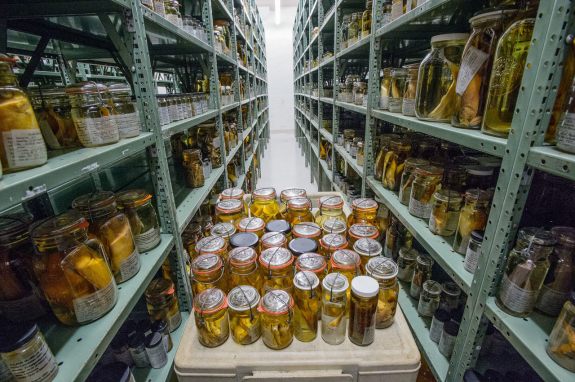
Hidden in a bend of the Mississippi River just south of New Orleans, 29 concrete bunkers lie on a grid of dirt and grass roads. Some hold remnants from the past—40-year-old gas masks and biohazard signs still hang on a wall. Most of them have been abandoned for decades. But inside two of those bunkers, 15 million fish eyes stare at the walls through the glass of their jars. This is the Royal D. Suttkus Fish Collection, the largest collection of preserved fish in the world, and almost no one knows it exists…
More of the story– and explore the collection– at “A Pair of WWII Bunkers in New Orleans Contains 7 Million Fish.”
* Franz Kafka (commenting on his then new-found vegetarianism)
###
As we ponder preservation, we might spare a thought for David Starr Jordan; he died on this date in 1931. The leading ichthyologist of his time, he was also an educator and advocate for science. He became the youngest President of Indiana University, then founding President of Stanford; he was an expert witness at the Scopes Trial, testifying for the efficacy of the theory of evolution.
His career was not unblemished however: he helped cover up the murder of Jane Stanford, and argued in favor of eugenics.

You must be logged in to post a comment.