“An understanding of the natural world, and what’s in it is a source of not only great curiosity but great fulfillment”*…
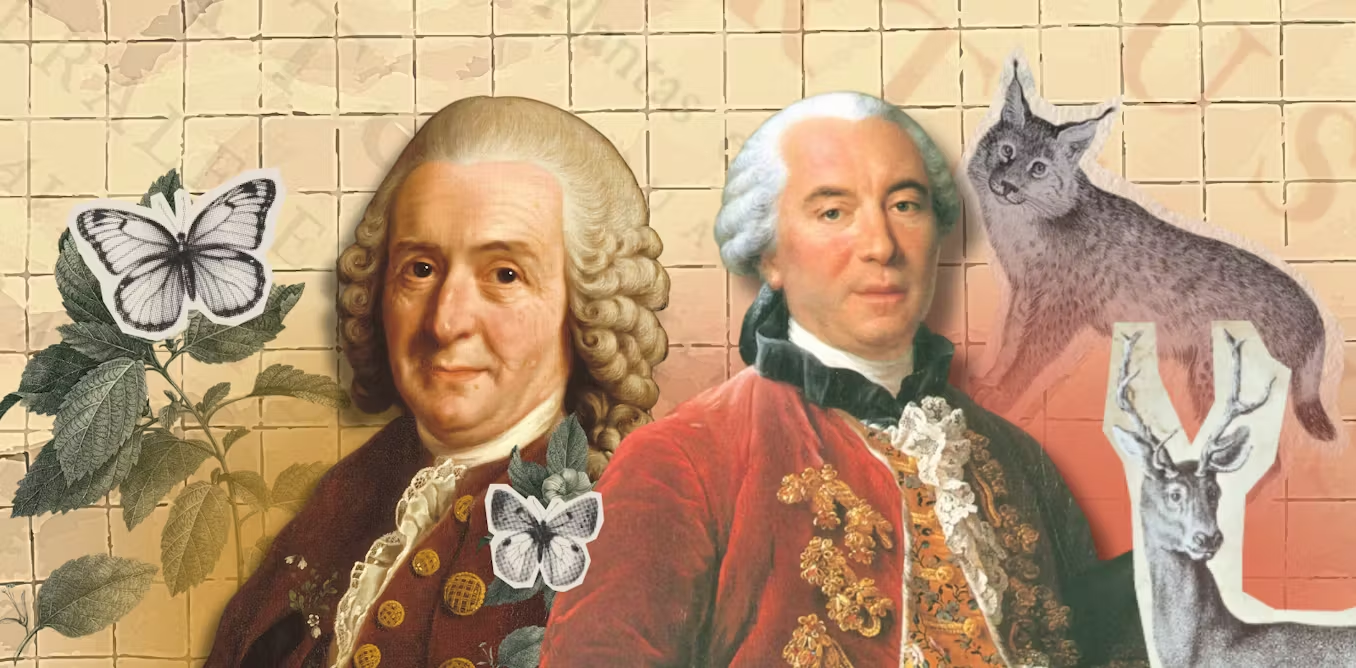
Ah yes, but in what does that understanding consist? John Long considers the competing frameworks of Linnaeus and Buffon…
The modern science biography must hold back no punches in its mission to represent the subject’s life, equally celebrating their great works while including their personal shortcomings.
Jürgen Neffe’s Einstein: A Biography (2005) and Dava Sobel’s The Elements of Marie Curie (2024) are wonderful examples of this style. Such books succeed in clearly explaining the complex science of their subject’s work for non-scientific readers, enabling a deep appreciation of their achievements and bringing them to life as rounded, flawed humans.
The modern science biography must hold back no punches in its mission to represent the subject’s life, equally celebrating their great works while including their personal shortcomings.
Jürgen Neffe’s Einstein: A Biography (2005) and Dava Sobel’s The Elements of Marie Curie (2024) are wonderful examples of this style. Such books succeed in clearly explaining the complex science of their subject’s work for non-scientific readers, enabling a deep appreciation of their achievements and bringing them to life as rounded, flawed humans.
Jason Roberts’ Every Living Thing – The Great and Deadly Race to Know all Life is another of these rare works. This engrossing, precisely researched book focuses on two central characters born in the same year: Carl Linnaeus (1707-1778), a Swede, and Frenchman Georges-Louis LeClerc, the Compte de Buffon (1707-1788), better known as just Buffon.
Roberts’ book won the 2025 Pulitzer Prize for biography. His writing pulls the reader effortlessly through the story, revealing delightful, unexpected twists and turns in the two men’s complex and disparate lives. Each worked diligently to reach a level of global notoriety for their many published books. Both are revered in the natural history world today.
Linnaeus, a biologist and physician, is known for his system of hierarchical classification: how all living things comprise a genus and species, (we humans are Homo sapiens), which fit into families, orders, classes and so on. (A good many intermediate ranks were added later). While his work has been hugely influential, Linnaeus is portrayed by Roberts at times as being lazy, vain and unethical.
Linnaeus was primarily driven to be the first to name new species. Buffon was working on a grand thesis of how all life’s organisms function and are related to one another. A wealthy count who inherited a vast fortune at the age of ten, Buffon trained as a lawyer but became fascinated by the trees that grew in his large garden.
Buffon is best known today for his extensive books on natural history and works on mathematics and cosmology. He calculated the Earth was much older than the Bible predicted and that life sprung from unorganised matter. He explored the relationships between organisms rather than how they were classified. His core work formed the basis for modern evolutionary theory.
Why was all this important? At the time, the task of classifying plants was vital to the growing economies of nations. Travellers to the far reaches of the globe brought back examples of economically valuable new species, like plant foods, medicinal plants or beautiful ornamental specimens.
The author’s central thesis is Linnaeus was not as brilliant as history paints him and Buffon was a far greater genius for his day.
Where does genius come from, Roberts asks? Is it inherent by birth, grown from an inspiring education, or is it something within that is nurtured by passion?
Both these brilliant men who made a lasting mark on science came from not very inspiring families. Nor did they excel at school or university. This story shows success in academic work is not just about intellect, but intimately tied to the ethics and morality of doing research…
Eminently worth reading in full: “How do we understand life on Earth? A prize-winning biography charts the tension between two types of science ‘genius’” from @theconversation.com.
* David Attenborough, who also observed, “We moved from being a part of nature to being apart from nature.”
###
As we noodle on knowing, we might send birthday greetings to Gregor Mendel; he was born on this date in 1822 (though some sources give the date as July 20). A botanist, geneticist, and monk, he pioneered in the study of heredity.
Mendel spent his adult life with the Augustinian monastery in Brunn, where as a plant experimenter, he was the first to lay the mathematical foundation of the science of genetics, in what came to be called Mendelism. Over the period 1856-63, Mendel grew and analyzed over 28,000 pea plants. He carefully studied for each their plant height, pod shape, pod color, flower position, seed color, seed shape and flower color. He made two very important generalizations from his pea experiments, known today as the Laws of Heredity, and coined the genetic terms recessiveness and dominance. He read a paper on his studies in 1865 to the Brünn Society for Natural Sciences in Moravia– but it lay unappreciated until 1900.

You must be logged in to post a comment.