Archive for August 2017
“The truth is far more frightening – nobody is in control”*…
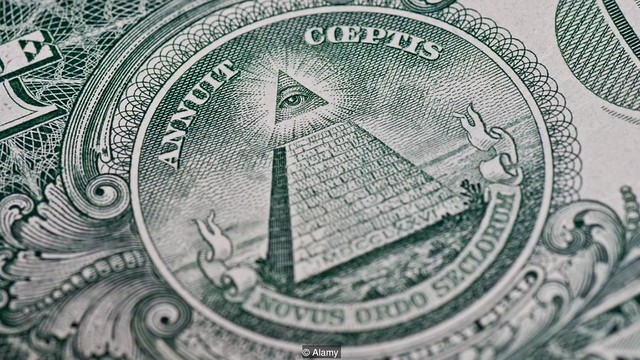
It’s the conspiracy theory to dwarf all conspiracy theories. A smorgasbord of every other intrigue under the sun, the Illuminati are the supposed overlords controlling the world’s affairs, operating secretly as they seek to establish a New World Order.
But this far-fetched paranoia all started with a playful work of fiction in the 1960s. What does this tell us about our readiness to believe what we read and hear – and what can the Illuminati myth reveal about the fake news and stories we continue to be influenced by today?…
What the myth reveals about how fake stories spread today and about the psychology of their fiercest proponents: get illuminated at “The accidental invention of the Illuminati conspiracy.”
* Alan Moore
###
As we believe that the truth is out there, we might send sultry birthday greetings to Mary Jane “Mae” West; the actress, singer, playwright, screenwriter, comedian, and sex symbol was born on this date in 1893. Known over her seven-decade career for her lighthearted double entendre and breezy sexual independence, she has been named 15th among the greatest female stars of classic American cinema by the American Film Institute.
Among her memorable mots:
Too much of a good thing is wonderful.
When choosing between two evils I always like to take the one I’ve never tried before.
To err is human, but it feels divine.
Between two evils, I always pick the one I never tried before.
I generally avoid temptation unless I can’t resist it.

“The knack lies in learning how to throw yourself at the ground and miss”*…

The oldest gliding mammals ever discovered are strengthening the case for taking to the skies.
Well, they couldn’t exactly soar like the eagles, but the two new species, discovered in China, at least sampled the aerial life. Both date to around 160 million years ago during the Jurassic Period, when mammals as a lineage were first getting off the ground — both metaphorically and literally. They’re not directly related to the gliders of today, however. Gliding instead seems to be advantageous enough that it has appeared several times throughout our evolutionary history…
Both fossils belong to a group of ancestral mammals that have long been extinct. As such, there is no line connecting them to gliding mammals today, indicating that mammalian aerial skills disappeared and re-emerged at least once throughout history. Using birds as an obvious example, flight is a powerful advantage to have. Even as a (temporarily) airborne creature you expend less energy, move faster and evade potential predators — all benefits that make the evolutionary trade-offs worthwhile. It’s not just mammals either, many frog species and even some fish have gained the ability to glide, with evidence that the trait has appeared more than once in those species as well…
The full story at: “Oldest Gliding Mammals Shed Light on the History of Flight.”
* Douglas Adams on flying, in Life, the Universe and Everything
###
As we take to the air, we might recall that it was on this date in 1829 that Chang and Eng Bunker, arrived in Boston aboard the ship Sachem to be exhibited to the Western world. The original “Siamese Twins,” they were joined at the waist by a band of cartilage, about 8 in. circumference and 4 in. long. In 1828 British merchant Robert Hunter “discovered” them and paid their family to let them be exhibited as a curiosity during a world tour; at the end of that engagement, the brothers went into business for themselves. In 1839, they visited Wilkesboro, N.C. with P. T. Barnum; they found the town appealing, settled there, took the surname “Bunker,” became United States citizens, and in 1843 married two sisters with whom they raised 10 children. Only after their death was it discovered that the cartilage that connected them could have been easily and safely removed.
Click here for Mark Twain’s short story, “The Siamese Twins,” based on Chang and Eng.

Chang and Eng Bunker
“He was a bold man that first ate an oyster”*…

“Speaking to the oysters”: a scene from “The Walrus and the Carpenter”, by Lewis Carroll, drawn by Sir John Tenniel in 1871.
In a change from chocolates and fizzy drinks, the French are starting to offer fresh oysters from vending machines in the hope of selling more of the delicacy outside business hours.
One pioneer is Tony Berthelot, an oyster farmer whose automatic dispenser of live oysters on the Ile de Re island off France’s western coast offers a range of quantities, types and sizes 24 hours a day, seven days a week.
French oyster farmers are following in the footsteps of other producers of fresh food who once manned stalls along roadsides for long hours but now use machines…
Oysters on demand at “French oysters go on sale in vending machines.”
* Jonathan Swift
###
As we dispose of the shells, we might recall that it was on this date in 1943 that Sgt. Edward Dzuba received the Legion of Merit award in recognition of his talent for “using food scraps in unusual and appetizing recipes.”

Sgt. Dzuba encouraging one of his patrons
“The Agee woman told us for three quarters of an hour how she came to write her beastly book, when a simple apology was all that was required”*…

Since 1982, the English Department at San Jose State University has sponsored the Bulwer-Lytton Fiction Contest, a whimsical literary competition that challenges entrants to compose the opening sentence to the worst of all possible novels…
The winner of the thirty-fifth Lyttoniad is Kat Russo from picturesque Loveland, Colorado. Kat describes herself as having twenty-six years of experience in covering social awkwardness with humor and stories about her cats. She spends her time working in outdoor retail and at a wildlife rehabilitation center while trying to figure out how to use her art degree.
Conceived to honor the memory of Victorian novelist Edward George Earl Bulwer-Lytton and to encourage unpublished authors who do not have the time to actually write entire books, the contest challenges entrants to compose bad opening sentences to imaginary novels. Bulwer was selected as patron of the competition because he opened his novel “Paul Clifford” (1830) with the immortal words, “It was a dark and stormy night.” Lytton’s sentence actually parodied the line and went on to make a real sentence of it, but he did originate the line “The pen is mightier than the sword,” and the expressions “the almighty dollar” and “the great unwashed.” His best known work, one on the book shelves of many of our great-grandparents, is “The Last Days of Pompeii” (1834), an historical novel that has been adapted for film multiple times.
As has happened every year since the contest went public in 1983, thousands of entries poured in not just from the United States and Canada but from such far-flung locales as England, Wales, Ireland, France, Belgium, the Netherlands, Germany, China, Japan, Australia, New Zealand, South Africa, and Botswana…
All of the 2017 category winners and runners-up– all of which are eminently worthy– at “The Bulwer-Lytton Fiction Contest.”
* P.G. Wodehouse, The Girl in Blue
###
As we read ’em and weep, we might send amusing birthday greetings to Ernest Lawrence Thayer; he was born on this date in 1863. A Harvard classmate (and Hasty Pudding and Lampoon colleague) of William Randolph Hearst, Thayer was recruited by his friend to the humor columnist for The San Francisco Examiner, 1886–88. Thayer’s last piece, dated June 3, 1888, and published under his pen name “Phin,” was a ballad entitled “Casey” (“Casey at the Bat”) which made him “a prize specimen of the one-poem poet” according to American Heritage.
The first public performance of the poem was by actor De Wolf Hopper on this date in 1888, Thayer’s 25th birthday. Thayer’s recitation of the poem at a Harvard class reunion in 1895 finally settled the question of its authorship.

“Libertarians sometimes prove that a foolish consistency is the hobgoblin of little minds, and that there is a difference between logic and wisdom”*…

Art Martinez de Vara, the architect of Von Ormy’s incorporation as a liberty city
For the last few years, Von Ormy has been in near-constant turmoil over basic issues of governance: what form of municipal government to adopt, whether to tax its residents, and how to pay for services such as sewer, police, firefighters and animal control. Along the way, three City Council members were arrested for allegedly violating the Open Meetings Act, and the volunteer fire department collapsed for lack of funds. Nearly everyone in town has an opinion on who’s to blame. But it’s probably safe to say that the vision of the city’s founder, a libertarian lawyer whose family traces its roots in Von Ormy back six generations, has curdled into something that is part comedy, part tragedy.
In 2006, fearing annexation by rapidly encroaching San Antonio, some in Von Ormy proposed incorporating as a town. But in government-averse rural Texas, incorporation can be a hard sell. Unincorporated areas are governed mainly by counties, which have few rules about what you can do on private property and tend to only lightly tax. There’s no going back from what municipal government brings: taxes, ordinances, elections and tedious city council meetings. Still, the fear of being absorbed by San Antonio — with its big-city taxes and regulations — was too much for most Von Ormians.
Enter Art Martinez de Vara. At the time, Martinez de Vara was an ambitious third-year law student at St. Mary’s University in San Antonio, a local boy with a penchant for Texas history and right-wing politics.
Martinez de Vara suggested a compromise of sorts. Von Ormy could become a “liberty city” — a stripped-down, low-tax, low-government version of municipal government that’s currently en vogue among the tea party in Texas.
Initially, the city would impose property and sales taxes, but the property tax would ratchet down to zero over time. The business-friendly environment would draw new economic activity to Von Ormy, and eventually the town would cruise along on sales taxes alone…
* Molly Ivins, Fort Worth Star-Telegram (7 September 1996)
###
As we seek the middle way, we might recall that this is International Left-Handers Day. Celebrated since 1976, it promotes awareness of the inconveniences faced by left-handers– 7 to 10% of the world’s population– and celebrates their uniqueness and differences in a predominantly right-handed world.

You must be logged in to post a comment.