Posts Tagged ‘Twitter’
How to prepare for a *real* emergency…

That readers are perusing this missive suggests that The Rapture did not in fact happen as advertised. But that humankind (well, the sinners among us anyway) dodged a bullet today doesn’t mean that the threat of Apocalypse isn’t real. Indeed, no less an authority than the CDC has weighed in with a Twitter Alert:

Of course, the Law of Unintended Consequences being what it is, this Tweet seems to have created one kind of disaster even as it attempted to ameliorate another: the response to the message– clicks through to the featured URL– immediately crashed the CDC’s servers.
Some semblance of normalcy has been recovered; readers can once more reach “Preparedness 101: Zombie Apocalypse.”
As we reconcile ourselves to the fact that the Zombie craze may well last at least until after the release of Brad Pitt’s upcoming World War Z— and that’s not yet even in production, we might recall that on this date in 1972 Heathen! (an original musical with music and lyrics by Eaton Magoon, and book by Magoon and Sir Robert Helpmann) both opened and closed on Broadway.

Where’s a cop when you need one?…
Canadian IT consultant and author Sean Power had his laptop stolen in New York just before he had to leave for Ottawa. But as Sean uses Prey (a freeware tracker) he was able to locate it remotely. Sean called the cops… who responded that unless he (physically) filed a report, NYC’s Finest were unwilling to take any action… He put out the word on Twitter…

… and a flash-crew of civilian crime-fighters recovered the stolen property. Watch the story unfold in Brandon Ballenger’s recap.
As we appreciate the now-deeper resonance of “neighborhood watch,” we might recall that it was on this date in 1866 that Charles Elmer Hires formulated his eponymous “root beer” Hires was inspired by root tea, but thought that “beer” would be a more attractive name to “the working class”– for whom Hires, a supporter of temperance, saw it as an alternative to alcohol.

Me, me meme…
Jeremy Toeman explains…
And TechCrunch elaborates…
Richard Dawkins’ definition of a meme in The Selfish Gene is “a unit of cultural transmission.” Like genes and diseases, the prevailing characteristic of memes is that they tend to replicate, just add humans.
Anything can be a meme, but there are certain characteristics that make information units more likely to go viral (namely funniness).
The Internet, where replication is as easy as hitting “Like” or “Retweet,” is one big meme pool. Internet hipsters (people who spend a lot of time online – cough) now judge each other by whether they posted it before whatever it is it hit Buzzfeed.
Much like hardy genes confer biological advantage, being aware of memes now confers a feeling of superiority amongst those in the know. Hence the above video, which was basically engineered to propagate itself.
(TotH to Laughing Squid)

As we prepare to go viral, we might recall that it was on this date in 1960 that fishermen in British Columbia ended a labor dispute that had shut down the province’s herring fishery for a full year.
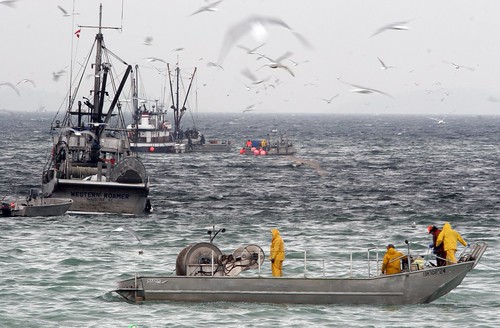 Back at work… (source)
Special Beach Blanket Edition: Roll Over, Eustace Tilley…
In your correspondent’s quest to highlight mash-ups of note*, an interruption of the annual idyll to share the exquisite pleasure of Kanye New Yorker Tweets (c.f. also here): the actual twittering of the Taylor Swift-interrupting hip hop climber, set to drawings that have graced the pages of The New Yorker.
Consider for example:


Many, many more here.
*Other mash-ups: C.f., e.g., here, here, or here…
As we celebrate the serendipitous results of radical juxtaposition, we might recall that it was on this date in 30 BCE that Cleopatra VII Philopator, the last pharaoh to rule Egypt (and storied lover of Antony) committed suicide. Historians from Strabo and Plutarch have reported that the Queen did herself in by having an asp bite her. But earlier this year, the German historian Christoph Schaefer challenged this account, declaring that the queen had actually died from drinking a mixture of poisons. After studying historic texts and consulting with toxicologists, Schaefer concluded that the asp could not have caused the slow and pain-free death reported. Schaefer and his lead toxicologist Dietrich Mebs insist that Cleopatra used a mixture of hemlock, wolfsbane and opium.
Another asterisk for the record books…

Yaka-Wow!…
 Rubik’s Cube for the Blind (via Yanko Design, which readers will remember)
On an obliquely-related front, from the ever-illuminating World Wide Words:
In what seems to have been a mixture of rueful admission
of error and pleasure in accidental accomplishment, the Times noted
on 23 April that a transcription error in an interview on 15 April
with the neuroscientist Baroness Greenfield has gone viral. She was
concerned that excessive playing of computer games or using social
networks such as Twitter would stop the malleable brains of young
people developing as they should: “It’s not going to destroy the
planet but is it going to be a planet worth living in if you have a
load of breezy people who go around saying yaka-wow. Is that the
society we want?” Within 24 hours, it is said, Google had 75,000
results for “yaka-wow”. It has inspired a Twitter stream, a page on
Facebook, mugs and T-shirts; it has become a personal philosophy:
“I think, therefore I yaka-wow”; and it has led to the creation of
the virtual First Church of the Yaka-Wow. What Baroness Greenfield
really said was “yuck and wow”, a derogatory comment about the
limited emotional range and vocabulary of Twitter users. Considered
linguistically and culturally, it’s a fascinating example of the
way electronic communications can today create and transmit a new
word.
As we coin ’em as fast as we can, we might recall that it was on this date in 1469 that civil servant, philosopher, and father of political science Niccolò di Bernardo dei Machiavelli was born. Machiavelli served the Florentine Republic; in 1498, after the ouster and execution of Girolamo Savonarola, the Great Council elected Machiavelli as Secretary to the second Chancery– the blunt instrument replaced by the sharp…
But Machiavelli is, of course, best known for his short “how to” book on political power, The Prince. Written in 1513, it was only privately circulated during Machiavelli’s life; but it was published publicly in 1532, five years after his death– and has had such an impact on our understanding of the cynical exercise of political power that “Machiavellian” has become a widely-understood adjective.

You must be logged in to post a comment.