Posts Tagged ‘Twitter’
Ignorance is strength…
From where Winston stood it was just possible to read, picked out on its white face in elegant lettering, the three slogans of the Party:
WAR IS PEACE
FREEDOM IS SLAVERY
IGNORANCE IS STRENGTH.
– George Orwell, 1984
China’s State Council Information Office (SCIO), an arm of the Central Propaganda Department, operates an “Internet Affairs Bureau” to oversee all web sites that publish news, both the official sites of news organizations and independents.
This Internet Affairs Bureau sends very specific instructions to all large news web sites, often multiple times per day. Sometimes these instructions ban contents outright, but often they instruct web sites to highlight or suppress certain type of opinions or information– in a very detailed manner. Consider these directives (issued March 23, 2010; translated by the China Digital Times):

(The link to “China’s princelings” goes here.)
On the subject of Google’s exit from China (well, to Hong Kong; excellent background piece from PRI’s The World here), the Bureau had very specific instructions (again, translated by the CDT):

But technology marches on… these government directives are meant to be confidential. But while they are not showing up on web sites per se in China, some of their recipients– the web editors at whom they are aimed– are using Twitter, Sinaweibo (Sina’s popular micro-blogging service), and other social media to slip them into cyberspace. To wit, the CDT coverage.
It should come as no surprise then that the SCIO is expanding: an “Internet Affairs Bureau 2” is being established to control social media and other Web 2.0 services driven by user-generated content. (More background on Chinese “management of web content” here.)
As we remark that a vigorous independent media is the infrastructure of democracy, and that it is an issue of some valence not just in China, but essentially everywhere in the world,* we might recall that it was on this date in 1936 that a German referendum ratified Deutschland’s armed occupation of the Rhineland earlier that month, in violation of the Treaty of Versailles. Hitler acted when he did for a variety of reasons, main among them that France, the most directly-affected/threatened other nation, was in internal political and financial disarray, and that Germany was in the midst of an economic crisis of its own, from which the Fuhrer needed a foreign policy distraction… the Chancellor’s timing was good: France’s response was limited to a strongly-worded condemnation, and 99% of the votes cast in the German referendum (44.5 million votes out of 45.5 million registered voters), were in support.

* For peeks at two very different examples of action that can matter, check out The Censorship Research Center and The Media Development Loan Fund…
Homage is where the heart is…
On the tenth anniversary of the release of The Matrix, Trevor Boyd and Steve Ilett invested 440 hours in painstakingly recreating 990 frames of the film– the famous “Bullet Time” dodge sequence– in Lego.
See the finished sequence:
And marvel at the extraordinary fidelity of their craft in this side-by-side comparison:
ToTH to Scott Beale and Laughing Squid…
Readers might want to tweet the news that the “Top Words of 2009” (as culled by the Global Language Monitor) are in. The winner? “Twitter— the ability to encapsulate human thought in 140 characters.” (And then again, readers might want to choose their words carefully…)
As we wander around Plato’s cave, we might take celebratory dip in the pork barrel today in honor of Andrew Jackson, whose election as 7th President of the U.S. (as solemnized by the Electoral College) on this date in 1828 both manifest and accelerated America’s shift toward its democratic (if not Democratic) future.

What’s Twitter good for?…
“Justin”:
I’m 28. I live with my 73-year-old dad. He is awesome. I just write down shit that he says
 For instance…
You know, sometimes it’s nice having you around. But now ain’t one of those times. Now gimmie the remote we’re not watching this bullshit.
Your mother made a batch of meatballs last night. Some are for you, some are for me, but more are for me. Remember that. More. Me.
The dog is not bored, it’s a fucking dog. It’s not like he’s waiting for me to give him a fucking rubix cube. He’s a god damned dog.
Your brother brought his baby over this morning. He told me it could stand. It couldn’t stand for shit. Just sat there. Big let down.
Don’t touch the bacon, it’s not done yet. You let me handle the bacon, and I’ll let you handle..what ever it is you do. I guess nothing.
One can join the other 165,471 folks following Justin (user name: shitmydadsays) by clicking here.
As we listen to all the little birdies go tweet, tweet, tweet, we might recall that the very first U.S. National Skeet Shooting Championships concluded (in Cleveland, Ohio) on this date in 1935…
 source: CarolinaRegion.com
![Reblog this post [with Zemanta]](https://i0.wp.com/img.zemanta.com/reblog_e.png?w=700)
Tweet, tweet…
Twitter, that font of 140-character updates, assertions, musings, and forwarded links, has its fans (“revolutionizing journalism”) and it’s detractors (“who cares?”)… but even if one stipulates to Twitter’s ultimate place in the technosphere, one observes that getting there is a heuristic process…
Consider, for example, the postings collected at OverSharers, e.g,

and at TweetingTooHard, e.g.,
 (Yes, it’s that John Mayer…)
With thanks to reader PR (and to his brother, WR) for the tip, your correspondent notes that (Roughly) Daily can be followed on Twitter here :)
As we fiddle on the frontier, we might recall that it was on this date in 1843 that a thousand pioneers left Elm Grove (near Independence), Missouri in the first major wagon train on the Oregon Trail, a massive caravan, 1,000 settlers and 1,000 head of cattle. Known as the “Great Emigration,” the expedition came two years after the first modest party of settlers made the long, overland journey to Oregon. The giant wagon train finally arrived in October, completing the 2,000-mile journey from Missouri in five months.
In the next year, four more wagon trains made the journey, and in 1845 more than 3,000 emigrants used the Oregon Trail. But with the advent of the railroads, travel along the trail gradually declined; and the route was finally abandoned in the 1870s.

On the internet, *everybody* knows that you’re a dog…
From Silicon Alley Insider‘s “The 5 Worst Tweets Ever,” a reminder that it pays to understand social media before one uses them… and that once something hits the web, it’s there to stay:
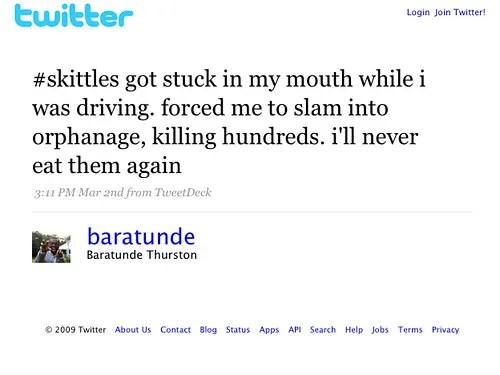
Back in March, the social media-savvy people employed by Skittles-maker Mars thought they had the whole thing figured out. Instead of worrying about building a fancy web page, they simply redirected Skittles.com to a Twitter search results page for the hashtag “Skittles.” Then came reality, as pranksters flooded the results page with unflattering remarks about the candy. Lafksy says this tweet from comedian Baratunde Thurston is actually one of the “less raunchy” examples:
Do read them all…
(Baratunde Thurston, a very funny guy, can be found here.)
As we limit ourselves to 140 characters, we might console ourselves that even really, really smart people sometimes get things really, really wrong… e.g., according to the great German astronomer and mathematician Johannes Kepler, it was on this date in 4977 BC that the universe was created. Kepler’s observations and theories had a powerfully positive impact on human knowledge, building as they did on the work of Copernicus and Tyco Brahe to influence (his contemporary) Galileo and their followers, maybe most notably, Isaac Newton. But for all that, Kepler’s fix on creation was, modern calculations suggest, roughly 13.7 Billion years off.

You must be logged in to post a comment.