Posts Tagged ‘tsunami’
“Don’t look away. Look straight at everything. Look it all in the eye, good and bad.”*…

Frustrated by fragmented war news, Elie Habib built World Monitor, a platform that fuses global data– everything from military activity and intel hotspots to climate events and cyber threats– to track trouble as it unfolds. Lilian Wagdy reports…
Elie Habib doesn’t work in the defense or intelligence industries. Instead, he runs Anghami, one of the Middle East’s largest music streaming platforms. But as missiles began flying across the region, a side project he coded earlier this year suddenly became something bigger: an open-source dashboard people around the world were using to track the war in real time…
… The idea emerged as headlines began colliding in ways that felt impossible to follow. “The news became genuinely hard to parse,” he says. “Iran, Trump’s decisions, financial markets, critical minerals, tensions compounding from every direction simultaneously.”
Traditional media wasn’t solving the problem he had in mind. “I didn’t need a news aggregator,” he says. “I needed something that showed me how these events connect to each other in real time. The existing OSINT tools that did this cost governments and large enterprises tens of thousands of dollars annually.”…
… The platform processes a messy stream of global data, bypassing social media noise to pull facts directly from the source.
“The system ingests 100-plus data streams simultaneously,” Habib notes. The result is a constantly updating map of global tensions: conflict zones with escalation scores, military aircraft broadcasting positions through ADS-B transponders, ship movements tracked through AIS signals, nuclear installations, submarine cables, internet outages and satellite fire detections.
“Everything is normalized, geolocated and rendered on a WebGL globe capable of displaying thousands of markers without frame drops,” Habib says.
The underlying architecture wasn’t built from scratch. Much of it draws on the same principles used to process massive volumes of streaming data…
… Processing hundreds of live data streams during a military conflict raises a question: How do you verify information fast enough to keep the system moving?
Habib’s answer was to remove human editors entirely. “Zero editorializing,” he says. “No human editor makes a call.”
Instead, Habib says the platform relies on a strict source hierarchy. Wire services and official channels such as Reuters, AP, the Pentagon and the UN sit at the top tier. Major broadcasters including the BBC and Al Jazeera follow, along with specialist investigative outlets such as Bellingcat. In total, he says the system processes about 190 sources, assigning higher confidence scores to more reliable ones.
Software then scans incoming reports for major events and emerging patterns. If multiple credible sources report the same development within minutes, the system flags it as a breaking alert. But headlines alone are not enough.
Because online claims can be unreliable, the platform also looks for physical signals on the ground. It tracks disruptions such as internet blackouts, diverted military flights, halted cargo ships and satellite-detected fires. “A convergence algorithm then checks how many distinct signal types activate in the same geography simultaneously,” Habib says.
“One signal is noise. Three or four converging in the same location is the signal worth surfacing,” Habib says. If an internet outage coincides with diverted aircraft and a satellite heat signature in the same area, the map flags a potential escalation.
Habib acknowledges that removing humans from the loop carries risks. “The multi-tier source-credibility system and convergence algorithm [are a] substitute for editorial judgment,” he says. “Whether that creates blind spots in genuinely novel scenarios, an event with no historical baseline, is a real architectural question the system doesn’t fully resolve.”…
… Habib does not plan for the platform to become a business. “World Monitor started as a personal learning project,” he says. But the experiment quickly grew beyond that. Developers from around the world began contributing code and ideas, helping expand the system’s capabilities.
Now the project is shifting toward a broader goal. “The direction shifts from pure conflict tracking toward broader world signal understanding and acting on these signals,” Habib says.
Instead of simply mapping events after they happen, the platform is increasingly designed to detect patterns before they become headlines, Habib says. “The architecture is moving toward predicting where signals converge before events become news.”…
More at: “How a Music Streaming CEO Built an Open-Source Global Threat Map in His Spare Time,” from @lilianwagdy81.bsky.social and @wired.com. (JIC of paywall trouble, here is an archived link.)
Then, try out World Monitor yourself.
* Henry Miller
###
As we pay attention, we might recall that today is the anniversary of an event that would surely have made Wolrd Monitor’s map if that tool hasd been around back then: on the this date in 2011, Tōhoku earthquake (a 9.0–9.1 undersea megathrust earthquake occurred in the Pacific Ocean, 45 mi east of the Oshika Peninsula of the Tōhoku region— the most powerful earthquake ever recorded in Japan, and the fourth most powerful earthquake recorded in the world since modern seismography began in 1900.
The quake was followed by a tsunami that killed thousands and caused the devastation of whole cities. Together, they did damage estimated to have cost well into the tens of billions of US dollars. Famously, the quake and subsequent tsunami caused the shutdown of eleven nuclear reactors in power plants in the region. The Fukushima reactors were especially heavily damaged, and leaked radioactive waste water, leading to radiation levels outside the plant that were up to eight times normal levels.

“I want to make a long journey”*…
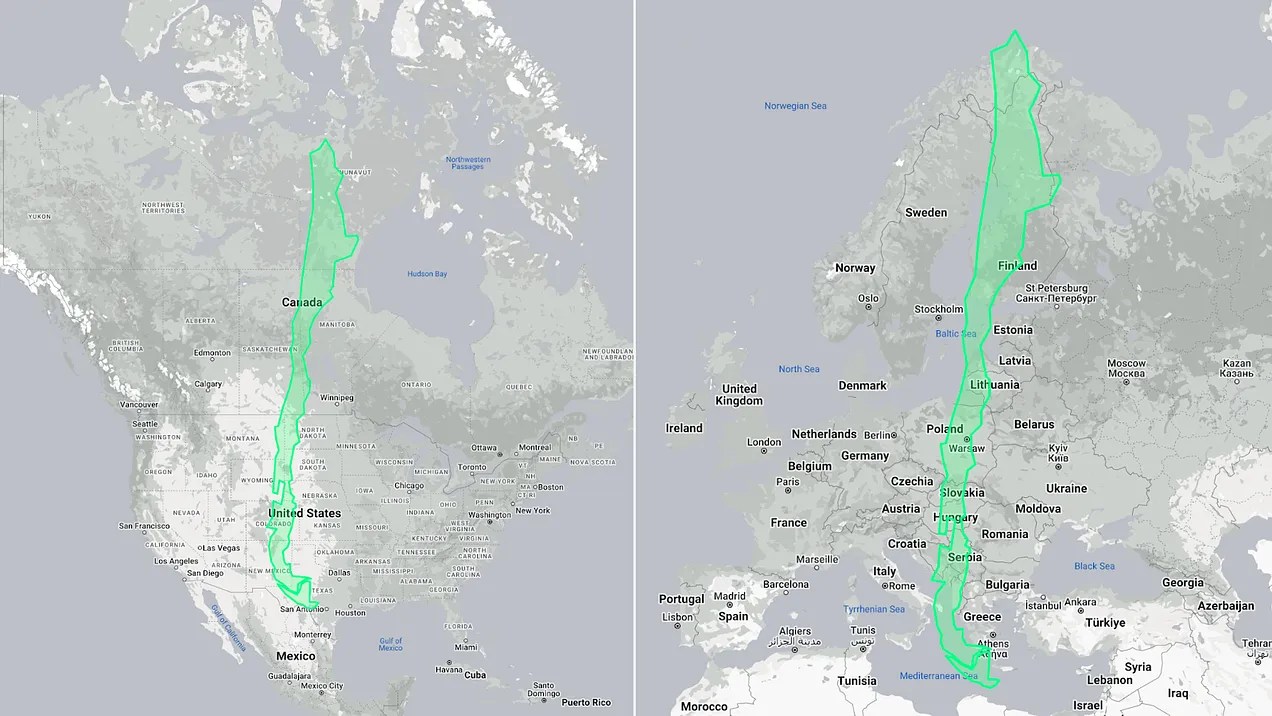
Thomas Pueyo on how geography shaped the longest (and proportionately thinnest) country in the world…
Chile is as long as the [vertical dimensions of]US and Canada combined.
Chile is as long as all of Europe!Chile is so long, it’s curved.

How long is it?
Why not longer?
Why is no other country as thin?
How does that make Chileans incomprehensible?
These questions (and more) answered: “Why Is Chile So Long?” from @tomaspueyo
* (Chilean poet) Pablo Neruda
###
As we stretch, we might recall that it was on this date in 1730 that the Valparaíso earthquake occurred. (As Pueyo explains, Chile’s unique geography and geology have frequently seismic implications.)
The quake had an estimated magnitude of 9.1–9.3 and triggered a major tsunami with an estimated magnitude of Mt 8.75, that inundated the lower parts of Valparaíso and caused severe damage from La Serena to Chillan; the tsunami affected more than 620 mi of Chile’s coastline.
While damage was widespread, only a few deaths were recorded due to the earthquake, reportedly because a strong foreshock had prompted people to leave their homes. Similarly, the subsequent tsunami: inhabitants ran to higher ground after seeing the water recede, so that only a few were killed.

“To overcome a desperate situation, make a complete turn in one sudden burst”*…
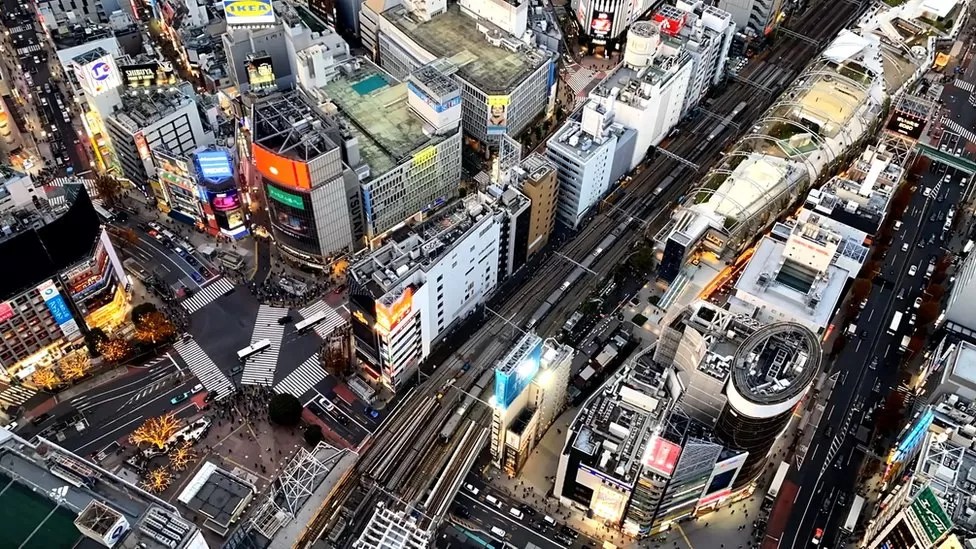
Rupert Wingfield-Hayes, the BBC’s Tokyo correspondent, on the riddle of Japan…
This is the world’s third-largest economy. It’s a peaceful, prosperous country with the longest life expectancy in the world, the lowest murder rate, little political conflict, a powerful passport, and the sublime Shinkansen, the world’s best high-speed rail network.
America and Europe once feared the Japanese economic juggernaut much the same way they fear China’s growing economic might today. But the Japan the world expected never arrived. In the late 1980s, Japanese people were richer than Americans. Now they earn less than Britons.
For decades Japan has been struggling with a sluggish economy, held back by a deep resistance to change and a stubborn attachment to the past. Now, its population is both ageing and shrinking.
Japan is stuck…
His diagnosis and his prognosis: “Japan was the future but it’s stuck in the past,” @wingcommander1 in @BBCWorld.
* Japanese proverb
###
As we ponder progress, we might recall that it was on this date in 2011 that three reactors at the Fukushima Daiichi Nuclear Power Plant exploded and released radioactivity into the atmosphere a day after the 2011 Tōhoku earthquake and tsunami.
The radiation releases forced the evacuation of 83,000 residents from towns around the plant. The meltdown caused concerns about contamination of food and water supplies, including the 2011 rice harvest, and also the health effects of radiation on workers at the plant. Scientists estimate that the accident released 18 quadrillion becquerels of caesium-137 into the Pacific Ocean, contaminating 150 square miles of the ocean floor.

“There’s no big apocalypse. Just an endless procession of little ones”*…

Humanity is facing multiple possible apocalypses, with narratives that often miss an important point: The apocalypse probably won’t be quick or final. It will be an environment, not an event or an end point for humanity. The apocalypse is more likely to bring misery than catharsis or salvation. Although worst-case scenarios theoretically make it easier to prevent dire outcomes, in the case of slow-moving apocalypses such as climate change, it’s difficult for humans to envision the scale of the problem and to imagine how we will actually experience it…
Via Bulletin of the Atomic Scientists, Jamias Cascio argues that we’d be well served to face up to the deeply dramatic– if not melodramatic– realities that we face: “The apocalypse: It’s not the end of the world.” [free access until January 1, 2020]
* Signal to Noise
###
As we take care, we might we might recall that it was on this date (coincidentally, now Chicken Soup of the Soul Day) in 1952 that 9.0 Mw earthquake centered at Severo-Kurilsk in the Kamchatka Peninsula triggered a major tsunami. the majority of the Severo-Kurilsk citizens fled to the surrounding hills, where they escaped the first wave. But most of them returned to the town and were killed by the second wave. According to the authorities, out of a population of 6,000 people, 2,336 died; the survivors were evacuated to continental Russia. The settlement was then rebuilt in another location.
The tsunami caused flooding as far away as Hawaii, almost 3400 miles way. Midway Island (over 1800 miles away) was inundated with water, flooding streets and buildings. On the Hawaiian Islands the waves destroyed boats, knocked down telephone lines, destroyed piers, scoured beaches, and flooded lawns. In Honolulu Harbor a cement barge was thrown into a freighter. In Hilo Bay a small bridge connecting Coconut Island to the shore was destroyed by a wave when it lifted off its foundation and then smashed down.

Midway Island after the tsunami
You must be logged in to post a comment.