Posts Tagged ‘Richard Trentlage’
“Time isn’t the main thing. It’s the only thing.”*…
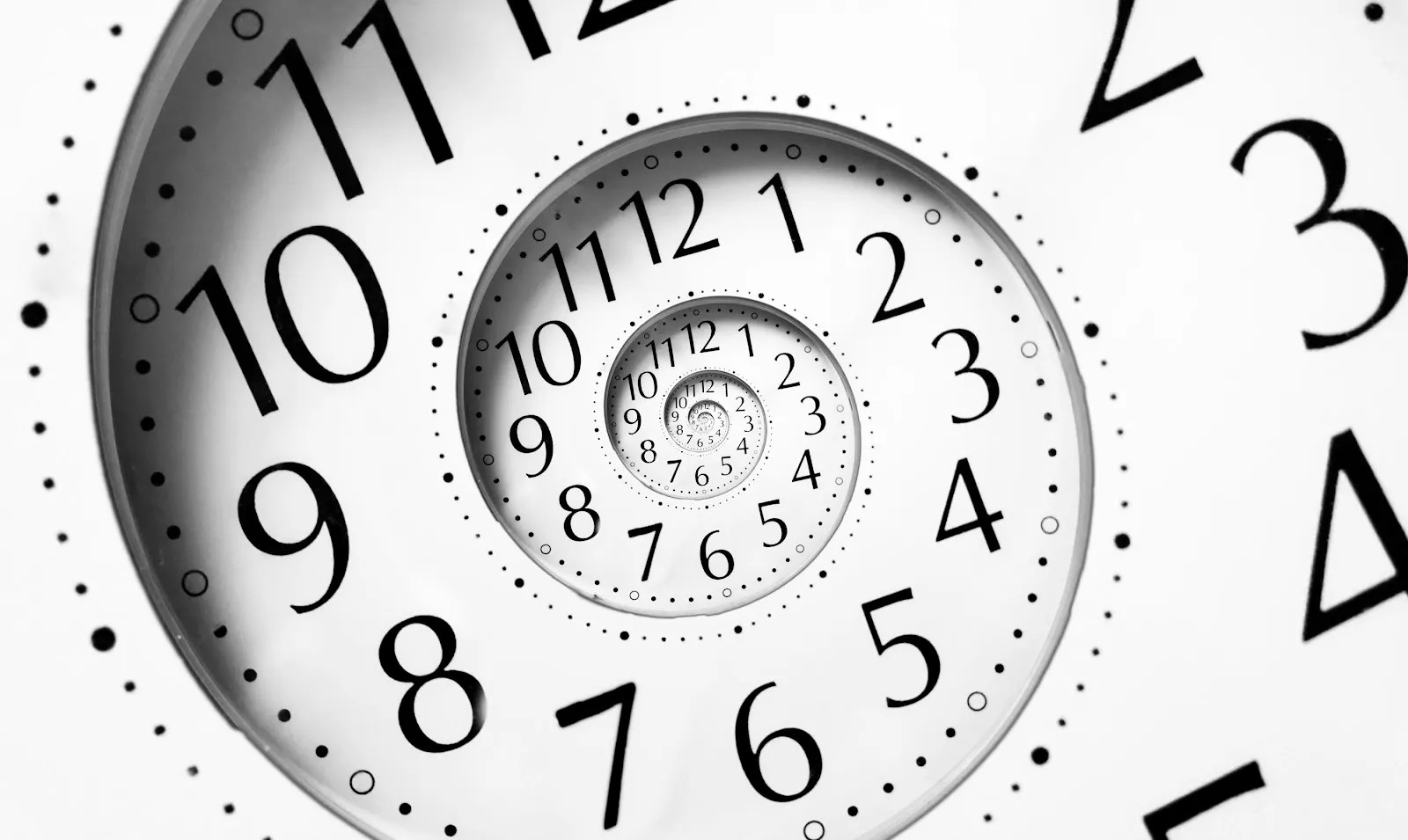
We keep marveling at how fast the years go by. The deeper problem, Mike Mariani argues, is that we’re forgetting them — and losing the quiet, boring moments where memory forms…
We’ve long been ensorcelled by the passage of time. Puckered leaves fluttering from the spidery arms of barren trees. Grains of sand tumbling through the delicate neck of an hourglass. A curved cornice perched over a snow-covered mountain, awaiting an avalanche to bring it down. These evocative emblems of seasons, hours, and the vicissitudes they leave in their wake speak to the bittersweet relationship we’ve cultivated with this unit of measurement.
Whether in Proustian reveries, digital photo libraries, or the watchful doppelgänger that gazes out at us each morning, ever-so-slightly altered, we’re inclined to a tender wistfulness toward time — the persistent awareness that, however fast or slow, it’s forever slipping through our fingers.
But lately, our relationship to the months, years and decades that landscape our lives has shifted in some unsettling ways. Instead of regarding the passage of time with introspection or melancholy, many of us now observe it with a mounting sense of alarm.
You don’t have to look very far to find ample evidence that we are experiencing a metaphysical crack-up around time. There’s a growing conviction among people from all walks of life that time is moving faster than it did several decades ago — or even prior to the Covid pandemic. While this belief crept into the zeitgeist like a sly, slinking fog, the refrains are now so pervasive that they’ve started to supplant idle chatter on the weather. Our focus has shifted from rejoicing in cloudless days or grousing over gloomy skies to fixating on the dizzying speed at which our lives are hurtling by.
This is particularly evident on sites like Reddit, where users now regularly commiserate over how rapidly the years are passing. A farmer whose work cycles alongside the seasons “can’t believe how fast this year has gone.” A middle school teacher recounts how she finds herself “having these conversations with students … who are perturbed by the speed of life.” Perhaps most tellingly, for a programmer, the “pandemic years blurred together, and everything after feels compressed, like one long season instead of separate years.” Civilizational events, including not only Covid but also climate change, large-scale armed conflict and the rise of AI “have piled up so quickly that it feels like we’re living through multiple decades at once.”
In recent years, these stray observations have coalesced into a chorus. Everyone from Boomers to Zoomers is mystified at how the passage of time has sped up, and feels disoriented by the strange velocity that’s colored how we’re living through the 2020s. But to hear these stifled laments is also to observe the absurdity of contemporary American life: While so many of us agree that our relationship to time has been warped, our collective response has been to shake it off and move on. It’s as though we all started losing our depth perception at the same time — crashing into road medians, pratfalling down staircases — and instead of resolving to rectify the predicament, we’ve simply resigned ourselves to daily collisions and collapses.
In some ways, the scale of this phenomenon resembles an episode of mass cognitive dissonance, or even a population-level folie à deux. It’s worth asking if something about our internal mechanisms for gauging the passage of time has changed — or been irrevocably thrown out of sync with human timekeeping and the atomic clocks we’ve structured civilization around for nearly a century. Or, alternatively, perhaps the pandemic spoiled our capacity to judge duration, expanding and contracting our sense of time over and over until the fabric grew loose and rippled, an undifferentiated mass of fibers stretched into a form we no longer recognize…
[Mariani considers the thinking of scientists and philosophers who’ve grappled with this issue since the 19th century, considers “the internal clock fallacy,” and explores the impact of modern technology (“Browsing, scrolling and swiping are more likely to quiet or even anesthetize our brains than activate them in the ways required to form memories…”). He concludes with a “defense” of boredom…]
The stakes of this phenomenon can sometimes seem low. Feeling like time is speeding up is not a “kitchen table issue”; it won’t raise your taxes or make you go hungry. But the TIMED project has demonstrated that people who feel like they’re losing time are genuinely unhappy and even distressed about it. Members of Gen Z, in particular, don’t talk about the quickening pace of their lives with disinterested curiosity or frivolous bemusement — they lament it. When we lose our grip on the passage of time, it can feel like we’re also losing grip on our own lives.
Western culture views time as a currency to be leveraged, channeled and optimized. The societal pressure to perform productivity at all times is so insistent and thrumming that many of us — myself included — have lost the ability to slow down and luxuriate in the inherent slowness of time, the way it oozes forward like honey slithering across a glass jar. When Aldous Huxley was asked about time by an interlocutor in “The Doors of Perception,” his reply was both simple and profound. “There seems to be plenty of it,” he said. Untethered from his ego and all the worldly attachments it clung to, Huxley was able to tap into the spaciousness of existence — an amplitude and abundance that’s permanent and inviolable, if only we still had the freedom to see it.
It’s true that technology has capitalized on this culture of synchronized compliance. The companies that manufacture our devices and make the programs that run on them have wedged themselves into this perverse relationship to productivity, offering the badges and motifs that signify a certain enterprising competence. As Jenny Odell points out in her book, “How to Do Nothing,” there’s a battle playing out “for our time, a colonization of the self by capitalist ideas of productivity and efficiency.” Through these products, we personify the ideals of practicality and industriousness.
The pandemic, too, eventually fed into the hungry zeitgeist of maximizing our output and sacrificing ourselves on the altar of “getting ahead.” The increased use of communications platforms like Slack, Teams and Zoom promoted a porousness between our work and home lives, allowing what Odell calls a “certain nervous feeling, of being overstimulated and unable to sustain a train of thought” to infiltrate spaces long insulated from them.
This explains why many people feel that the way they experienced time during the pandemic never snapped back to how they processed it before Covid. In the aftermath, we became even more tethered to these platforms and other virtual spaces where productivity lingers at a low, insistent hum 24 hours a day. With our minds more anxious and overstimulated, our perception of time never had the chance to return to an earlier, more composed pace.
Further, trends that predated Covid resurfaced as though shot out of a cannon, and the ambient pressure to advance our lots at all costs imbued our culture with a mercenary quality. We were all racing to make more money, afford a home, secure a job, #YOLO at the live events we were unceremoniously robbed of. Amid this competitive turbulence — and the technologies that capitalized on our unease about it — everything started to move faster.
If we accept this premise, then maybe the crisis of time speeding up is not as hopelessly irreversible as it often seems. According to the latest time perception research, the amount of information our brains engage with shapes our subjective sense of how fast time is moving. If we intentionally reduce the stimuli we’re exposing ourselves to in a given day or week, then our brains will gradually slow down. And if our brains slow down, then our perception of time will taper off, too.
For their part, Ogden and other TIMED researchers feel that society has imposed too much responsibility on the individual to limit their use of technology. “Maybe it’s time that we shifted some of that onto the creators,” Ogden said. “The key metric for the success of digital technology is how long users are on it for, and how many people they can get on it for as long as possible. How do we flip that?” While we wait for those larger systemic changes, though, Ogden emphasized the importance of using our devices in a more intentional fashion. “What are you trying to get out of this digital technology use?” she asked. “You need to have an awareness of your own goals.”
In addition to modifying our own individual behavior, however, we also need to change the culture surrounding how we spend our time. That means coming to terms with the reality that boredom and “doing nothing” are neither shameful nor necessary evils. “There is huge value in doing nothing,” Ogden said. “We need to move away from thinking that it’s weird, lazy or slovenly.” Asked how she would spend a perfect holiday, Ogden described something very close to what people now labor so strenuously to avoid. “It would be to go and sit in a square in Italy with a nice glass of wine and watch the world go by.”
In his “Principles of Psychology,” William James invites us to participate in an experiment. “Close your eyes and simply wait to hear somebody tell you that a minute has elapsed,” he writes. The length of that single minute, he explains, will feel overwhelming. “You engulf yourself into its bowels as into those of that interminable first week of an ocean voyage, and find yourself wondering that history can have overcome many such periods in its course.” Those 60 seconds feel so full, James goes on, because “you attend so closely to the mere feeling of the time per se.” When our senses are engaged and stimulated, time is compressed, disguised, eclipsed. “The feeling of bare time,” however, “is the least stimulating experience we can have.”
We used to tolerate those interminable minutes standing in a crowded grocery line, gazing out the convex glass window of an airplane, waiting for the dull red digits on an oven timer to run down to zero. These are now the endangered species of our day-to-day lives. And they are far more valuable than we ever could have known…
“Your Perception Of Time Is, In Fact, Warped,” from @noemamag.com.
(Image above: source)
* Miles Davis
###
As we think about time, we might spare a thought for Richard Trentlage; he died on this date in 2016. A jingle writer, he wrote jingles for dozens of clients, including McDonald’s, the National Safety Council, and V8. But he is surely best remembered for penning the Oscar Mayer jingle:
“Oh, I wish I were an Oscar Mayer wiener / That is what I’d truly like to be / ’Cause if I were an Oscar Mayer wiener / Everyone would be in love with me”

You must be logged in to post a comment.