Posts Tagged ‘Pyolemaic system’
“There is only one world, the natural world, exhibiting patterns we call the ‘laws of nature’”*…
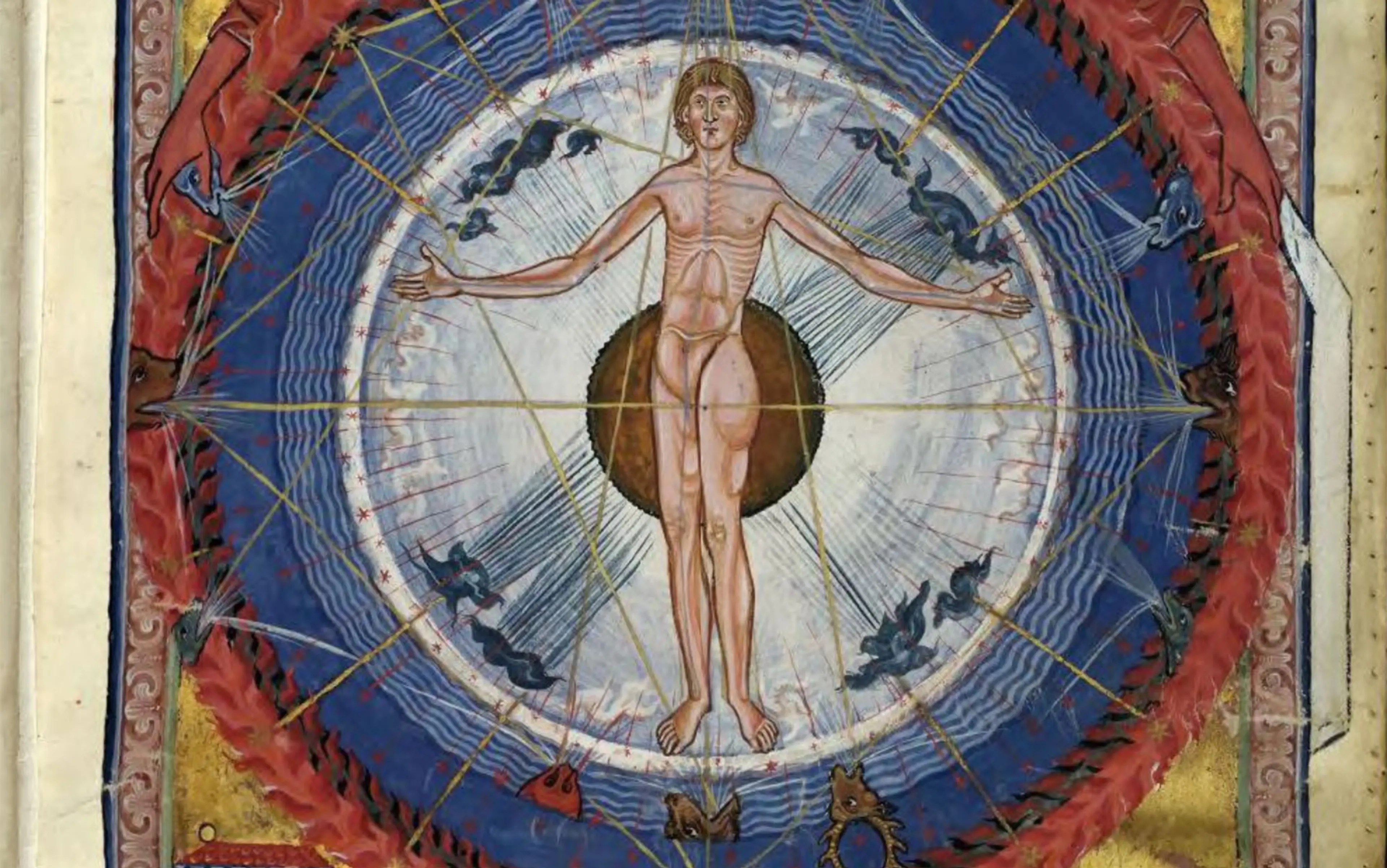
The quote above (in full, below) is the reigning substantive understanding of scientific naturalism that is commonplace today. Indeed, the modern era is often seen as the triumph of science over supernaturalism. But, as Peter Harrison explains, what really happened is far more interesting…
By any measure, the scientific revolution of the 17th century was a significant milestone in the emergence of our modern secular age. This remarkable historical moment is often understood as science finally liberating itself from the strictures of medieval religion, striking out on a new path that eschewed theological explanations and focused its attentions solely on a disenchanted, natural world. But this version of events is, at best, half true.
Medieval science, broadly speaking, had followed Aristotle in seeking explanations in terms of the inherent causal properties of natural things. God was certainly involved, at least to the extent that he had originally invested things with their natural properties and was said to ‘concur’ with their usual operations. Yet the natural world had its own agency. Beginning in the 17th century, the French philosopher and scientist René Descartes and his fellow intellectual revolutionaries dispensed with the idea of internal powers and virtues. They divested natural objects of inherent causal powers and attributed all motion and change in the universe directly to natural laws.
But, for all their transformative influence, key agents in the scientific revolution such as Descartes, Johannes Kepler, Robert Boyle and Isaac Newton are not our modern and secular forebears. They did not share our contemporary understandings of the natural or our idea of ‘laws of nature’ that we imagine underpins that naturalism…
[Harrison traces the history of the often contentious, but ultimately momentous rise of naturalism, then considers the historical acounts of that ascension– and what they gloss over or miss altogether. He then turns to whay that matters…]
… the contrived histories of naturalism that purport to show its victory over supernaturalism were fabricated in the 19th century and are simply not consistent with the historical evidence. They are also tainted by a cultural condescension that, in the past at least, descended into outright racism. Few, if any, would today endorse the chauvinism that attends these older, triumphalist accounts of the history of naturalism. Yet, it is worth reflecting upon the extent to which elements of cultural condescension necessarily colour scholarly endeavours that are premised on the imagined ‘neutral’ grounds of naturalism. Careful consideration of the contingent historical circumstances that gave rise to present analytic categories that enjoy significant standing and authority would suggest that there is nothing especially neutral or objective about them. Any clear-eyed crosscultural comparison – one that refrains from assessing worldviews in terms of how they measure up to the standard of the modern West – will reinforce this. We might go so far as to adopt a form of ‘reverse anthropology’, where we think how our own conceptions of the world might look if we adopted the frameworks of others. This might entail dispensing with the idea of the supernatural, and attempting to think outside the box of our recently inherited natural/supernatural distinction.
History [that is, the “actual” history that Harrison recounts] suggests that our regnant modern naturalism is deeply indebted to monotheism, and that its adherents may need to abandon the comforting idea that their naturalistic commitments are licensed by the success of science. As for the idea of the supernatural, ironically this turns out to be far more important for the identity of those who wish to deny its reality than it had ever been for traditional religious believers…
Fascinating and provocative: “The birth of naturalism,” from @uqpharri in @aeonmag.
* “There is only one world, the natural world, exhibiting patterns we call the ‘laws of nature’, and which is discoverable by the methods of science and empirical investigation. There is no separate realm of the supernatural, spiritual, or divine; nor is there any cosmic teleology or transcendent purpose inherent in the nature of the universe or in human life.” – Sean Carroll, The Big Picture
###
As we rethink reality, we might recall that it was on this date in 1588 that Tycho Brahe first outlined his “Tychonic system” concept of the structure of the solar system. The Tychonic system was a hybrid, sharing both the basic idea of the geocentric system of Ptolemy, and the heliocentric idea of Nicholas Copernicus. Published in his De mundi aethorei recentioribus phaenomenis, Tycho’s proposal, retaining Aristotelian physics, kept the the Sun and Moon revolving about Earth in the center of the universe and, at a great distance, the shell of the fixed stars was centered on the Earth. But like Copernicus, he agreed that Mercury, Venus, Mars, Jupiter, and Saturn revolved about the Sun. Thus he could explain the motions of the heavens without “crystal spheres” carrying the planets through complex Ptolemaic epicycles.

On this same date, in 1633, Galileo Galilei arrived in Rome to face trial before the Inquisition. His crime was professing the belief that the earth revolves around the sun– based on observations that he’d made further to Copernicus and Tycho.

You must be logged in to post a comment.