Posts Tagged ‘Pascal’
“The door handle is the handshake of the building”*…

Door handle and rose (1833–47), manufactured by Copeland & Garrett, Stoke-on-Trent. Victoria and Albert Museum, London
We have all become suddenly more aware of the moments when we cannot avoid touching elements of public buildings. Architecture is the most physical, most imposing and most present of the arts – you cannot avoid it yet, strangely, we touch buildings at only a very few points – the handrail, perhaps a light switch and, almost unavoidably, the door handle. This modest piece of handheld architecture is our critical interface with the structure and the material of the building. Yet it is often reduced to the most generic, cheaply made piece of bent metal which is, in its way, a potent critique of the value we place on architecture and our acceptance of its reduction to a commodified envelope rather than an expression of culture and craft.
Despite their ubiquity and pivotal role in the haptic experience of architecture, door handles remain oddly under-documented. There are no serious histories and only patchy surveys of design, mostly sponsored by manufacturers. Yet in the development of the design of the door handle we have, in microcosm, the history of architecture, a survey of making and a measure of the development of design and how it relates to manufacture, technology and the body.
For as long as there have been doors there have been door handles…
An appreciation of the apparati of accessibility: “Points of contact – a short history of door handles.”
* The Eyes of the Skin: Architecture and the Senses
###
As we get a grip, we might send thoughtfully-wagered birthday greetings to a man whose thought open a great many (metaphorical) doors, Blaise Pascal; he was born on this date in 1623. A French mathematician, physicist, theologian, and inventor (e.g.,the first digital calculator, the barometer, the hydraulic press, and the syringe), his commitment to empiricism (“experiments are the true teachers which one must follow in physics”) pitted him against his contemporary René “cogito, ergo sum” Descartes…

“Every technology, every science that tells us more about ourselves, is scary at the time”*…
Further to last weekend’s visit with Silicon Valley’s security robots...
Researchers led by the University of Cambridge have built a mother robot that can independently build its own children and test which one does best; and then use the results to inform the design of the next generation, so that preferential traits are passed down from one generation to the next.
Without any human intervention or computer simulation beyond the initial command to build a robot capable of movement, the mother created children constructed of between one and five plastic cubes with a small motor inside.
In each of five separate experiments, the mother designed, built and tested generations of ten children, using the information gathered from one generation to inform the design of the next. The results, reported in the open access journal PLOS One, found that preferential traits were passed down through generations, so that the ‘fittest’ individuals in the last generation performed a set task twice as quickly as the fittest individuals in the first generation…
email readers click here for video
“Natural selection is basically reproduction, assessment, reproduction, assessment and so on,” said lead researcher Dr Fumiya Iida of Cambridge’s Department of Engineering, who worked in collaboration with researchers at ETH Zurich. “That’s essentially what this robot is doing – we can actually watch the improvement and diversification of the species… We want to see robots that are capable of innovation and creativity…”
See and read more here (and here).
###
As we select naturally, we might spare a thought for Blaise Pascal; he died on this date in 1662. A French mathematician, physicist, theologian, and inventor (e.g.,the first digital calculator, the barometer, the hydraulic press, and the syringe), his commitment to empiricism (“experiments are the true teachers which one must follow in physics”) pitted him against his contemporary René “cogito, ergo sum” Descartes…
“History is a vast early warning system”*…
… Still, the hazards we face at any point in time have altogether-contemporary characteristics. Happily, Anders Sandberg has ridden to the rescue a new collection of warning signs…

See them all at “Warning Signs for Tomorrow.”
* Norman Cousins
###
As we duck and cover, we might spare a thought for René Descartes, the French philosopher and mathematician who thought and therefore was; he died on this date in 1650.
Many contemporaries (perhaps most notably, Pascal) rejected his famous conclusion, the dualist separation of mind and body; more (Voltaire, et al.), since. But Descartes’ emphasis on method and analysis, his disciplined integration of philosophy and physical science, his insistence on the importance of consciousness in epistemology, and perhaps most fundamentally, his the questioning of tradition and authority had a transformative– and lasting– effect on Western thought, and has earned him the “title” of Father of Modern Philosophy.
“In order to improve the mind, we ought less to learn than to contemplate.”
– Rene Descartes

Frans Hals’ portrait of Descartes, c. 1649
“The test of civilization is its estimate of women”*…

The makers of Barbie seem to apologize A LOT for underestimating young women. This time the Internet’s buzzing over a pretty cringe-worthy Barbie book, “I Can Be A Computer Engineer,” published out of Random House.
Barbie is featured in the book as a stylishly pink-clad computer engineer that somehow breaks everything and doesn’t know how to code. She does draw puppies though. This lady hacker needs the help of two dudes named Steve and Brian to do the real programming work cuz she’s just, “creating design ideas.” Ha ha ha…what?
In another section, a supposedly intelligent engineer Barbie (who should be familiar enough with technology not to do this) puts her flash drive into Skipper’s laptop and accidentally infects it with a virus. Skipper didn’t back up her homework and loses all her files and music, too. Silly Barbie. The two then get into a pillow fight. A pillow fight! Of course. Because women actually do that.
Don’t worry, Steve and Brian are here to save everything.
All the outrage over this book caught Mattel’s attention. It’s no longer available on Amazon.
A blogger who writes for Disney, Pamela Ribon first wrote about “I Can Be A Computer Engineer,” after picking it up at a friend’s house and reading horrific page after page. The traffic from her blog was so intense that she republished the piece on Gizmodo last night. The social blew up and people took to the Twitters to let Mattel know what a lady hacker can accomplish…
Mattel has since apologized for this completely sexist garbage on it’s Facebook page, promising it won’t do it again:
The portrayal of Barbie in this specific story doesn’t reflect the Brand’s vision for what Barbie stands for. We believe girls should be empowered to understand that anything is possible and believe they live in a world without limits. We apologize that this book didn’t reflect that belief. All Barbie titles moving forward will be written to inspire girl’s imaginations and portray an empowered Barbie character.
This is not the first time in Barbie’s more than half a century history something like this has happened. I clearly remember when Barbie held an aversion to math. Mattel released a Teen Talk Barbie back in 1992. The chattery doll would say things like, “Math class is tough,” and “I love shopping” right after, implying young girls would be better off skipping homework not suited for them…
More misogyny at “Mattel Pulls Sexist Barbie Book “I Can Be A Computer Engineer” Off Amazon.” Then, as a corrective, check out:”Barbie, Remixed: I (really!) can be a computer engineer.”
###
As we reaffirm our repugnance at Mattel, we might recall that it was on this date in 1654 that mathematician, physicist, inventor, writer and philosopher.Blaise Pascal had a carriage accident that changed his life: his horses bolted and plunged off a bridge, throwing into the roadway. He had just experienced the trials of his father, who’d broken his hip (at a time when such an injury was desperately serious and often fatal): while Pascal was himself only bruised, he saw the episode as a warning directly from God. That night he experienced a Christian conversion– light flooded his room; he recognized Jesus,– and changed the course of his work, favoring Christian philosophy over the scientific work that had occupied him until then. For the rest of his life Pascal carried around a piece of parchment sewn into his coat–a parchment inscribed with ecstatic phrases: “Fire. God of Abraham, God of Isaac, God of Jacob, not of the philosophers and the scholars…” and concluded by quoting Psalm 119:16: “I will not forget thy word. Amen.”
He went on to publish The Provincial Letters, and (posthumously) The Pensees.

Oh, the places we’ll go…
The Atlas Obscura, “A Compendium of the World’s Wonders, Curiosities, and Esoterica”… Consider, if you will:
The Cockroach Hall of Fame Museum
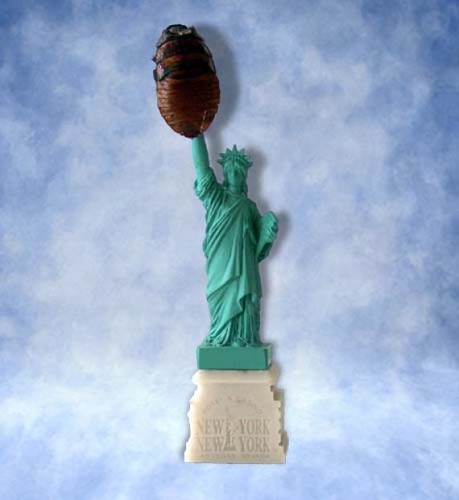
Featuring dead bugs dressed as celebrities and historical figures, this just might be the one time in your life that a cockroach puts a smile on your face.
On your visit, you’ll see cockroach displays featuring “Liberoachi,” “The Combates Motel,” and “David Letteroach,” among dozens of others.
See the Fremont Troll, the Wunderkammer, the Harmonic bridge and dozens of others, here.
***
As we re-plot our itineraries, we might offer a tip of the birthday beret to Blaise Pascal, born on this date in 1623. Pascal was an extraordinary polymath: a mathematician, physicist, theologian, inventor of arguably the first digital calculator (the “Pascaline”), the barometer, the hydraulic press, and the syringe. His principle of empiricism (“Experiments are the true teachers which one must follow in physics”) pitted him against Descartes (whose dualism was rooted in his ultimate trust of reason). Pascal also attacked from the other flank; his intuitionism (Pensées) helped kick-start Romanticism, influencing Rousseau (and his notion of what Dryden called the “noble savage”), and later Edmund Husserl and Henri Bergson. But perhaps most impactfully, his correspondence with Pierre de Fermat (the result of a query from a gambling-addicted nobleman) led to development of probability theory.

You must be logged in to post a comment.