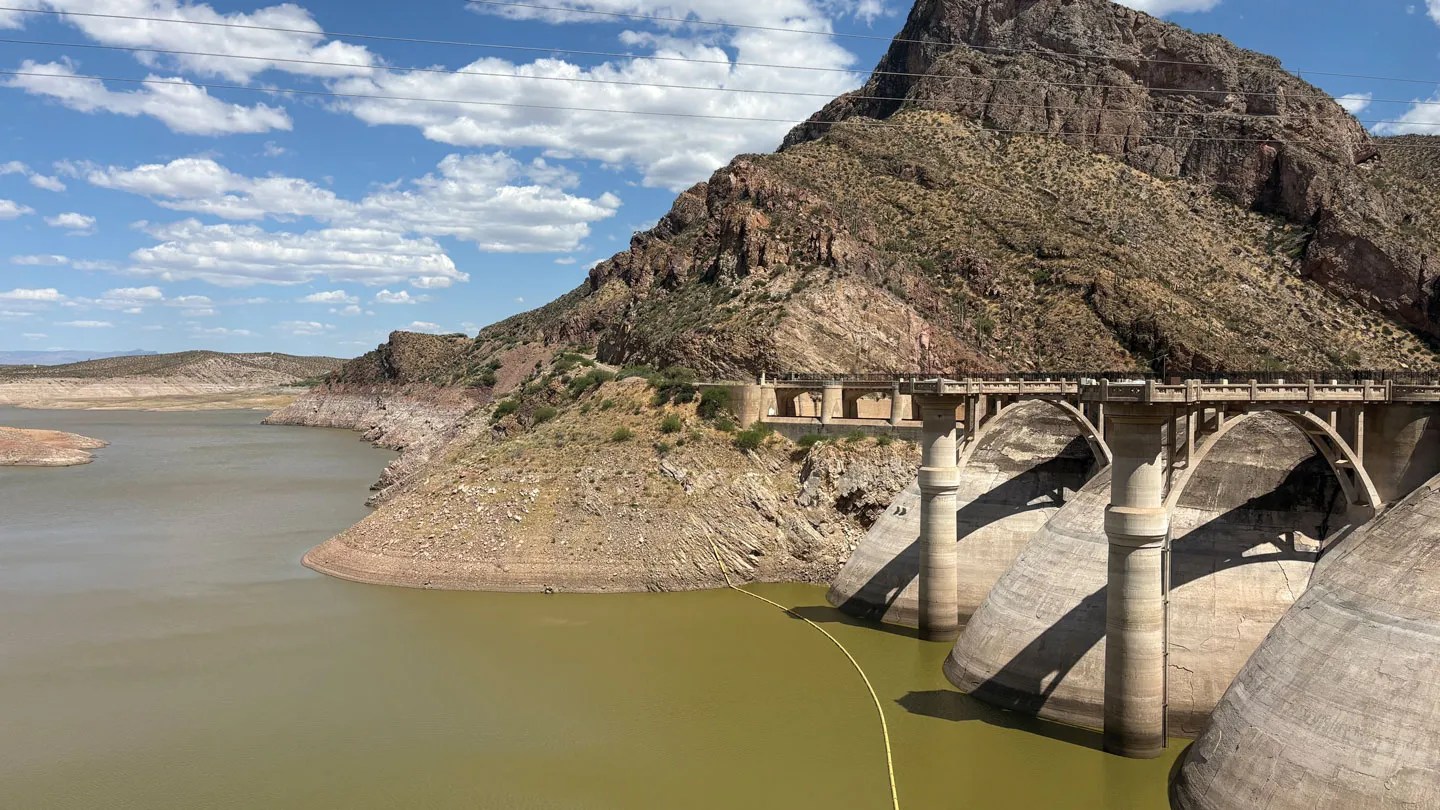
Water levels are running dangerously low in reservoirs across the U.S. Southwest. Declining flows in the Gila River have pushed levels to below 1 percent of capacity in Arizona’s San Carlos Reservoir
The Western U.S. is grappling with an extended drought. Nikk Ogasa explores the possibility that this continued dryness (and the fires and other hazards associated with it) could be our new climate change induced reality…
Kearny, Ariz., is a town on the brink. Located at the foot of the Dripping Spring Mountains in eastern Arizona, this small community of 2,000 people sources its water from the Gila River, a verdant waterway that snakes by the southern edge of town.
But in March, the snowpack feeding the river had dropped to precipitous levels: It was just 1 percent of its historic norm for that time of year. The Gila River water commissioner slashed Kearny’s allotment of river water by some 85 percent. And in April, town officials announced that “Zero Day” was approaching, at which point the taps would run dry.
“We need rain,” says Norm Warren, a lifelong Kearny resident. He owns the only large grocery store within a 45-minute drive of the town. Without tap water for refrigerator cooling systems, Warren says he won’t be able to store perishable products like meats and fresh produce.
Kearny’s dilemma foreshadows a crisis building across the American Southwest. Since 2000, the region — which includes Arizona, New Mexico, California, Utah, Colorado and parts of northern Mexico — has endured a historic “megadrought,” or a period of severe dryness that persists for decades. Scientists say it’s the driest this region has been in 1,200 years.
“We’re 27 years into it, and it shows no signs of letting up,” says Brad Udall, a water and climate researcher at Colorado State University in Fort Collins.
Scientists point to two factors causing the drought — rising temperatures and declining precipitation. Heat from human-caused climate change creates a thirsty atmosphere that is more effective at drying out the landscape, says Kevin Anchukaitis, a dendrochronologist who runs the University of Arizona Laboratory for Tree-Ring Research in Tucson. As for the lack of rain, many researchers wonder if it is simply a stroke of bad luck.
But a controversial study published in Nature in 2025 suggests something far more ominous: Humankind has disrupted a naturally occurring climate cycle in the Pacific Ocean that historically ushered episodes of wet weather into the Southwest. If that’s true, Udall says, things are not looking good for places like Kearny. Other researchers worry that the megadrought may be locked in place for the foreseeable future…
[Ogasa unpacks both the more traiditional analysis and the new hypothesis– that human behavior has disrupted the Pacific Decadal Oscillation, or PDO, an alternating climate pattern in which areas of warmer and cooler than normal surface waters switch their positions on a timescale of many decades…]
… “The conventional wisdom suggested that the PDO could shift any given year, and we [wouldn’t] have to worry about drought [after that],” says climate scientist Jeremy Klavans of the University of Miami.
But he and colleagues weren’t so sure. They dug into that assumption, analyzing more than 500 simulations of the PDO from a dozen major climate models. They examined how the PDO shifted — and stabilized — in the presence of outside forces such as volcanic eruptions, solar variation and levels of greenhouse gases and aerosols.
Their finding: Greenhouse gas and aerosol emissions had effectively hijacked the behavior of the PDO over the last 50 years by altering atmospheric temperatures, the team reported in 2025 in Nature.
Ballooning concentrations of industrial aerosols — which can have an atmospheric cooling effect — probably pushed the PDO to increasingly favor its warm phase starting in the 1950s, the researchers say. But in the 1980s, clean air legislation decreased aerosol emissions even as greenhouse gas levels continued to rise and warm the atmosphere. That combination drove the PDO toward its cool phase, making drought conditions more likely in the Southwest. Instead of being a rare event, drought “becomes kind of commonplace,” Klavans says….
… the current climate models may actually be underestimating the potential duration of the ongoing megadrought, based on those findings, says study coauthor Victoria Todd, a climate scientist at the National Center for Atmospheric Research in Boulder, Colo.
That could be bad news for the American Southwest, Udall says. Even if people stopped emitting greenhouse gases today, planet-warming carbon dioxide will continue to accumulate in the atmosphere, locking the PDO and megadrought into place, potentially for decades. If the emerging science is right, then the Southwest is going to keep getting drier and drier, Udall says. “No question about it.”
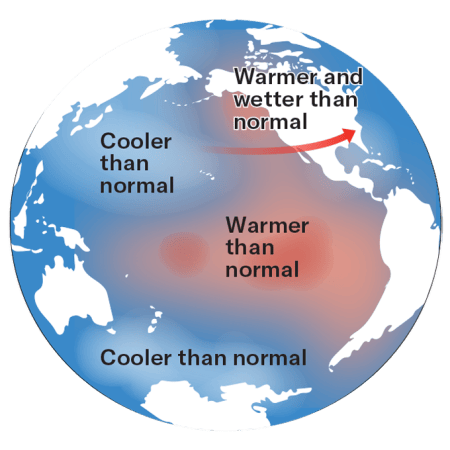
Warm Phase (1977-1998): During the PDO’s warm phase, the Pacific jet stream (red arrow) moves south over North America, drawing wet weather patterns into the Southwest.
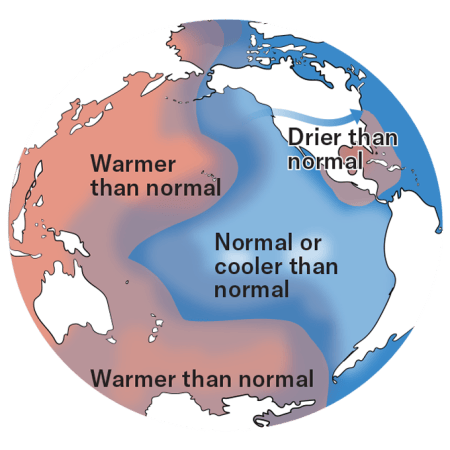
Cool phase (1999–now): When the PDO switches to its cool phase, the Pacific jet stream (blue arrow) moves north, diverting wet weather patterns out of the Southwest and making drought more likely.
The hypothesis that human emissions have disrupted the PDO could be put to the test this year. That’s because scientists are predicting a historically strong El Niño, a Pacific climate pattern characterized by months of warmer than normal sea surface temperatures in the eastern equatorial Pacific. El Niños often bring wet conditions to the Southwest — and they have been known to force the PDO into a different phase. For example, the 1976–1977 El Niño helped push the PDO into a warm phase for nearly a quarter of a century.
But a powerful El Niño in 2015 wasn’t able to force the switch for more than a few years. That suggests the PDO may be slowly changing, Klavans says. “Something’s different here.”
Even if the current El Niño is strong enough to force the PDO into a warm phase, no one should expect the megadrought to go away any time soon, Seager says. “We’re talking about something that’s been going on for a few decades now. Even one very wet winter is not going to be enough to restore Colorado River reservoirs to where they would preferably be.”…
… Even in the best-case scenarios, the Southwest never returns to the wet years of the 1980s and ’90s, when lakes Powell and Mead reached maximum capacity numerous times, the researchers reported in 2023 in npj Climate and Atmospheric Science. The findings instead suggest that, regardless of what the PDO does, the region will face a far drier climate than it did in its recent past. In other words, even if the megadrought were to end, the Southwest faces an uncertain future when it comes to water, according to the study.
Communities need to prepare for the future by improving their water conservation efforts and infrastructure, Anchukaitis says. Those practices will grow only more crucial as the Southwest’s population continues to balloon: Utah, Texas, Nevada, Colorado and Arizona are among the 10 fastest growing states by population this decade, according to a 2024 report by the University of Virginia’s Weldon Cooper Center for Public Service.
Even if wet weather returns, Anchukaitis says, the cities of the Southwest shouldn’t fall into complacency. “[More rain] doesn’t mean that … megadroughts aren’t going to come back,” he says. “Maybe it buys us some time to ease systems into a new way of thinking.”…
As we pray for rain, we might recall that it was on this date in 2006 that NASA recorded th largest ozone hole in the atmosphere to date. From September 21-30, the average area was 10.6 million square miles, as measured by the Ozone Monitoring Instrument on NASA’s Aura satellite. At the worst point, a record low of 1.2 Dobson Units compared to a 125 DU non-hole reading. For the past several decades, each year during the Southern Hemisphere Spring (Northern Hemisphere Autumn) chemical reactions due to chlorine and bromine man-made compounds in the atmosphere cause the destruction of ozone in the stratosphere over the southern polar region… all contributing to the phenomenon discussed above.
False-color view of total ozone over the Antarctic pole. The purple and blue colors are where there is the least ozone, and the yellows and reds are where there is more ozone. (source)

You must be logged in to post a comment.