At the same time, new technology and new applications of that technology are reshaping the Fourth estate. The Reuters Institute at Oxford surveyed 280 digital leaders from 51 countries and territories to learn what they are seeing– and planning. From the Executive Summary…
We are still at the early stages of another big shift in technology (Generative AI) which threatens to upend the news industry by offering more efficient ways of accessing and distilling information at scale. At the same time, creators and influencers (humans) are driving a shift towards personality-led news, at the expense of media institutions that can often feel less relevant, less interesting, and less authentic. In 2026 the news media are likely to be further squeezed by these two powerful forces.
Understanding the impact of these trends, and working out how to combat them, will be high up the ‘to do list’ of media executives this year, despite the unevenly distributed pace of change across countries and demographics.
Existential challenges abound. Declining engagement for traditional media combined with low trust is leading many politicians, businessmen, and celebrities to conclude that they can bypass the media entirely, giving interviews instead to sympathetic podcasters or YouTubers. This Trump 2.0 playbook – now widely copied around the world – often comes bundled with a barrage of intimidating legal threats against publishers and continuing attempts to undermine trust by branding independent media and individual journalists as ‘fake news’. These narratives are finding fertile ground with audiences – especially younger ones – that prefer the convenience of accessing news from platforms, and have weaker connections with traditional news brands. Meanwhile search engines are turning into AI-driven answer engines, where content is surfaced in chat windows, raising fears that referral traffic for publishers could dry up, undermining existing and future business models.
Despite these difficulties many traditional news organisations remain optimistic about their own business – if not about journalism itself. Publishers will be focused this year on re-engineering their businesses for the age of AI, with more distinctive content and a more human face. They will also be looking beyond the article, investing more in multiple formats especially video and adjusting their content to make it more ‘liquid’ and therefore easier to reformat and personalise. At the same time, they’ll be continuing to work out how best to use Generative AI themselves across newsgathering, packaging, and distribution. It’s a delicate balancing act but one that – if they can pull it off – holds out the promise of greater efficiency and more relevant and engaging journalism.
These are the main findings from our industry survey:
Only slightly more than a third (38%) of our sample of editors, CEOs, and digital executives say they are confident about the prospects for journalism in the year ahead – that’s 22pp lower than four years ago. Stated concerns relate to politically motivated attacks on journalism, loss of USAID money that previously supported independent media in many parts of the world, and significant declines in traffic to many online news sites.
By contrast, around half (53%) say they are confident about their own business prospects, similar to last year’s figure. Upmarket subscription-based publishers with strong direct traffic can see a path to long-term profitability, even as those that remain dependent on advertising and print worry about sharp declines in revenue and the potential impact of AI powered search on the bottom line.
Publishers expect traffic from search engines to decline by more than 40% over the next three years – not quite ‘Google Zero’ but a substantial impact none the less. Data sourced for this report from analytics provider Chartbeat shows that aggregate traffic to hundreds of news sites from Google search has already started to dip, with publishers that rely on lifestyle content saying they have been particularly affected by the roll out of Google’s AI overviews. This comes after substantial falls in referral traffic to news sites from Facebook (-43%) and X, formerly Twitter (-46%) over the last three years.
In response, publishers say it will be important to focus on more original investigations and on the ground reporting (+91 percentage point difference between ‘more’ and ‘less’), contextual analysis and explanation (+82) and human stories (+72). By contrast, they plan to scale back service journalism (-42), evergreen content (-32), and general news (-38), which many expect to become commoditised by AI chatbots. At the same time, they think it will be important to invest in more video (+79) – including ‘watch tabs’ – more audio formats (+71) such as podcasts but a bit less in text output.
In terms of off-platform strategies, YouTube will be the main focus for publishers this year with a net score of +74, up substantially on last year. Other video-led platforms such as TikTok (+56) and Instagram (+41) are also key priorities – along with working out how to navigate distribution through AI platforms (+61) such as OpenAI’s ChatGPT, Google’s Gemini and Perplexity. Google Discover remains a critical (+19), if slightly volatile, source of referral traffic, while some publishers are looking to find new audiences via newsletter platforms such as Substack (+8). By contrast, publishers will be deprioritising effort spent on old-style Google SEO (-25) – as well as traditional social networks Facebook (-23) and X (-52)
Last year we predicted the emergence of ‘agentic AI’, but this year we can expect to start to see real-world impact of these more advanced technologies. Some sources suggest that there will soon be more bots than people reading publisher websites, as tools like Huxe and OpenAI’s Pulse offer personalised news briefings at scale. Three-quarters of our respondents (75%) expect ‘agentic tools’ to have a ‘large’ or ‘very large’ impact on the news industry in the near future.
Alongside the traffic disruption from AI, news executives also see opportunities to build new revenue from licensing content (or a share of advertising revenue) within chatbots. Around a fifth (20%) of publisher respondents – mainly from upmarket news companies – expect future revenues to be substantial, with half (49%) saying that they expect a minor contribution. A further fifth (20%), mostly made up of local publishers, public broadcasters, or those from smaller countries, say they do not expect any income from AI deals.
More widely, subscription and membership remain the biggest revenue focus (76%) for publishers, ahead of both display (68%) and native advertising (64%). Online and physical events (54%) are also becoming more important as part of a diversified revenue strategy. Reliance on philanthropic and foundation support (18%) has declined this year, after cuts of media support budgets in the United States and elsewhere.
Meanwhile news organisations’ use of AI technologies continues to increase across all categories, with back-end automation considered ‘important’ this year by the vast majority (97%) of publisher respondents, many of whom integrated pilot systems into content management systems in the last year. Newsgathering cases (82%) are now the second most important, with faster coding and product development (81%) also gaining traction.
Over four in ten (44%) survey respondents say that their newsroom AI initiatives are showing ‘promising’ results, but a similar proportion (42%) describe them as ‘limited’. Two-thirds of respondents (67%) say they have not saved any jobs so far as a result of AI efficiencies. Around one in seven (16%) say they have slightly reduced staff numbers but a further one in ten (9%) have added new roles/cost.
The rise of news creators and influencers is a concern for publishers in two ways. More than two-thirds (70%) of our respondents are concerned that they are taking time and attention away from publisher content. Four in ten (39%) worry that they are at risk of losing top editorial talent to the creator ecosystem, which offers more control and potentially higher financial rewards.
Responding to the increased competition and a shift of trust towards personalities, three-quarters (76%) of publisher respondents say they will be trying to get their staff to behave more like creators this year. Half (50%) said they would be partnering with creators to help distribute content, around a third (31%) said they would be hiring creators, for example to run their social media accounts. A further 28% are looking to set up creator studios and facilitate joint ventures.
More widely, could 2026 be the year when AI company stock valuations come down to earth with a bump, amid concerns about whether their trillion-dollar bets will pay back their investors? Meanwhile the amount of low-quality AI automated content, including so-called ‘pink slime’ sites, looks set to explode, with platforms struggling to distinguish this from legitimate news.
We can expect more public concern about the role of big tech in our lives. This may include individual acts of ‘Appstinence’ and other forms of digital detox and a desire for more IRL (In Real Life) connection. Governments will also come under pressure to do more to protect young and other vulnerable groups online, even in the United States.
The creator economy will continue to surge, fuelled by investments from video platforms and streamers. At the top end creators will look more like Hollywood moguls with big budgets and their own studio complexes. Within news, we’ll also see the emergence of bigger, more robust, creator-led companies delivering significant revenues as well as value to audiences – offering ever greater competition for traditional journalism…
As we ponder the prospects of the press, we might type a birthday note to John Baskerville, a pioneering English printer and typefounder, who was born on this date in 1706. Among Baskerville’s publications in the British Museum’s collection are Aesop’s Fables (1761), the Bible (1763), and the works of Horace (1770)– many printed on a stock he invented, “wove paper”, which was considerably smoother than “laid paper”, allowing for sharper printing results. And as for his fonts, Baskerville’s creations (including the famous “Baskerville,” a predecessor to the very similar Times New Roman) were so successful that his competitors resorted to claims that they damaged the eyes.
As Josie Harvey reports, unlimited access to “doomscrolling” and the resultant emotional toll of constant negative news has led to record-high news avoidance…
News has never been more accessible – but for some, that’s exactly the problem. Flooded with information and relentless updates, more and more people around the world are tuning out.
The reasons vary: for some it’s the sheer volume of news, for others the emotional toll of negative headlines or a distrust of the media itself. In online forums devoted to mindfulness and mental health, people discuss how to step back, from setting limits to cutting the news out entirely…
… Globally, news avoidance is at a record high, according to an annual survey by the Reuters Institute for the Study of Journalism published in June. This year, 40% of respondents, surveyed across nearly 50 countries, said they sometimes or often avoid the news, up from 29% in 2017 and the joint highest figure recorded.
The number was even higher in the US, at 42%, and in the UK, at 46%. Across markets, the top reason people gave for actively trying to avoid the news was that it negatively impacted their mood. Respondents also said they were worn out by the amount of news, that there is too much coverage of war and conflict, and that there’s nothing they can do with the information…
[Harvey reviews the dynamics at play– overabundance, challenges to mental health– concluding that limited, mindful access may be the key…]
… Benjamin Toff, director of the Minnesota Journalism Center at the University of Minnesota, studied the trend in his book Avoiding the News. He draws a key distinction between those who consistently avoid the news and those who simply limit their consumption – the latter, he says, is “perfectly healthy”.
“We live in a world in which you can access news 24/7 and be inundated with information at all times. But that doesn’t mean you should,” he said.
What worries him and his co-authors is when withdrawal turns into a cycle that deepens social divides, leaving some groups less likely to participate in political life.
“The more you disengage, disconnect from the news, the harder it becomes to try to make sense of what’s happening on any given story,” he explained.
The authors observed that consistent news avoidance tends to be more common among young people, women, and lower socioeconomic classes.
“If you believe as we do, that normatively, we want people to be able to have the same opportunities to engage politically, to vote, to be vocal about the political issues that matter, then we think it’s a problem that people are disengaging from news,” Toff said.
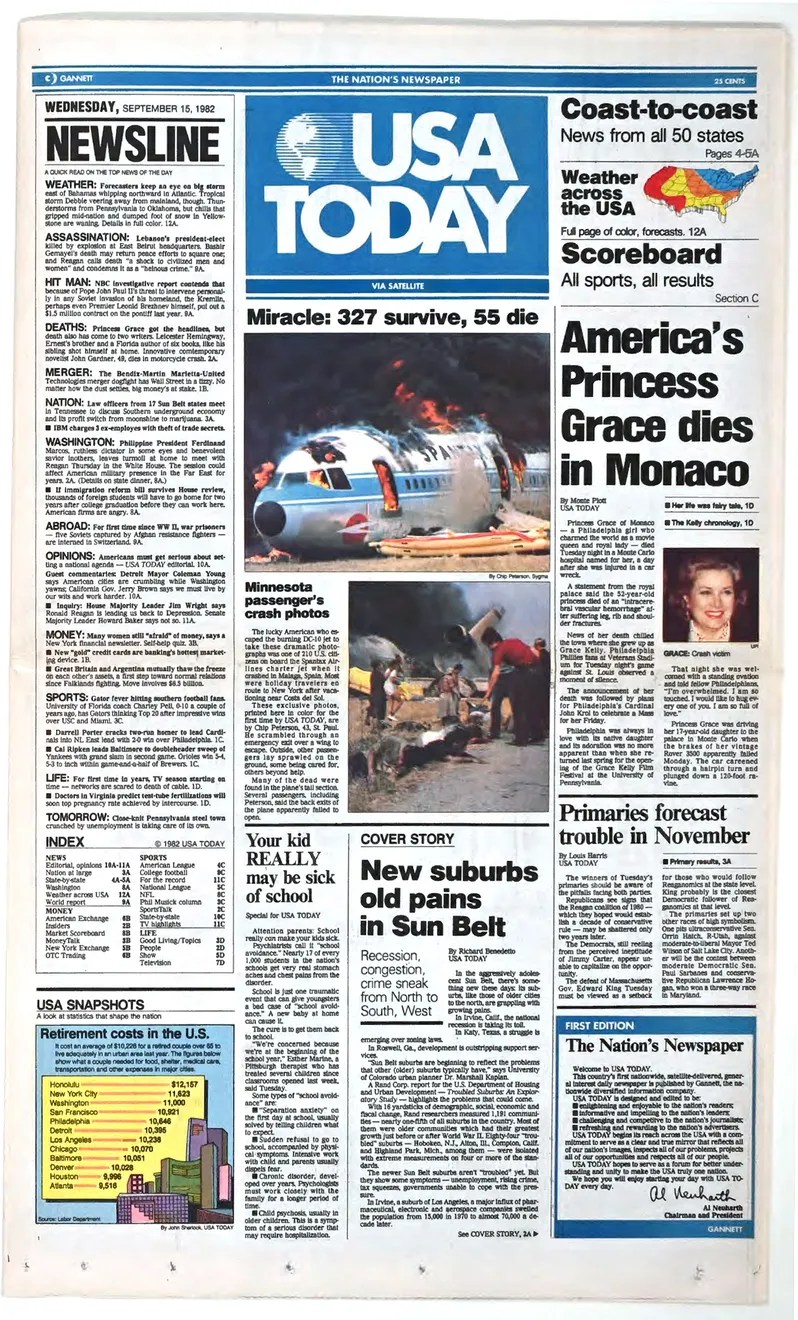
As we survive the surfeit, we might recall one of the larger steps toward the media environment in which we wallow was taken on this date in 1982: USA Today dropped its first issue.
The paper’s overall style– shorter articles, color photographs, an elevated use of graphics… and no longer, in-depth stories– was unique among newspapers at the time. Critics were largely unamused, referring to it as a “McPaper” or “television you can wrap fish in.” But as it succeeded, it changed the appearance and feel of newspapers around the world (in ways that anticipated the content and form/design of online jouranlism). Today, of course, while a print version survives, USA Today’s primary footprint is digital.
Still, community-rooted local radio perserveres. Consider ldial, a curated collection from Adam Scott— a list that let’s you sample some of the best independent and community radio stations in the US (and, ideally, encourages you to find your own local options).
Then, remembering that the best local radio is your local radio, consider supporting your local station(s).
* Tom Petty
###
As we tune in, we might recall that it was on this date in 1950 that Hormel registered the name and trademark “Spam” for its canned meat product. It is interesting to note that the company had marketed the product since 1937, and only felt the need to protect the name 13 years later.
Journalism in the U.S. is in turmoil, beset by cultural shifts, technology, economics, and politics. Today, two thoughful pieces on what its future could hold.
First, from Richard Gingras, a long (and fascinating and provocative) piece that diagnoses the situation, traces its evolution, and posits (at least approaches to) solutions. Eminently worth reading in full. Here, an excerpt especially resonant for your correspondent…
… I recently revisited the work of Robert Putnam. Putnam has researched the connection between effective governance and community engagement for five decades. He began his work in Italy, which in 1975 shifted power from the central government to the provinces. He found that the strongest corollary with effective governance was community engagement.
Basically, people in regions of ineffective governance were not joining clubs, they weren’t going on picnics or joining bowling leagues. They weren’t getting to know people who were different from them. They weren’t building a shared reality. They weren’t building social capital.
This is the result of many factors: the rise of television, increased suburbanization, the impact of technology and the Internet. The result is increased isolation, a narrowing of empathy, a reduction in common interest. Without community and real world social engagement we are not exposed to the diversity of our communities. We lose the opportunity to understand the challenges and the attributes of people who are not like us. If we don’t engage with the other, with those who are not like us, we become more vulnerable to perceiving the other from an isolated, removed, silo of fear.
Our greatest opportunity may be at the community level, by rethinking the role of a community news organization as a community platform suited to our modern digital world.
First, its explicit mission would be to strengthen the community, to both address the community’s information needs and create opportunities for engagement. In seeking to bring the diversity of a community together, it would also strive to be assiduously apolitical. Again, we inform, you decide.
Second, it would celebrate the community’s hopes and dreams, giving focus to its successes, to examples of civic empathy, as well as being the watchdog for misbehavior.
It would purposely address the community’s broad information needs — community events, local sports, the progression of life from birth to obituary. It would leverage topics of community interest that aren’t controversial. A recent mega-study coordinated by Stanford University determined the best method of addressing divisiveness is to engage the community on non-controversial subjects. This can help unify a community and build the trust necessary to address more difficult topics.
We see accountability journalism as the priority, to ferret out corruption, to expose criminal behavior. It is critical. But the audience for serious accountability journalism is small, in the low single digits. By addressing a community’s comprehensive information needs with service journalism, we can provide value to the community and gain exponentially higher engagement. This both drives the business model and increases the impact of accountability journalism by exposing it to those who might not seek it out…
Next, a piece from Patrice Schneider, the Chief Strategy Officer of Media Development Investment Fund, suggesting a funding approach that might make (more quality) journalism (more) viable. While his lens is global, the applicability to the U.S. is clear…
In the dynamic landscape of independent media funding, a three-decade-old model is gaining renewed attention among European foundations. It challenges the traditional dichotomy between grant support and market-driven investments. This innovative approach, known as the Third Way, offers a nuanced economic strategy that quantifies the intrinsic societal value of quality public interest information.
The Third Way recognizes quality information as critical infrastructure, akin to highways or electrical grids. Its value extends beyond immediate monetary returns, encompassing its capacity to sustain democratic dialogue, enable informed citizenship, and provide systemic transparency…
… The Third Way’s most profound insight is recognising the broad constituency invested in quality information:
Corporations require reliable, unbiased data for strategic decision-making.
Financial institutions depend on transparent market intelligence.
Civil society organizations need independent reporting to monitor power structures
Individual citizens seek credible narratives to navigate complex global challenges
Sustainable Development Goals (SDGs) fundamentally rely on access to accurate, independent information
By aligning these diverse interests, the model transcends traditional funding dichotomies; grants versus investments or market versus public funding.
And it’s not just about extracting more from philanthropy, but about creating a blended infrastructure of funding that recognises information as a shared societal resource...
(Full disclosure, both Richard and Patrice are colleagues. MDIF– originally Media Development Loan Fund– was founded by an old friend, Saša Vučinić, and your correspondent was an early investor.)
* Mahatma Gandhi
###
As we nourish the news, we might spare a thought for Alistair Cooke; he died on this date in 2004. While best known ot American audiences as a television host (Omnibus, Masterpiece Theatre), he had a long career as a journalist (for the BBC, NBC, The Gaurdian, and others) and author.
After Alistair Cooke’s death the Fulbright Alistair Cooke Award in Journalism was established as a tribute to his life and career achievements. The award supports students from the United Kingdom to undertake studies in the United States, and for Americans to study in the United Kingdom.
The estimable John Battelle on yet another brick in the wall…
There’s an old maxim in the news business: Stories in which a dog bites a man are uninteresting. But a man biting a dog? Now that’s worth writing up!
Last week Google released a report on the value of news to its business. Its conclusions minced no words. Here’s the money quote: “…news content in Search has no measurable impact on ad revenue for Google.”
On first glance, Google’s experiment feels like a Dog Bites Man story – everyone knows news doesn’t drive advertising revenue – hell, I lived that truth most of my career, most recently with The Recount, which attempted to convince advertisers to support high-quality news coverage across video and social media (we couldn’t). But look a bit closer, and you might just see a Man Bites Dog story after all.
To understand why, we’ll need to go into a bit of background (those of you already deep in this story, you can skip the next few grafs.) The news business has had a tortured relationship to the tech industry for decades – first as it attempted to adapt to the Internet, then as it realized in doing so, it had been disintermediated, first by Google, and later by social media (and Apple’s iOS). The reasons for the news’ industry’s decline are too numerous to review here, but the results are clear: Overall, the sector is losing outlets, practitioners, revenue, and audience.
This has caused considerable alarm both inside the industry and within (certain) governments. The most notable of these is the European Union, which passed legislation in 2019 that mandated Google (and other intermediaries) share revenues with the news industry (the specific portion of the law that impacts Google’s revenues is Article 15, also known as “the snippet tax.”)
Google claims that when it shows a portion of a news article to its users, it’s doing both the user and the publisher a service. Publishers claim that by showing that snippet, Google subverts their business model, poaching the customer’s attention, relationship, and resultant revenue that the publisher would otherwise enjoy.
To prove otherwise, Google’s report details an experiment (PDF download) that removed all European news content from Google’s Search, Discover, and News products over a period of roughly three months. The idea was to determine whether the loss of this content had any impact on Google’s overall revenue.
The answer, as we’ve already seen, is no.
Despite being passed more than five years ago, details of how the EU legislation will be implemented in the real world are still being negotiated. Google’s report is intended to impact those negotiations with “proof” that a snippet tax is based on faulty logic. After all, how can you tax a company for stealing news revenues when, in point of fact, news creates no provable increase in samesaid company’s revenue in the first place?
This is where the story veers into “Man Bites Dog” territory. Google’s logic seems straightforward. But this argument is a classic example of a false dilemma (with a side of grading-your-own-homework tossed in for good measure).
The false dilemma is this: News has no value because news doesn’t add revenue to Google’s bottom line. To this assertion I call bullshit. Sure, Google might not make money from news. But publishers certainly do. And is news worthless to Google? Hardly.
Let’s start with the fact that Google has not one, but two major products that depend on “news.” (So does Apple, for what it’s worth). Both even call their product News! Google’s second is Discover, which for those of you who aren’t on Android phones, is the river of stories that comes up when you “swipe right” from the home screen (it’s also known as “left of home.”) Both News and Discover are massive engagement honeypots for Google (and Apple). They might not drive a ton of direct advertising revenue, but they are crucial to both companies’ overall product satisfaction. Why would either Google or Apple even build and maintain these products if “they have no value?” The answer is they wouldn’t.
If you dig into the data that came out of Google’s experiment, you can see why. While they remained constant for Search users, Daily Active Users (DAU) declined significantly – nearly 6% – for the company’s Discover product. Put another way, when Google yanked “real news” out of its Discover product, a fair number of people stopped using it. That didn’t happen with Search (down just .77%) or News – which in fact showed a significant uptick of 1.54%. Why?
Well, as a serious user of all three products, I have a pretty strong opinion. As it stands today, Discover is a crappy Instagram clone, only with more news content (Instagram and its parent Meta have spent the past few years eliminating fact-checking and down-ranking news in its feeds). The only reason I engage with Discover is for the often-pleasant surprise of a news story that is relevant to me. Take those out, and I’ll use Discover a lot less.
Google’s News product, on the other hand, is filled with mostly “quality news” stories. Take out all the European news, and what do you have left? Well, loads of content from non-EU based news publishers, as well as any engagement bait that has made it through Google’s “real news” filters.
In effect, Google “Instagram-ified” Discover when it eliminated all reputable European news, and it also “globalized” its News product (and likely added a side of clickbait). Users were likely initially confused by this, but they acted rationally: Those who went to Discover because it featured European local news started to abandon the product.
Those who went to Google News, on the other hand, found other reputable news sources (there are plenty) and probably didn’t notice the lack of local news, at least initially. They might have even enjoyed seeing stuff they usually miss, given their European identities. But one thing is certain: They went to a site dedicated to news, and they got news.
It’s hard to say exactly what happened here, because the report didn’t go into much detail. But Google did report where people went after they engaged with these two lobotomized products. The top outbound domains were, according to a footnote in the report: youtube.com, infobae.com, facebook.com, wikipedia.org, and pinterest.com. YouTube is fast replacing traditional news as an information source. Infobae is a fast-growing Spanish-language news site based in Argentina. That probably explains what happened in Spain. Facebook? Anybody’s guess what that’s all about, but since I’m writing this post, I’m going to guess Facebook’s famous engagement bait won the day there. Wikipedia is a famously trusted source of truth on the Internet. And….Pinterest?! ¯\_(ツ)_/¯
Pulling back, I think it’s fair to say that Google’s experiment falls somewhere between “vaguely well-intentioned” and “deeply cynical.” The company set out to prove something it already knew: It makes almost no direct revenue from news content. But it spun the resulting data into a narrative that it believes will allow the company to avoid sharing revenue with real news outlets under the EU directive.
“In other words,” Google’s report concluded, “the experiment worked as intended.”…
As we fumble the fourth estate, we might recall that it was on this date in 1881 that a celebrated hoaxster (and exploiter of the axiom “nobody ever lost a dollar by underestimating the taste of the American public”) took on partners: “P.T. Barnum’s Grand Traveling Museum, Menagerie, Caravan, and Circus: The Greatest Show on Earth” joined forces with James Bailey and James Hutchinson. By 1887, the re-branded circus went by the name “The Barnum & Bailey Greatest Show on Earth.”




You must be logged in to post a comment.