Posts Tagged ‘National Nut Day’
“Your life has a limit, but knowledge has none”*…

Kurt Gödel’s Incompleteness Theorems put a cap on what we can “know” from within the logical and perceptual systems in which we live. While Gödel’s focus was trained on mathematics, his insight has seen much broader application (e.g., here).
Alexander V. Gheorghiu argues that it’s not so simple– and that what we claim as “true” is not a ceiling we are forever failing to reach but something that changes as we climb toward it…
On the evening of 8 September 1930, the German mathematician David Hilbert stepped up to a microphone in Königsberg and addressed his countrymen by radio. He was 68, recently retired, and at the height of his fame. The talk was a defense of pure reason, delivered in the city of Immanuel Kant, and it ended with two phrases that would later be carved on his tombstone: Wir müssen wissen. Wir werden wissen. We must know. We shall know.
Are certain questions closed to the human mind? Are there truths about the world that we can never know? Hilbert thought that, at least within mathematics, this could not be the case. For him, mathematics was a game played with symbols: one could fix the right axioms as rules of the game and every mathematical problem could be solved. He was wrong.
The day before his Königsberg address, at a small academic meeting in the same city, a 24-year-old Austrian named Kurt Gödel had quietly announced that no such system for arithmetic could exist. Whatever reasonable set of rules you fix, something true must lie beyond them and thus beyond our knowledge. We can’t know. We won’t know. Gödel’s results, known as the Incompleteness Theorems, are landmark achievements of 20th-century logic. Recent work in philosophy and mathematics has begun to illuminate the gap they opened, and with it something deeper about the foundations of knowledge itself. The story begins in the same city, but two centuries earlier…
[Gheorghiu unpacks the arguments of Kant, Hilbert, and Gödel, then traces the work done since. He concludes…]
… In 2005, Tor Sandqvist, a doctoral student at Uppsala University, submitted a thesis that took up [Michael Dummett‘s]’s challenge: to justify the ordinary practices of mathematicians without any appeal to truth. Where Dummett had given the conditions a solution must satisfy, Sandqvist gave a solution. He produced a precise mathematical justification of deduction as mathematicians actually use it, grounded entirely in practices of assertion. The boxer’s fists were untied.
It was rediscovered a decade later in the Department of Computer Science at University College London, where a group of logicians recognised what Sandqvist had actually built, and developed it into a full framework on a par with the orthodox truth-conditional view. The framework now stands equal to the truth-based account, analogous to the situation after Gödel’s PhD thesis. What about mathematics? The UCL team have recently shown that the Dummett-Sandqvist framework gives a way to understand what Gödel’s Incompleteness Theorems are about, and it is not the limits of knowledge.
If meaning comes from practices of assertion, then our concepts are settled only as far as our practices have settled them. A system of definitions is a kind of constitution that determines something. The US Constitution, for example, is meant to enshrine a form of democracy. But what a constitution defines answers to how it is amended.
Principia Mathematica is a constitution for arithmetic. To read it as a constitution is to assume it is consistent; otherwise, it would be nonsense. So, when we amend it by asserting that ‘Principia Mathematica is consistent,’ we are not changing the subject: the new axiom says aloud only what the practice already did. Gödel’s theorems apply afresh to the enlarged constitution: the amended system has its own unprovable truth, its own consistency it cannot certify. No amendment is the last; each faithful extension opens room for the next. To grasp a concept like arithmetic is not to survey a finished structure; it is to hold a principle for going on: a rule for laying the next stretch of line, not a map of where the line ends. Dummett called this openness indefinite extensibility.
Faithful is the word doing the work, because not every amendment is. Gödel claimed the US Constitution could deliver a dictatorship. That does not make dictatorship a form of democracy. Whatever loophole he had in mind, it would have contradicted the practices the Constitution already enshrined. An amendment can betray what a constitution defines. But it can also unfold it, drawing out what the founding commitments demanded all along. Only the second kind is what Dummett has in mind.
The constitution of our language is our current practice for public discourse. As it is extensible in this way, what we claim as ‘true’ is not a fixed structure with a ceiling we are forever failing to reach, but something that can change. Gödel’s verdict never applied to mathematics, but only to some edition of the constitution. Within the Sandqvist system, we can attend to the extension systematically. Hilbert’s words outlive his programme: Wir werden wissen. We shall know. Not because the answers are waiting at the end of a ladder, but because truth goes exactly as far as we have built the rungs…
Eminently worth reading in full: “The Ladder of Knowledge,” from @aeon.co.
###
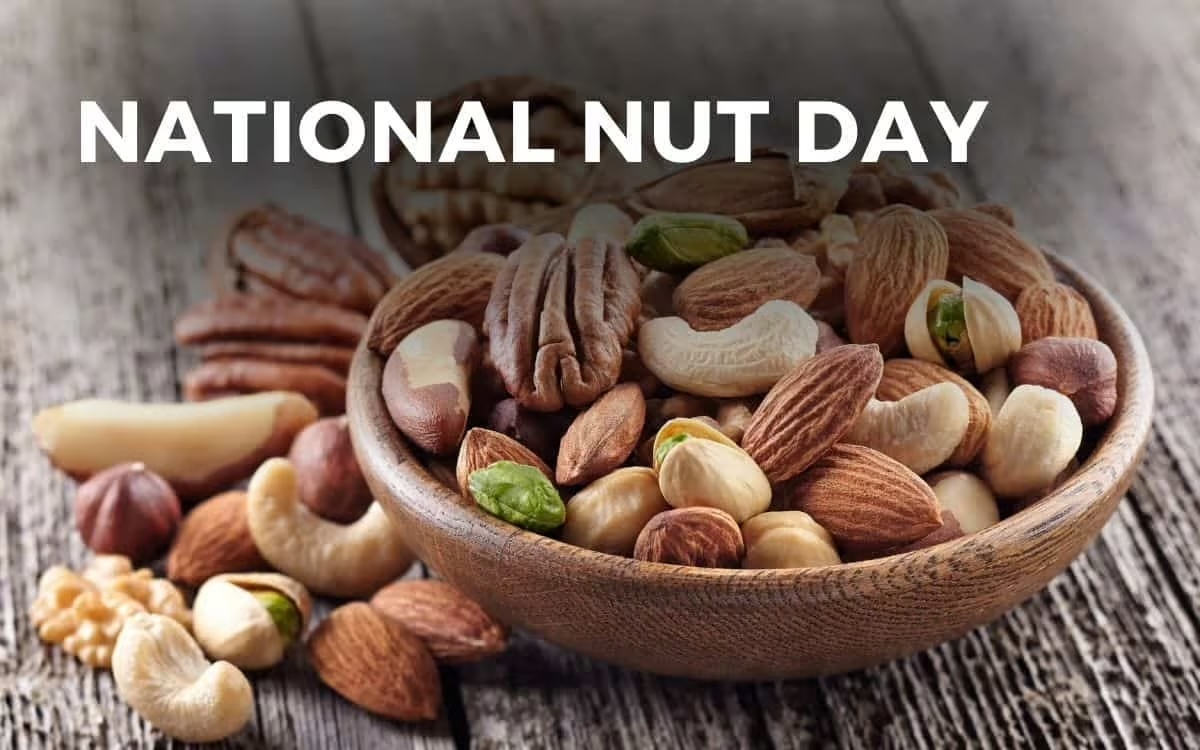
As we stand on the shoulders of giants, we might note that today is National Nut Day.
You must be logged in to post a comment.