Posts Tagged ‘National Gallery’
“A doctor can bury his mistakes, but an architect can only advise his clients to plant vines.”*…

Actually, sometimes architecture is buried– or at least demolished. And occasionally, as in the “refurbishing” of the Sainsbury Wing of London’s National Gallery, that unearths a surprise. Martin Bailey reports…
A “time capsule” has been discovered at London’s National Gallery, buried deep in a column in the foyer of the Sainsbury Wing. It is a letter recording that one of the wing’s funders, John Sainsbury (Lord Sainsbury of Preston Candover), believed the architects had committed a serious “mistake”. The 1990 letter, typed on Sainsbury’s supermarket notepaper, has recently been deposited in the gallery’s archive as an historic document.
John Sainsbury is critical in the letter of the American post-Modernist architect Robert Venturi and his professional partner and wife Denise Scott Brown for inserting two large false columns in the gallery’s foyer that served no structural purpose. Other than the false columns, John Sainsbury was happy with the Venturi and Scott Brown design.
While building work was under way, Sainsbury gained access to the site and dropped his letter into a concrete column that was under construction. The letter, protected in a plastic folder, was discovered last year, when the foyer was being reconfigured.
The Sainsbury letter of 26 July 1990 was addressed “To those who find this note”—who turned out to be the 2023 demolition workers.
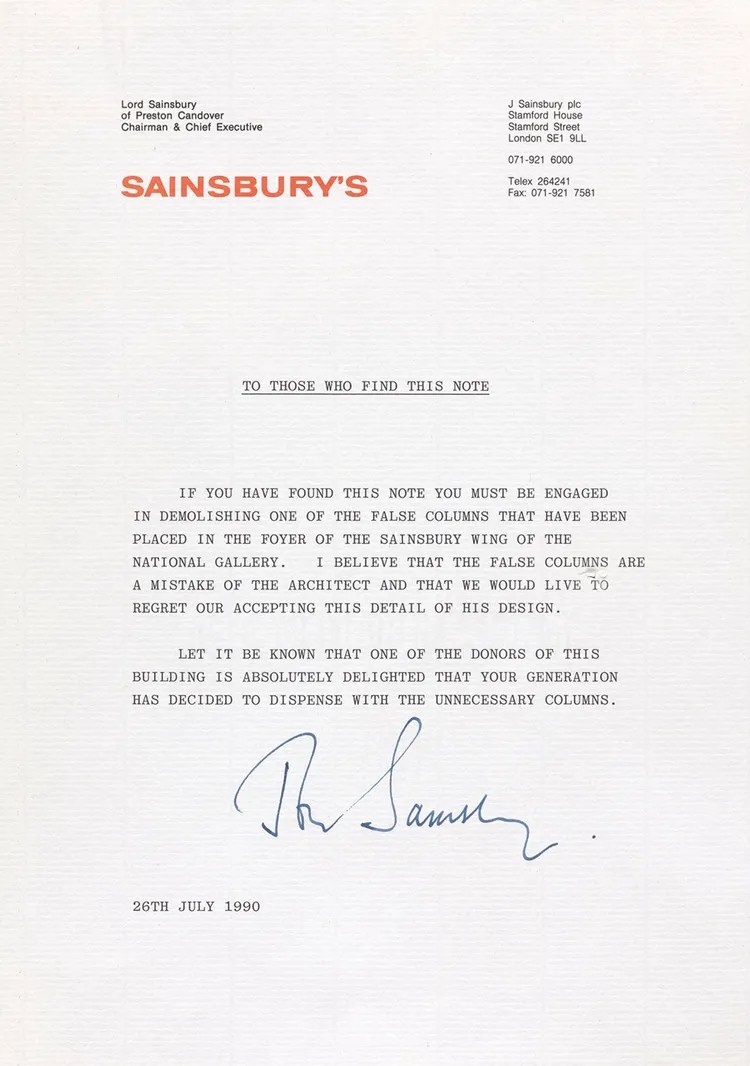
John and his wife Anya presumably never imagined that the demolition of the Sainsbury Wing foyer might take place during their lifetimes. John, one of the most generous UK donors to the arts, died in 2022, aged 94. His widow Anya, a former ballerina, was present when her husband’s note was removed. “I was so happy for John’s letter to be rediscovered after all these years,” she says, “and I feel he would be relieved and delighted for the gallery’s new plans and the extra space they are creating.”…
From the annals of architecture– a dissenting voice from the past: “Sainsbury Wing contractors find 1990 letter from donor anticipating their demolition of false columns,” from @TheArtNewspaper.
But lest we forget that when one critic is assuaged, others are appalled: “Eight Prestigious Architects Blast Annabelle Selldorf’s Proposed $40 Million Redesign of London’s National Gallery, Likening It to an ‘Airport Lounge’,” from @artnet.
(Image above: source)
* Frank Lloyd Wright
###
As we deconstruct design, we might send peaceful birthday greetings to Stephen Geary; he was born on this date in 1797. An architect who designed everything from gin palaces to the (short-lived) monument to King George IV that gave King’s Cross its name, he is best remembered for Highgate Cemetery, opened in 1839, and later to be his resting place, where he designed the Egyptian Avenue and the Terrace Catacombs. He also designed Gravesend, Nunhead, and Brompton Cemeteries, and founded the London Cemetery Company, established by Act of Parliament in 1836, which owned Highgate Cemetery and Nunhead Cemetery.

“The medieval principles led up to Raphael, and the modern principles lead down from him”*…
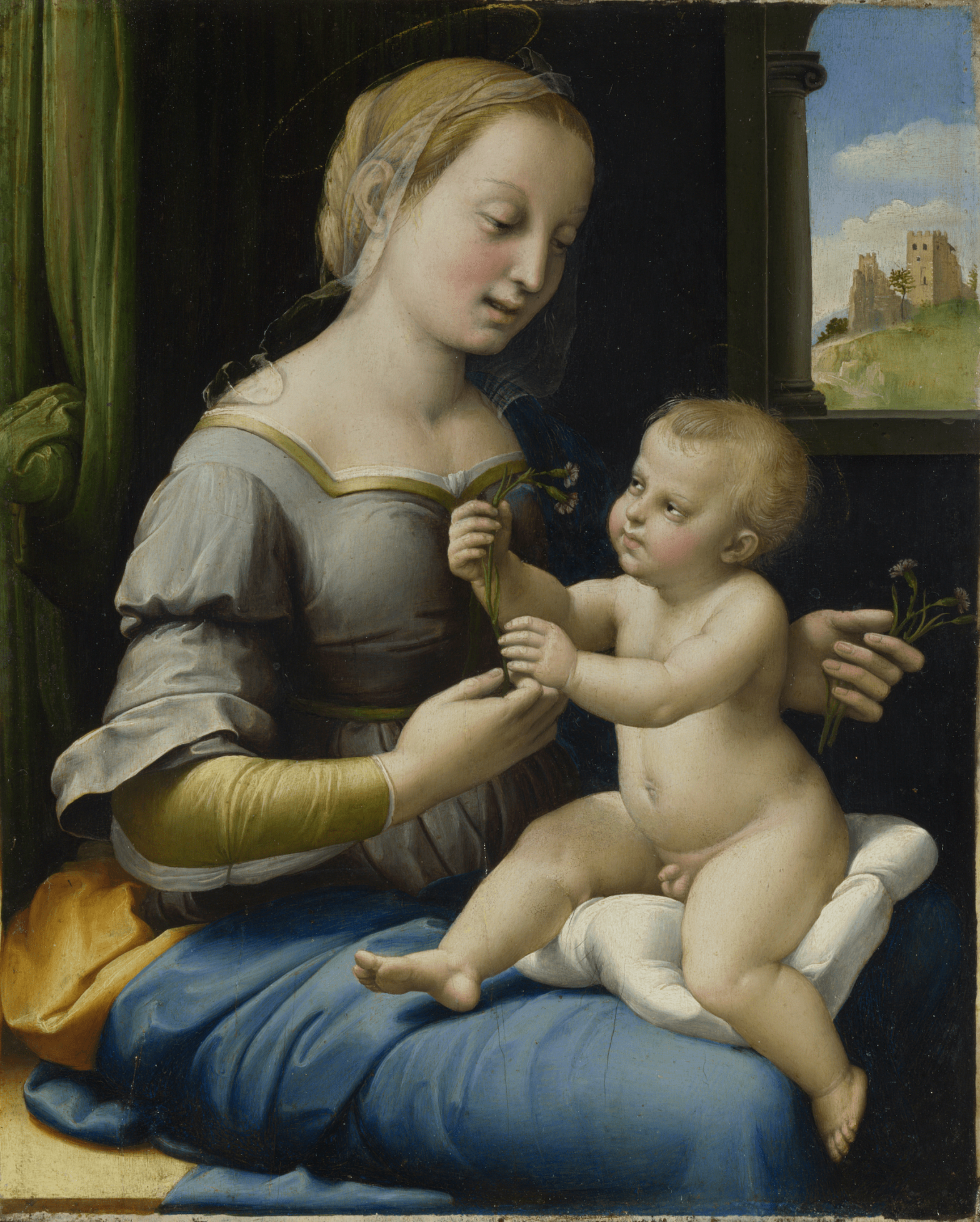
On the occasion of a major National Gallery show in London, Michael Glover on Raphael…
… he was born a mere man, a citizen of Urbino in the Marche, the son of a court painter, who was orphaned very young and raised by an uncle who also happened to be a priest. Perhaps the reverence is due to his talents, which were superabundant, and moved in so many directions at once. He was a painter, printmaker, architect, designer, sculptor, and much else. His industriousness, and the consistent quality of his output, were superhuman. That is undeniable.
Raphael painted relatively few portraits… during his short lifetime, and even fewer in which he could be said to have painted them in order to please himself, because he was always so much in demand by immensely rich and powerful male patrons for the kinds of things that they wanted him to do. They wanted him to beautify public (and private) spaces, all the greater to reflect their own power and importance — beneath the ever-watchful eye of the Christian God, their chief sponsor, in whose revered name they splashed all this cash.
Raphael was the very well remunerated servant of these rich masters, and this was entirely a matter of choice. He was boundlessly ambitious and intimidatingly energetic (he was already running a studio by the age of 17), charming, good-looking (though not to an excessive degree), diplomatic, and utterly opportunistic. Michelangelo loathed him because, though much younger, Raphael seemed to sweep all before him. What a break for the irascible, prickly Michelangelo that his young rival died, quite unexpectedly, of a fever, when he did, leaving him unchallenged for decades!
And Raphael, the name, the work, the style, has resonated and resonated across the centuries…
On the Renaissance painter described by Vasari, his first biographer, as the universal artist: “Raphael Between Heaven and Earth,” in @hyperallergic.
Raphael paints wisdom, Handel sings it, Phidias carves it, Shakespeare writes it, Wren builds it, Columbus sails it, Luther preaches it, Washington arms it, Watt mechanizes it.
Ralph Waldo Emerson
###
As we appreciate art, we might recall that it was on this date in 1890 that Vincent Van Gogh shot himself in the chest with a revolver; he died two days later. A post-impressionist painter, he was not commercially successful in his lifetime and, struggling with severe depression and poverty, committed suicide at the age of 37. But he subsequently became, with Raphael, one of the most famous and influential figures in Western art history.

“I like boring things”*…

EarthCam, The Andy Warhol Museum, and St. John Chrysostom Byzantine Catholic Church present a special Andy Warhol experience: “The Warhol Cams.”
* Andy Warhol
###
As we settle in, we might recall that it was on this date in 1941 that the National Gallery of Art was completed. It was officially “received” the following day by President Franklin Roosevelt from Paul Mellon, the son of Andrew Mellon, whose gift funded the construction and whose collection of Old masters constituted the core of the new museum’s collection. Now materially expanded, it remains open, free, to the public.

“I like good strong words that mean something”*…

From Word Journal, “a journal of interesting and infrequently encountered words.”

Many more wonderful words there, and at its frequent source, the remarkable Ragbag.
* Louisa May Alcott, Little Women
###
As we luxuriate in language, we might recall that it was on this date in 1984 that noted slinger of mots Prince Charles threw a wrench into plans to build an addition onto England’s National Gallery. The museum had held a competition for designs, and tentatively settled on plans drawn by Ahrends, Burton and Koralek (with elements from the high-tech scheme of Richard Rogers). The Prince, on reviewing the drawings, pronounced them a “monstrous carbuncle on the face of a much-loved and elegant friend.” His pronouncement sparked spirited dialogue, both on the proper role of the Royal Family and on the state of modern architecture. Indeed, “monstrous carbuncle” has become a common descriptor for a modern building that clashes with its surroundings.
The ABK plans were withdrawn, and the Gallery went back to the drawing board. In 1991 they opened The Sainsbury Wing, designed by the architects Robert Venturi and Denise Scott Brown.

The Sainsbury Wing, as built, seen from Trafalgar Square
You must be logged in to post a comment.