Posts Tagged ‘Microsoft’
“There are two ways to make money in business: bundling and unbundling”*…

Many ventures seek profit by repackaging existing goods and services as revenue streams they can control, with technology frequently serving as the mechanism. The tech industry’s mythology about itself as a “disruptor” of the status quo revolves around this concept: Inefficient bundles (newspapers, cable TV, shopping malls) are disaggregated by companies that serve consumers better by letting them choose the features they want as stand-alone products, unencumbered of their former baggage. Why pay for a package of thousands of unwatched cable television channels, when you can pay for only the ones you watch? Who wants to subsidize journalism when all you care about is sports scores?
Media has been the most obvious target of digital unbundling because of the internet’s ability to subsume other forms and modularize their content. But almost anything can be understood as a bundle of some kind — a messy entanglement of variously useful functions embedded in a set of objects, places, institutions, and jobs that is rarely optimized for serving a single purpose. And accordingly, we hear promises to unbundle more and more entities. Transportation systems are being unbundled by various ridesharing and other mobility-as-a-service startups, causing driving, parking, navigation, and vehicle maintenance to decouple from their traditional locus in the privately owned automobile. Higher education, which has historically embedded classroom learning in an expensive bundle that often includes residence on campus and extracurricular activities, is undergoing a similar change via tools for remote learning…
Things that have been unbundled rarely remain unbundled for very long. Whether digital or physical, people actually like bundles, because they supply a legible social structure and simplify the complexity presented by a paralyzing array of consumer choices. The Silicon Valley disruption narrative implies that bundles are suboptimal and thus bad, but as it turns out, it is only someone else’s bundles that are bad: The tech industry’s unbundling has actually paved the way for invidious forms of rebundling. The apps and services that replaced the newspaper are now bundled on iPhone home screens or within social media platforms, where they are combined with new things that no consumer asked for: advertising, data mining, and manipulative interfaces. Facebook, for instance, unbundled a variety of long-established social practices from their existing analog context — photo sharing, wishing a friend happy birthday, or inviting someone to a party — and recombined them into its new bundle, accompanied by ad targeting and algorithmic filtering. In such cases, a bundle becomes less a bargain than a form of coercion, locking users into arrangements that are harder to escape than what they replaced. Ironically, digital bundles like Facebook also introduce novel ambiguities and adjacencies in place of those they sought to eliminate, such as anger about the political leanings of distant acquaintances or awareness of social gatherings that happened without you (side effects that are likely to motivate future unbundling efforts in turn)…
In a consideration of one of the most fundamental dynamics afoot in our economy today, and of its consequences, Drew Austin observes that no goods or services are stand-alone: “Bundling and Unbundling.”
* Jim Barksdale (in 1995, when he was the CEO of Netscape)
###
As we contemplate connection, we might recall that it was on this date in 1980 that IBM and Microsoft signed the agreement that made Microsoft the supplier of the operating system for the soon-to-be-released IBM PC. IBM had hoped to do a deal with Digital Research (the creators of CP/M), but DR would not sign an NDA.
On Nov. 6, 1980, the contract that would change the future of computing was signed: IBM would pay Microsoft $430,000 for what would be called MS-DOS. But the key provision in that agreement was the one that allowed Microsoft to license the operating system to other computer manufacturers besides IBM — a nonexclusive arrangement that IBM agreed to in part because it was caught up in decades of antitrust investigations and litigation. IBM’s legal caution, however, would prove to be Microsoft’s business windfall, opening the door for the company to become the dominant tech company of the era.
Hundreds of thousands of IBM computers were sold with MS-DOS, but more than that, Microsoft became the maker of the crucial connection that was needed between the software and hardware used to operate computers. Company revenue skyrocketed from $16 million in 1981 to $140 million in 1985 as other computer-makers like Tandy and Commodore also chose to partner with them.
And as Microsoft’s fortunes rose, IBM’s declined. The company known as Big Blue, which had once been the largest in America, and 3,000 times the size of Microsoft, lost control of the PC platform it had helped build as software became more important than hardware. [source]

Paul Allen and Bill Gates in those early years
“A better world won’t come about simply because we use data; data has its dark underside.”*…

Data isn’t the new oil, it’s the new CO2. It’s a common trope in the data/tech field to say that “data is the new oil”. The basic idea being – it’s a new resource that is being extracted, it is valuable, and is a raw product that fuels other industries. But it also implies that data in inherently valuable in and of itself and that “my data” is valuable, a resource that I really should tap in to.
In reality, we are more impacted by other people’s data (with whom we are grouped) than we are by data about us. As I have written in the MIT Technology Review – “even if you deny consent to ‘your’ data being used, an organisation can use data about other people to make statistical extrapolations that affect you.” We are bound by other people’s consent. Our own consent (or lack thereof) is becoming increasingly irrelevant. We won’t solve the societal problems pervasive data surveillance is causing by rushing through online consent forms. If you see data as CO2, it becomes clearer that its impacts are societal not solely individual. My neighbour’s car emissions, the emissions from a factory on a different continent, impact me more than my own emissions or lack thereof. This isn’t to abdicate individual responsibility or harm. It’s adding a new lens that we too often miss entirely.
We should not endlessly be defending arguments along the lines that “people choose to willingly give up their freedom in exchange for free stuff online”. The argument is flawed for two reasons. First the reason that is usually given – people have no choice but to consent in order to access the service, so consent is manufactured. We are not exercising choice in providing data but rather resigned to the fact that they have no choice in the matter.
The second, less well known but just as powerful, argument is that we are not only bound by other people’s data; we are bound by other people’s consent. In an era of machine learning-driven group profiling, this effectively renders my denial of consent meaningless. Even if I withhold consent, say I refuse to use Facebook or Twitter or Amazon, the fact that everyone around me has joined means there are just as many data points about me to target and surveil. The issue is systemic, it is not one where a lone individual can make a choice and opt out of the system. We perpetuate this myth by talking about data as our own individual “oil”, ready to sell to the highest bidder. In reality I have little control over this supposed resource which acts more like an atmospheric pollutant, impacting me and others in myriads of indirect ways. There are more relations – direct and indirect – between data related to me, data about me, data inferred about me via others than I can possibly imagine, let alone control with the tools we have at our disposal today.
Because of this, we need a social, systemic approach to deal with our data emissions. An environmental approach to data rights as I’ve argued previously. But first let’s all admit that the line of inquiry defending pervasive surveillance in the name of “individual freedom” and individual consent gets us nowhere closer to understanding the threats we are facing.
Martin Tisné argues for an “environmental” approach to data rights: “Data isn’t the new oil, it’s the new CO2.”
Lest one think that we couldn’t/shouldn’t have seen this (and related issues like over dependence on algorithms, the digital divide, et al.) coming, see also Paul Baran‘s prescient 1968 essay, “On the Future Computer Era,” one of the last pieces he did at RAND, before co-leading the spin-off of The Institute for the Future.
* Ethics and Data Science
###
As we ponder privacy, we might recall that it was on this date in 1981 that IBM released IBM model number 5150– AKA the IBM PC– the original version and progenitor of the IBM PC compatible hardware platform. Since the machine was based on open architecture, within a short time of its introduction, third-party suppliers of peripheral devices, expansion cards, and software proliferated; the influence of the IBM PC on the personal computer market was substantial in standardizing a platform for personal computers (and creating a market for Microsoft’s operating system– first PC DOS, then Windows– on which the PC platform ran). “IBM compatible” became an important criterion for sales growth; after the 1980s, only the Apple Macintosh family kept a significant share of the microcomputer market without compatibility with the IBM personal computer.

“Chance favors the connected mind”*…

The Wall Street Journal‘s review of the web in late 1996– completely intact, with links still live…
Stroll down memory lane here.
[TotH to Benedict Evans]
See also “We haven’t learned anything about what the web is for since 1996.”
* Steven Johnson, Where Good Ideas Come From: The Natural History of Innovation
###
As we try to remember, we might send well-connected birthday greetings to Bob Wallace; he was born on this date in 1949. A software developer, programmer and the ninth employee of Microsoft, He was the first popular user of the term “shareware,” creator of the word processing program PC-Write, founder of the software company Quicksoft, and an “online drug guru” who devoted much time and money to the research of psychedelic drugs.
Bob ended his Usenet posts with the phrase, “Bob Wallace (just my opinion).”

“It is not enough for code to work”*…
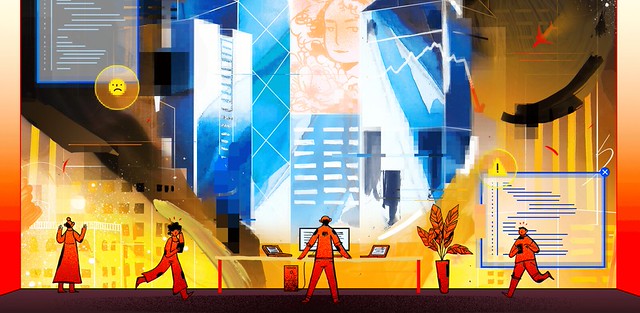
It’s been said that software is “eating the world.” More and more, critical systems that were once controlled mechanically, or by people, are coming to depend on code. This was perhaps never clearer than in the summer of 2015, when on a single day, United Airlines grounded its fleet because of a problem with its departure-management system; trading was suspended on the New York Stock Exchange after an upgrade; the front page of The Wall Street Journal’s website crashed; and Seattle’s 911 system went down again, this time because a different router failed. The simultaneous failure of so many software systems smelled at first of a coordinated cyberattack. Almost more frightening was the realization, late in the day, that it was just a coincidence…
Our standard framework for thinking about engineering failures—reflected, for instance, in regulations for medical devices—was developed shortly after World War II, before the advent of software, for electromechanical systems. The idea was that you make something reliable by making its parts reliable (say, you build your engine to withstand 40,000 takeoff-and-landing cycles) and by planning for the breakdown of those parts (you have two engines). But software doesn’t break… Software failures are failures of understanding, and of imagination…
Invisible– but all too real and painful– problems, and the attempts to make them visible: “The Coming Software Apocalypse.”
* Robert C. Martin, Clean Code: A Handbook of Agile Software Craftsmanship
###
As we Code for America, we might recall that it was on this date in 1983 that Microsoft released its first software application, Microsoft Word 1.0. For use with MS-DOS compatible systems, Word was the first word processing software to make extensive use of a computer mouse. (Not coincidentally, Microsoft had released a computer mouse for IBM-compatible PCs earlier in the year.) A free demo version of Word was included with the current edition of PC World— the first time a floppy disk was included with a magazine.

“In any field, it is easy to see who the pioneers are — they are the ones lying face down with arrows in their backs”*…

The story of Vector Graphic, a personal computer company that outran Apple in their early days: “How Two Bored 1970s Housewives Helped Create the PC Industry.”
* Anonymous
###
As we try to remember what “CP/M” stood for, we might recall that it was on this date in 1991 (on the anniversary of the issuing of IBM’s first patent in 1911) that Microsoft Corp. for the first time reported revenues of more than $1 billion for its fiscal year (1990), the first software company ever to achieve that scale. While in this age of ‘unicorns,” a billion dollars in revenue seems a quaint marker, that was real money at the time.
As readers who followed the link above will know, Microsoft, founded in 1975, was an early purveyor of the CP/M operating system on which the Vector ran; but (unlike Vector) Gates and Allen embraced IBM’s new architecture, creating DOS (for younger readers: the forerunner of Windows)… and laying the foundation for Microsoft’s extraordinary growth.

Bill Gates in 1990
You must be logged in to post a comment.