Posts Tagged ‘Martin Luther King Jr. Day’
“Gotta have opposites, light and dark and dark and light, in painting. It’s like in life. Gotta have a little sadness once in awhile so you know when the good times come.”…

Bob Ross’ The Joy of Painting ran on PBS (and the CBC) from 1983 to 1994. Reruns continue around the world, including the non-commercial digital subchannel network Create and the streaming service Hulu. As part of its launch of Twitch Creative, Twitch streamed every episode over a nine-day period starting on October 29, 2015 – what would have been Ross’s 73rd birthday– and scored 5.6 million viewers. So they created a weekly rebroadcast of all 31 seasons of The Joy of Painting to air, with episodes in order, on Twitch each Monday from November 2015 onward, and a marathon of episodes each October 29. In the United Kingdom, the BBC re-ran episodes during the COVID-19 pandemic while most viewers were in lockdown at home.
Ross is estimated to have pained 30,000 canvases during his lifetime. But as those paintings are scarce on the art market, sale prices of the paintings average in the thousands of dollars and frequently topping $10,000. Lately, they’ve done even better– and for an important cause.
Starting last November, auction house Bonhams has been offering what will be a total of 30 Ross oils to benefit the public broadcasting system that made him famous…
Bonhams has revealed the next works by the beloved US television painter Bob Ross it will offer for sale, with auction proceeds going toward public television following devastating funding cuts by president Donald Trump’s administration. More than $1bn in federal funding previously allocated to support public broadcasters was slashed by the Republican-controlled congress last year.
Last year, Bonhams announced it would sell 30 Ross paintings donated by Bob Ross Inc to benefit public television. The first three paintings from the group went up for sale in November and fetched a combined total of $662,000 with fees. Ross’s painting Winter’s Peace (1993) sold for $318,000 with fees, setting an auction record for the artist. Just weeks later, that record was shattered again when his painting Cabin at Sunset (1987) sold for more than $1m in an online charity auction for the Public Media Bridge Fund initiative [see here], organised by the television host John Oliver. [One more reason to love John Oliver.]
Three more Ross paintings will be part of the “Americana: Crafting a Nation: Art, History & Legacy” auction on 27 January at Bonhams in Massachusetts, and could fetch as much as $155,000 collectively, according to the auction house’s estimates.
Valley View (1990) is estimated to sell for between $30,000 and $50,000, and was the first work completed for the 21st volume of Ross’s Joy of Painting instructional book. Change of Seasons (1990) comes with an estimate of $40,000 to $60,000, and was completed live on air in 1990, on the 11th episode of the 20th season of his The Joy of Painting television series. In that episode, Ross describes the scene as “just a beautiful little painting”.
Babbling Brook (1993), a unique oval-shaped painting, is estimated to fetch between $25,000 and $45,000. It was completed during filming for the first episode of the 30th season of The Joy of Painting. Ross often let the subject in his landscapes develop as he went along, encouraging viewers to add spontaneous details as they saw fit. While painting Babbling Brook, Ross said, “I see something!” and painted in a waterfall, adding: “Let your imagination take you to any world that you want to go to.”
An additional 24 Ross works will be sold throughout this year across Bonhams salesrooms in New York, Boston and Los Angeles, the auction house says…

Giving back: “More Bob Ross paintings head to auction to benefit US public television” from @theartnewspaper.bsky.social.
* Bob Ross
###
As we “don’t make mistakes, just happy little accidents,” we might note that Ross’ rough contemporary and fellow “popular” painter, Thomas Kinkade was born on this date in 1958. While Ross was concerned with communicating the joy of creating and was opposed to his paintings becoming “financial instruments,” Kinkade was focused on capitalizing on his creations.
Kinkade, who described himself as a “master of light” (putting himself in the company of Rembrandt and Caravaggio), achieved success during his lifetime via the mass marketing of his work as printed reproductions and other licensed products through the Thomas Kinkade Company (according to which, at one point one in every 20 American homes owned a copy of one of his paintings).
Ross died in 1995 of complications from lymphoma (which he’d had for several years). KInkade died in 2012 of acute intoxication from alcohol and diazepam.


“Darkness cannot drive out darkness: only light can do that. Hate cannot drive out hate: only love can do that”
Happy Martin Luther King Jr. (MLK) Day
“The details are not the details. They make the design.”*…
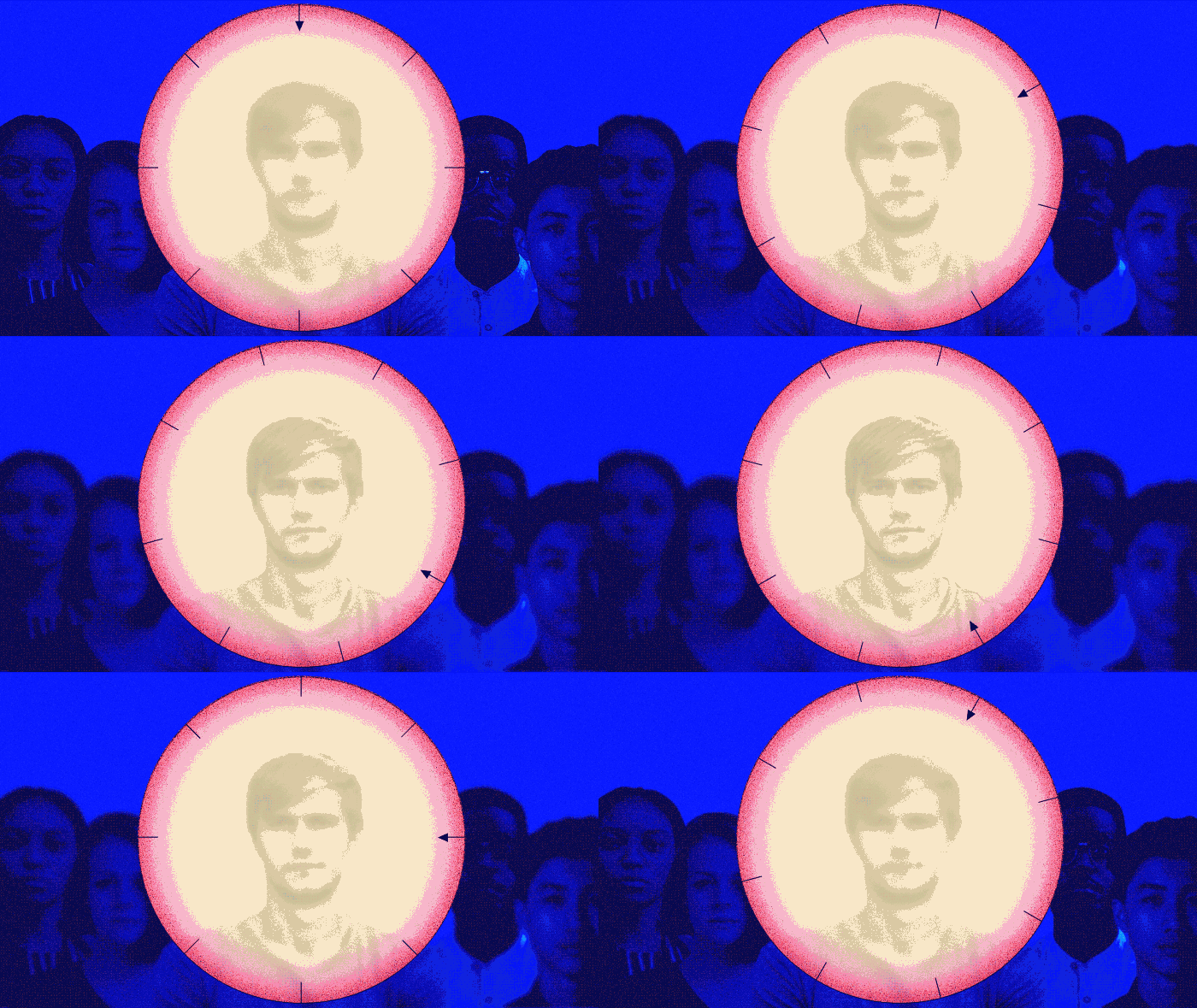
It’s 2020 and our systems are failing us. We are increasingly reliant on technology that automates bias. We are celebrating “essential workers” while they are underpaid and their work is precarious. We are protesting in the streets because of policing systems that put black and brown people at risk every day. We use apps for travel, shopping, and transportation that productize exploitative labor practices. The list goes on and on.
How did we get here? These systems didn’t just emerge of their own accord. They were crafted by people who made hundreds of decisions, big and small, that led to the outcomes we see now. In other words, these systems and all of their component parts were designed. And for the most part, they were designed with processes intended to create positive user experiences. So what went wrong? Might the way we approach design be contributing to the problems we now experience?
It’s unlikely that the techniques that got us into this situation will be the ones to get us out of it. In this essay, we’re going to take a deeper look at dominant design practices — specifically user-centered design — to identify where our frameworks might be failing us and how we can expand our design practices to close those gaps.
Any framework is a lens through which you see things. A lens allows you to see some things quite well, but almost always at the expense of obscuring others. Prior to the development of user-centered design, technological experiences were primarily designed through the lens of business needs. The needs of the user were only considered insofar as they furthered or hindered those goals, but it was the bottom line that was firmly the focal point of that approach.
User-centered design (UCD) was developed in reaction to those blind spots. It advocated for a design practice that instead focused on the person using the technology, and was intended to create experiences based on an understanding of their needs and goals. As designers, we’ve spent much of the last 25 years convincing our peers of the virtues of putting user needs at the center of our design process.
This practice has produced some amazing products, services and technical innovations. And for designers who entered the industry in the past decade or so, UCD has become a default mindset and approach. By empathizing with users and designing with their needs and wants in-mind, we have strived to create products that are more helpful, more intuitive, and less stressful. Certainly many of the digital tools & platforms we use today would not have been possible without the contributions of designers and the user-centered approach.
However, like any lens, UCD also has its own blind spots, and those have played a role in leading us to our current state…
As the world grows increasingly complex, the limitations of user-centered design are becoming painfully obvious. Alexis Lloyd (@alexislloyd) on what’s gone wrong and how we can fix it: “Camera Obscura: Beyond the lens of user-centered design.“
[Via Patrick Tanguay‘s ever-illuminating Sentiers]
For an amusingly– and amazingly– apposite example of inclusively-empathetic design, see “‘If the aliens lay eggs, how does that affect architecture?’: sci-fi writers on how they build their worlds.”
* Charles Eames
###
As we ideate inclusively, we might recall that on this date in 1993 (following President George H.W. Bush’s executive order in 1992) Martin Luther King Jr. Day was officially proclaimed a holiday the first time in all 50 states. Bush’s order was not fully implemented until 2000, when Utah, the last state fully to recognize the holiday, formally observed it. (Utah had previously celebrated the holiday at the same time but under the name Human Rights Day.)

“For every complex problem there is an answer that is clear, simple, and wrong”*…

What is a sentence? But that is such a formal question. How about, what is a sentence for? Less formal, perhaps, but obviously impossible to answer, for sheer variety. There may be some human purposes that don’t find their way into sentences, but writers keep trying, and for any limit we experience there may be a sentence in waiting and a writer to try it…
I’ll propose one purpose that all sentences have in common. The purpose of a sentence is to end. If this is a property of all sentences, any ought to do for an example, but here is one particularly determined to be done with itself:
1 The world is everything that is the case.
It comes from Wittgenstein’s Tractatus Logico-Philosophicus, as translated from German into English by C. K. Ogden in 1922…
From the first of the Paris Review’s eight-part series, Life Sentence, the literary critic, scholar, and poet Jeff Dolven takes apart and puts back together one beloved or bedeviling sentence every week. Tom Toro illustrates each sentence Dolven chooses.
[TotH to John Stedman]
* H.L. Mencken
###
As we pause to parse prose, we might recall that it was on this date in 1983 that the celebration of the crafter of so very many elegant sentences, Martin Luther King, was made official, when President Ronald Reagan signed the bill creating the Martin Luther King Jr. Day federal holiday. Reagan had opposed the holiday, citing its cost, joining southern Republicans like Jesse Helms, who were more naked in their reasoning; but the enabling legislation had passed by a veto-proof margin.

You must be logged in to post a comment.