Posts Tagged ‘literature’
“Time will bring to light whatever is hidden”*…
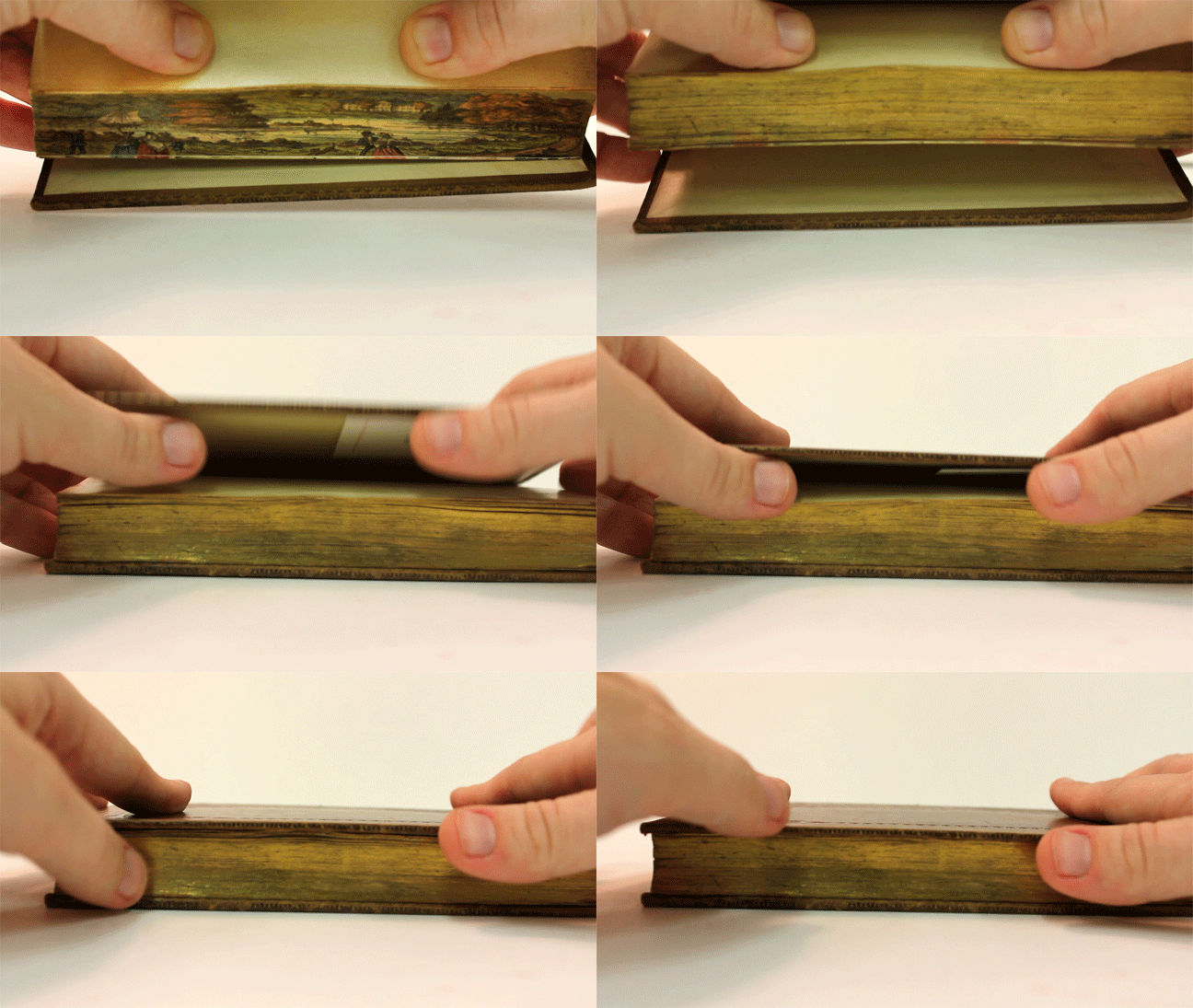

A fore-edge painting is an image on the edges of the pages of a book. The work can only be seen when the pages are fanned (as illustrated in the GIF above and the videos below). When the book is closed, the image is obscured by the gilding– the gold leaf applied to the edges of the page.
email readers click here for video

Fore-edge paintings first arose during the European Middle Ages but came to prominence during the mid-17th century to the late 19th century. Anne C. Bromer for the Boston Public Library [which holds one of the finest collections of fore-edge paintings in the U.S.] writes, “Most fore-edge painters working for binding firms did not sign their work, which explains why it is difficult to pinpoint and date the hidden paintings.”
email readers click here for video

See and read more at “40 Hidden Artworks Painted on the Edges of Books.” See also here, here, and here.
* Horace
###
As we hunt for Easter eggs, we might spare an ecumenical thought for Ramon Llull; he died on this date in 1315 [source]. A philosopher, logician, poet, and theologian who was heavily influenced by Islam, he is credited with the first major work of Catalan literature (the romantic novel Blanquerna), with having anticipated by several centuries prominent work on elections theory, and with pioneering work on computation theory (largely given his influence on Leibniz).
One of the earliest Encyclopedists, he gave up the life of a courtier (to King James of Aragon) first to become a hermit, then a Franciscan. After a 1297 meeting with Duns Scotus, he was given the nickname Doctor Illuminatus.

“A children’s story that can only be enjoyed by children is not a good children’s story in the slightest”*…

In the mid 17th-century John Comenius published what many consider to be the first picture book dedicated to the education of young children, Orbis Sensualium Pictus – or The World of Things Obvious to the Senses drawn in Pictures, as it was rendered in English…

Originally published in 1658 in Latin and German, the Orbis — with its 150 pictures showing everyday activities like brewing beer, tending gardens, and slaughtering animals — is immediately familiar as an ancestor of today’s children’s literature. This approach centered on the visual was a breakthrough in education for the young, as was the decision to teach the vernacular in addition to Latin. Unlike treatises on education and grammatical handbooks, it is aimed directly at the young and attempts to engage on their level.
The Orbis was hugely popular. At one point it was the most used textbook in Europe for elementary education, and according to one account it was translated into “most European and some of the Oriental languages.” Its author John Comenius, a Czech by birth, was also well-known throughout Europe and worked in several countries as a school reformer. His portrait was painted by Rembrandt, and according to an 1887 edition of the Orbis, Comenius was even “once solicited to become President of Harvard College.” (Although he never came to Harvard, one can still find his name engraved on the western frieze of Teachers College at Columbia University.) Even if he is less celebrated today by name, his innovative ideas about education are still influential. In his Didactica Magna, for example, he advocates for equal educational opportunities for all: boys and girls, rich and poor, urban and rural…

Read more in Charles McNamara’s “In the Image of God: John Comenius and the First Children’s Picture Book.”
* C.S. Lewis
###
As we see Spot run, we might recall that this the date commonly given for the day that the Pied Piper (Rattenfänger) led the children of Hamelin, Germany, into a mountain cave.
A German version of the tale has survived in a 1602/1603 inscription found in Hamelin in the Rattenfängerhaus (Pied Piper’s, or Ratcatcher’s house):
Anno 1284 am dage Johannis et Pauli
war der 26. junii
Dorch einen piper mit allerlei farve bekledet
gewesen CXXX kinder verledet binnen Hamelen gebo[re]n
to calvarie bi den koppen verloren
which has been translated into English as:
In the year of 1284, on John’s and Paul’s day
was the 26th of June
By a piper, dressed in all kinds of colours,
130 children born in Hamelin were seduced
and lost at the place of execution near the Koppen.

“Ah, to think how thin the veil that lies Between the pain of Hell and Paradise”*…
 click here for enlargeable and navigable version
From the remarkable Russian periodical, INFOGRAFIKA (see also here), a handy map of Hell. per the title of this post, one just never knows when it might come in handy…
* George William Russell (AE)
###
As we bird-dog Beatrice, we might send sardonic birthday greetings to Ambrose Gwinnett Bierce; he was born on this date in 1842. A journalist, editor, short story writer, fabulist, and satirist, Bierce is probably best remembered for his short-story “An Occurrence at Owl Creek Bridge” (which Kurt Vonnegut considered the greatest American short story, a “work of flawless genius”) and, pace Dante, for his scathingly satirical lexicon The Devil’s Dictionary…
- Advice, n. The smallest current coin…
- Boundary, n. In political geography, an imaginary line between two nations, separating the imaginary rights of one from the imaginary rights of the other…
- Year, n. A period of three hundred and sixty-five disappointments…

“Words, words, mere words”*…
Email readers click here for video
Welcome to Star Wars as you’ve never seen it before. Arst Arsw takes every English word from George Lucas’ classic movie and rearranges them alphabetically. If you can make it past the 201 “a”s that start the video, you’re in for a treat, as long sequences of words are punctuated up by oddly therapeutic and memorable words from the movie. The eighth “battlestation” is especially rewarding.
The video’s maker, Tom 7, provided some interesting facts garnered while cutting Arst Arsw manually. A total of 1695 individual English words are uttered in Star Wars, the most common of which is “the,” with 368 mentions. The word “Lightsaber” is only said aloud once (at 19:20 in Arst Arsw).
“Watch every word from ‘Star Wars’ sorted from A to Z.”
Special lingui-bonus:

Click here for background (and larger version of chart): “Graphing the distribution of English letters towards the beginning, middle or end of words”:
*William Shakespeare, Troilus and Cressida, Act V, Scene 3
###
As we hope that the Force is with us, we might recall that it was on this date in 1914 that Wyndham Lewis published the first issue of Blast, a literary magazine championing Vorticism, a movement related to Futurism and Cubism in painting and to Imagism in literature, chiefly concerned to extoll the virtues of mechanization and the machine. The inaugural number was edited and largely written by Lewis with contributions from Ezra Pound, Henri Gaudier-Brzeska, Jacob Epstein, Spencer Gore, Edward Wadsworth, and Rebecca West, and included an extract from Ford Madox Hueffer’s novel The Saddest Story– better known by its later title The Good Soldier (published under his subsequent pseudonym, Ford Madox Ford). The second issue, which was publish a month later, had more work from Pound and two poems by T.S. Eliot. But at about the same time that issue came out, Britain entered World War I. Several of the Vorticists were called up; and machines– deployed all too lethally in the conflict– lost some of their romance. The Vorticist movement did not survive the war.; still, it is remembered as a seminal step in the evolution of 20th century Modernism.

The cover of Blast #1
“Do not let your adorning be external”*…

In 2011, textile conservators discovered fragments of medieval manuscripts lining the hems of dresses at the Cistercian convent of Wienhausen in Northern Germany. The dresses in question, made by nuns in the late fifteenth century, clothed the convent’s statues.
The medieval dresses were made of patches of different cloth such as linen, velvet and silk, some in the form of lampas, a luxurious material, and sported rabbit fur trim. To achieve drapery-like folds in the fur, the nuns stiffened the hems by lining them with strips of parchment gathered in folds by means of a thread. The parchment… was not brought into the Convent for the purpose of lining. In fact, the manuscript fragments that have been discovered are recycled materials that include liturgical manuscripts and legal texts. Book recycling was common in the late fifteenth century, as evidenced by a manuscript from the Bodleian’s own collection (below). Because this was a period of religious reform, liturgical texts became outdated particularly quickly, accounting for their use as dress lining…

Bodleian Library, MS. Lat. liturg. e. 18
Read more at the Bodleian Library’s Conveyor, in Nora Wilkinson’s “Texts and Textiles: Finding Manuscripts in Unusual Places.”
* 1 Peter 3:3
###
As we wear it well, we might recall that it was on this date in 1374 that Geoffrey Chaucer received an annual pension of 10 pounds from John of Gaunt. Chaucer was fresh back from a military expedition to Italy, during which he is believed to have met Petrarch and/or Boccacio, and to have encountered the forms of medieval Italian poetry which he would use in later work like The Canterbury Tales. Earlier in the year Gaunt’s brother, King Edward III, granted Chaucer “a gallon of wine daily for the rest of his life” for an unspecified task– an unusual grant, but given on a day of celebration, St George’s Day (April 23rd), when artistic endeavors were traditionally honored, it is assumed to have been for an early poetic work. It is not known which, if any, of Chaucer’s extant works prompted the reward, but the suggestion of him as poet to a king places him as a precursor to later poets laureate.

Chaucer in an initial from Lansdowne MS 851 fol. 2. British Library
You must be logged in to post a comment.