Posts Tagged ‘Libraries’
“It is what you read when you don’t have to that determines what you will be when you can’t help it”*…
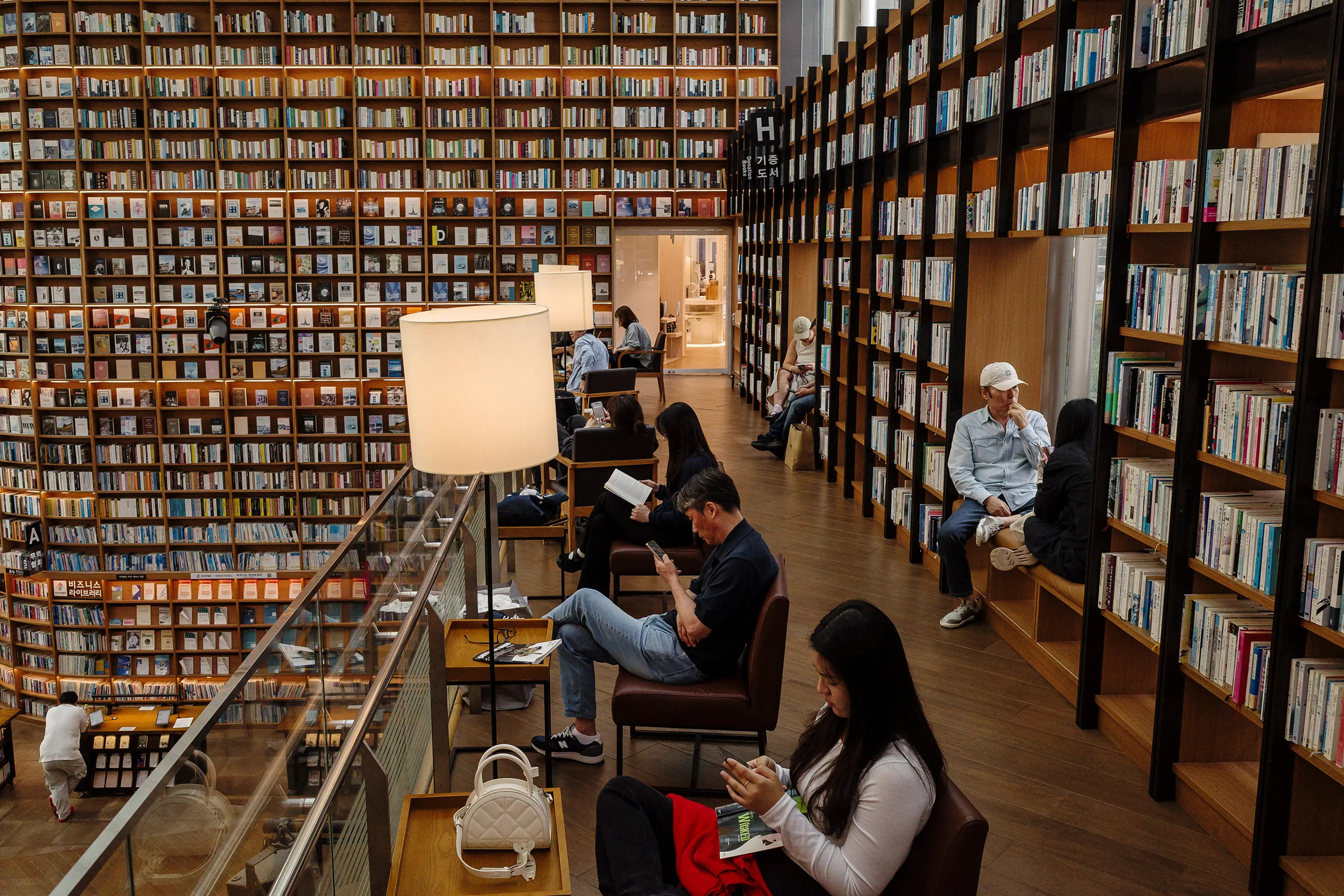
… What we read– and, librarian Carlo Iacono argues, how we read.
Our inabilty to focus isn’t a failing. It’s a design problem, and the answer isn’t getting rid of our screen time…
Everyone is panicking about the death of reading. The statistics look damning: the share of Americans who read for pleasure on an average day has fallen by more than 40 per cent over the past 20 years, according to research published in iScience this year. The OECD calls the 2022 decline in educational outcomes ‘unprecedented’ across developed nations. In the OECD’s latest adult-skills survey, Denmark and Finland were the only participating countries where average literacy proficiency improved over the past decade. Your nephew speaks in TikTok references. Democracy itself apparently hangs by the thread of our collective attention span.
This narrative has a seductive simplicity. Screens are destroying civilisation. Children can no longer think. We are witnessing the twilight of the literate mind. A recent Substack essay by James Marriott proclaimed the arrival of a ‘post-literate society’ and invited us to accept this as a fait accompli. (Marriott does also write for The Times.) The diagnosis is familiar: technology has fundamentally degraded our capacity for sustained thought, and there’s nothing to be done except write elegiac essays from a comfortable distance.
I spend my working life in a university library, watching how people actually engage with information. What I observe doesn’t match this narrative. Not because the problems aren’t real, but because the diagnosis is wrong.
The declinist position rests on a category error: treating ‘screen culture’ as a unified phenomenon with inherent cognitive properties. As if the same device that delivers algorithmically curated rage-bait and also the complete works of Shakespeare is itself the problem rather than how we decide to use it…
[… observing that “people who ‘can’t focus’ on traditional texts can maintain extraordinary concentration when working across modes, he argues that “we haven’t become post-literate. We’ve become post-monomodal. Text hasn’t disappeared; it’s been joined by a symphony of other channels.”…]
… What troubles me most about the declinist position is not its diagnosis but its conclusion. The commentators who lament the post-literate society often identify the same villains I do. They recognise that technology companies are, in Marriott’s words, ‘actively working to destroy human enlightenment’, that tech oligarchs ‘have just as much of a stake in the ignorance of the population as the most reactionary feudal autocrat.’
And then they surrender. As Marriott says: ‘Nothing will ever be the same again. Welcome to the post-literate society.’
This is the move I cannot follow. To name the actors responsible and then treat the outcome as inevitable is to provide them cover. If the crisis is a force of nature, ‘screens’ destroying civilisation like some technological weather system, then there’s nothing to be done but write elegiac essays from a comfortable distance. But if the crisis is the product of specific design choices made by specific companies for specific economic reasons, then those choices can be challenged, regulated, reversed.
The fatalism, however beautifully expressed, serves the very interests it condemns. The technology companies would very much like us to believe that what they’re doing to human attention is simply the inevitable result of technological progress rather than something they’re doing to us, something that could, with sufficient political will, be stopped.
Your inability to focus isn’t a moral failing. It’s a design problem. You’re trying to think in environments built to prevent thinking. You’re trying to sustain attention in spaces engineered to shatter it. You’re fighting algorithms explicitly optimised to keep you scrolling, not learning.
The solution isn’t discipline. It’s architecture. Build different defaults. Create different spaces. Establish different rhythms. Make depth as easy as distraction currently is. Make thinking feel as natural as scrolling currently does.
What if, instead of mourning some imaginary golden age of pure text, we got serious about designing for depth across all modes? Every video could come with a searchable transcript. Every article could offer multiple entry points for different levels of attention. Our devices could recognise when we’re trying to think and protect that thinking. Schools could teach students to translate between modes the way they once taught translation between languages.
Books aren’t going anywhere. They remain unmatched for certain kinds of sustained, complex thinking. But they’re no longer the only game in town for serious ideas. A well-crafted video essay can carry philosophical weight. A podcast can enable the kind of long-form thinking we associate with written essays. An interactive visualisation can reveal patterns that pages of description struggle to achieve.
The future belongs to people who can dance between all modes without losing their balance. Someone who can read deeply when depth is needed, skim efficiently when efficiency matters, listen actively during a commute, and watch critically when images carry the argument. This isn’t about consuming more. It’s about choosing consciously.
We stand at an inflection point. We can drift into a world where sustained thought becomes a luxury good, where only the privileged have access to the conditions that enable deep thinking. Or we can build something unprecedented: a culture that preserves the best of print’s cognitive gifts while embracing the possibilities of a world where ideas travel through light, sound and interaction.
The choice isn’t between books and screens. The choice is between intentional design and profitable chaos. Between habitats that cultivate human potential and platforms that extract human attention.
The civilisations that thrive won’t be the ones that retreat into text or surrender to the feed. They’ll be the ones that understand a simple truth: every idea has a natural form, and wisdom lies in matching the mode to the meaning. Some ideas want to be written. Others need to be seen. Still others must be heard, felt or experienced. The mistake is forcing all ideas through a single channel, whether that channel is a book or a screen.
Your great-grandchildren won’t read less than you do. They’ll read differently, as part of a richer symphony of sense-making. Whether that symphony sounds like music or noise depends entirely on the choices we make right now about the shape of our tools, the structure of our schools, and the design of our days.
The elegant lamenters offer a eulogy. I’m more interested in a fight…
Reunderstanding reading: “Books and screens,” from @carloiacono.bsky.social in @aeon.co.
* Oscar Wilde
###
As we turn the page, we might note that we’ve been here before, and celebrate the emergence of a design, an innovation, a technology that took on a life of its own and changed reading and… well, everything: this day in 1455 is the traditionally-given date of the publication of the Gutenberg Bible, the first Western book printed from movable type.
(Lest we think that there’s actually anything new under the sun, we might recall that The Jikji— the world’s oldest known extant movable metal type printed book– was published in Korea in 1377; and that Bi Sheng created the first known moveable type– out of wood– in China in 1040.)

“Frederick Douglass taught that literacy is the path from slavery to freedom. There are many kinds of slavery and many kinds of freedom, but reading is still the path”*…
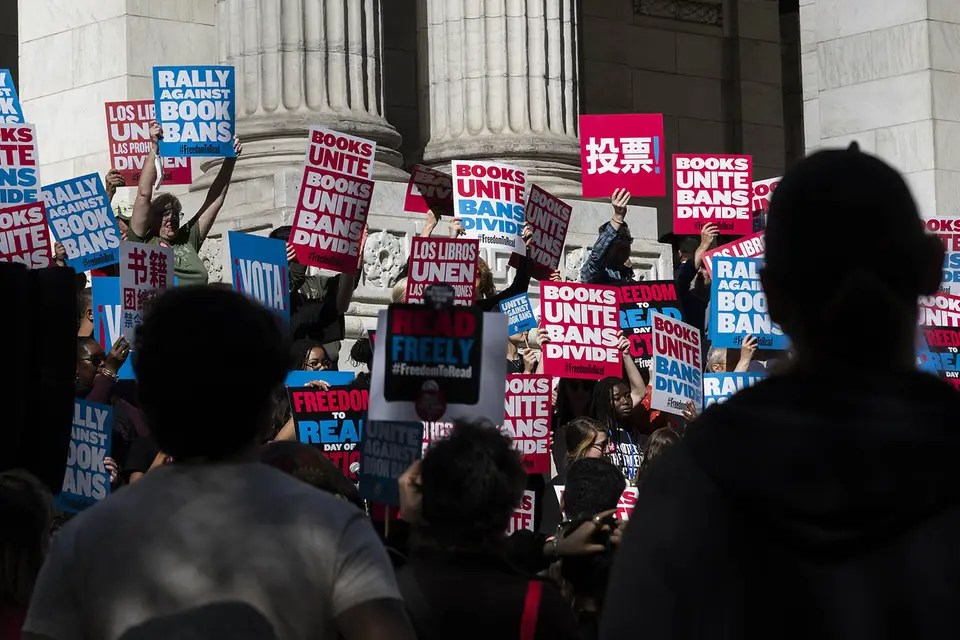
The attack on libraries, in the U.S. and beyond, has been a recurring theme here– precisely because it is so threatening. The estimable Richard Ovenden considers the titles banned, the data deleted, the nation’s librarians sacked without explanation, and explains that Donald Trump’s war on books is a threat to democracy across the world…
I am a librarian. I am fortunate enough to run one of the world’s largest and best known libraries – the Bodleian in Oxford – but my experience of libraries began as a reader. My mother took me as a child to the Deal public library in Kent, and it was there, in its modest book-filled rooms, that I discovered new worlds. My life was transformed by a public library (and its librarians) that allowed me to read freely from its well-stocked shelves. Throughout my career, I have seen at first-hand how libraries underpin the education and self-improvement of all of our citizens, rich and poor, young and old, of all creeds and colours, through providing access to a multitude of ideas and knowledge.
They celebrate the history and identity of our communities; they are stout defenders of facts and truth in an age of misinformation; and they are places where people can learn about their rights and how to protect them. This year we celebrate the 175th anniversary of the Public Libraries Act of 1850, which created our system of free public libraries – a kind of “NHS for the mind”. But what has been happening to American libraries rings a loud alarm bell for our own cherished library system.
Libraries large and small in the US are now on the frontline of the battles over knowledge that have intensified since the second presidency of Donald Trump began. The attack on libraries and librarians there is shocking and happening at a disorienting pace. Thousands of books have been banned from public and school libraries, librarians have received death threats and many have been fired. The heads of both the National Archives and the Library of Congress have been sacked on spurious grounds. Data has been deleted and funding for critical initiatives ceased.
Why is the US, the land of the free, where the realm of ideas and knowledge has been enabled by the first amendment, now turning on institutions that have been among the most trusted in society?
The first dispatches from the war on libraries began to reach me in 2022. I had recently published Burning the Books, which highlighted the role of libraries in society through a long history of attacks on the written word. Librarians began to send me messages and tagged me on social media, sharing news of assaults on public and school libraries in Florida and Texas. As one librarian put it, my book was fast beginning to look as if it would need updating. A pattern was forming: an epidemic of book banning, driven by groups from the far right of the political spectrum, empowered through social media, and funded, it seemed, by larger and darker organisations.
Throughout Joe Biden’s presidency, a coalition of extremist groups, with interests ranging from Christian nationalism to white supremacy, and anti-gay protesters were able to mobilise around common themes such as opposing sex education, LGBTQ+ issues and race equality. They began a concerted campaign to control what young people could read. Two tactics were deployed. The first was to seize control of the boards that oversee small public and school libraries. The boards then censored the books available to library users, especially young people. The second was the mobilisation of supporters using social media, manufacturing outrage through spreading lies, and encouraging challenges to libraries and attacks on librarians.
These tactics have been highly successful. The American Library Association (ALA) collects data on book bans in US libraries. Between 2001 and 2020 an average of 273 unique titles were challenged each year. In 2023, 9,021 individual titles were challenged across hundreds of libraries…
[Richard elaborates on those attacks…]
… Trump’s second presidency has heralded a more ferocious phase in the book-banning wars, moving these acts of local censorship to state and federal level. In April, I received an email letting me know that the Rutherford County’s board of education in Tennessee ordered 145 books to be removed from circulation, citing their “sexually explicit” content; they included Beloved by Toni Morrison and Forever by Judy Blume. In May, a judge ruled that users of Llano County library in Texas have no first amendment right to receive information in the form of books held by public libraries, and that the choice of books a library holds is a form of allowable “government speech” immune from constitutional scrutiny. At a stroke, in Trump’s US, public libraries are the mouthpiece of central government…
… The great civic public libraries, such as those in New York, Brooklyn, San Diego, Boston and Los Angeles, have not sat idly by as the smaller libraries drew the fire. They have digitised banned books to make them available freely online and they have helped develop toolkits to support libraries facing book banning. Despite these efforts, Friedman’s assessment of the future of the free circulation of ideas in the US is sobering: “Between Llano County and Mahmoud v Taylor, we are now seeing a radical upheaval in the legal frameworks for freedom to read,” he explained. It is hard to believe, but in Tennessee, the works of Bill Watterson, the cartoonist author of Calvin and Hobbes, are now considered a danger to young people and are banned in school libraries in many counties…
[Richard unpacks the assault on the Library of Congrees and teh national Archive, and explores the ways on which this particularly heinous form of censorship is being “exported” to other countries…]
… On 10 May 1933, in the heart of Berlin, a mass book-burning was held, where texts considered to be “un-German” – including, of course, Jewish texts, but also books from a library of human sexuality on LGBTQ+ themes – were burned on a pyre on the Unter den Linden boulevard. It is tempting to draw the analogy between this event and the mass burning of books across the US right now.
But if we do we should also remember that new libraries were founded, such as the German Freedom Library in Paris, to counteract Nazi censorship. “You may burn my books and the books of the best minds in Europe,” Helen Keller wrote in 1933, “but the ideas those books contain have passed through millions of channels and will go on.”
We should, in this anniversary year, not only defend the bold and ambitious idea of the Victorian age – that society would benefit from its citizens having access to a free library – but ensure that all people can read freely. To do so, we must empower, support and celebrate the role of libraries and librarians as defenders of an open, pluralist society – the hidden but essential infrastructure of democracy itself…
Eminently worth reading in full: “There is no political power without power over the archive,” from @richove.bsky.social in @theobserveruk.bsky.social.
We might note that, while the primary energy behind this threat is political, it is being supported by the same folks who are hollowing out journalism in the U.S. and capitalizing on the rush to incarcerate immigrants— private equity, which is supporting book banners and local defunding of libraries, then angling to take over the public libraries that they denude.
Your correspondent supports libraries and archives like Richard’s (Oxford’s Bodleian Library), the Harvard Libraries, The New York Public Library, my own local San Francisco Public Library, and the remarkable Internet Archive. You might consider contributing to your local library and to the other libraries and archives of your choice.
* Carl Sagan
###
As we opt for open, we might recall that on this date in 1951 J. D. Salinger’s The Catcher in the Rye was published by Little, Brown and Co. Almost immediately, it was the subject of bans. From 1961 to 1982 it was the most challenged book in the U.S. There was a resurgence of challenges in 2005 and 2009… and it is again the subject of broad removal efforts. In spite of (or more probably, because of) this, it keeps finding its way into adolescent hands, often as assigned reading by high school English teachers.

“Good librarians are natural intelligence operatives”*…

The estimable Richard Ovenden (see here, here, here, and here) on Elyse Graham’s new Book and Dagger…
At dinner parties, it has always been a struggle to get random people to be interested in my work as a librarian. Indeed, throughout my career, I have battled with stereotypes of my profession. We are often pigeonholed as being nerdy, rules obsessed, tweed wearing, bespectacled, and, above all, “dusty.” At least “nerd” has been transformed from negative to positive since the rise of digital technologies over the past few decades. Sometimes, with strangers, I have used the term “archivist” to describe what I do, but that hasn’t helped much.
So my heart rate soared—as would that of any librarian like me—at the idea suggested by the mere title of Book and Dagger that librarians and archivists could be involved in secret and dangerous tasks in a war, risking their lives and taking an active role in fighting against an evil tyrannous oppressor. Perhaps those tweeds are just camouflage.
During World War II, as shown in Elyse Graham’s new book Book and Dagger, librarians, archivists, and scholars played an unexpected and important role in the intelligence services of the United States (and to a lesser extent, of Great Britain). She writes with verve and pace, making this book an easy and enjoyable one to read. Best of all, Graham argues that the humanities—and those librarians and scholars that came from within the discipline—brought special expertise, experience, and attributes that were critical to the direction of strategy, the ultimate victory of the war, and the defense of democracy in the face of tyranny…
[Ovenden unpacks the turf covered…]
… Graham’s study is certainly heartwarming for any librarian, archivist, or humanities scholar seeking confirmation that the skills necessary for their day jobs are directly transferrable to the defense of the realm and of democracy, gaining a utility beyond education, scholarship, and learning to that most visceral of tasks—the waging of war. Also heartwarming is the value which Graham’s account places on the infrastructure of the humanities—the libraries and archives themselves, and the sheer task of acquiring, managing, and preserving knowledge: buying books can keep us free!
Today, the humanities are in a funding crisis, and libraries and archives are being actively defunded by the state. Graham’s book is thus a timely reminder that the skills that are taught and honed in the humanities, in academic departments and in the libraries and archives that support humanistic study, are of vital importance not just to study the past. In fact, they are crucial to defend us in the present, so that we all might enjoy a secure and free future. That’s something I am willing to fight for…
The crucial roles played by unexpected combatants in World War II: “Secrets in the Stacks,” from @richove.bsky.social in @publicbooks.bsky.social.
(Image above: source)
* “Good librarians are natural intelligence operatives. They possess all of the skills and characteristics required for that work: curiosity, wide-ranging knowledge, good memories, organization and analytical aptitude, and discretion.” – Marilyn Johnson, This Book Is Overdue!: How Librarians and Cybrarians Can Save Us All
###
As we check it out, we might recall that it was on this date in 1953 that the first public television station in the U.S.– KUHT, operated in Houston, Texas by the University of Houston– began operation. It was first station to broadcast under an educational non-profit license in the United States, one of the earliest member stations of National Educational Television (which was succeeded by PBS) and offered the university’s first televised college credit classes. Running 13 to 15 hours weekly, these telecasts accounted for 38 percent of the program schedule, mostly airing at night so that students who worked during the day could watch them. By the mid-1960s, with about one-third of the station’s programming devoted to educational programming, more than 100,000 semester hours had been taught on KUHT.

“We are not to judge what is possible and what is not, according to what is credible and incredible to our apprehension”*…

Jason Rhode on the signature work of the Renaissance philosopher Michel de Montaigne…
… In 1571, a skeptical nobleman retires to his tower. He dictates 107 short pieces over 20 years. He calls them “essais” (“attempt,” in French). The “Essays” bear titles like “Of Drunkenness.”
They are informal, conversational. Montaigne begins on-topic, but his mind wanders. You’ll be reading an essay about rapid speech, but he’ll veer off to tell us “I am not a very collected and deliberate person” or he’ll hit you with the dankest shit ever about how to consider death.
His learning is so great, his insights so keen, that again and again he shocks us: What if the indigenous people of the Americas are superior to Europeans? What if culture’s relative; are our values real? What if we’re wrong about God? What if learning doesn’t matter that much? And over and over again, What do I know? A twist, then another. This is a mind forever in the process of finding itself…
If he had just been a clever 16th-century chronicler, that would’ve been enough. If he had merely written frankly and fearlessly, that would have been enough. If he had just invented the essay, that would have been enough.
But this book is something more: the “Essays” are the imprinting of a consciousness in a book, as no consciousness has ever been so imprinted. I’ll be plain: this work contains a mortal soul. It forever bears the real essence of its maker—like Sauron’s ring, but for a great and good man…
Eminently worth reading in full (before you turn Essays itself): “Essays, by Michel de Montaigne, (1570-1592)” from @iamthemaster.
* Michel de Montaigne
###
As we essay, we might recall that it was on this date in 1732 that the Library Company of Philadelphia signed a contract with its first librarian. Founded by Benjamin Franklin and friends in November 1731, the library enrolled members for a fee of forty shillings but had to wait for books to arrive from England before beginning full operation.
Many subscription libraries—founded to benefit academies, colleges, and other groups—were established from the late seventeenth through the nineteenth centuries. The Library Company of Philadelphia grew out of the needs of the Leather Apron Club, also known as the “Junto,” of which Franklin was a member. In addition to exchanging business information, these merchants discussed politics and natural philosophy, contributing to their requirements for books to satisfy their widespread interests. Volumes were purchased with the annual contributions of shareholders, building a more comprehensive library than any individual could afford.
Directors of the Library Company made their holdings available to the first Continental Congress when it convened in Philadelphia in September 1774. After independence, the third session of the new Federal Congress convened in Philadelphia in January 1791, and the Library Company directors again tendered use of their facility. In essence, the Library Company served as the de facto Library of Congress until 1800 when the fledgling legislature moved to its permanent Washington, D.C., location and the Library of Congress was founded.
Today, the Library Company of Philadelphia is a research center and museum.

“Google will bring you back 100,000 answers. A librarian will bring you back the right one.”*…

Stephen Akey remembers the time before online search…
How do you find the life expectancy of a California condor? Google it. Or the gross national product of Morocco? Google it. Or the final resting place of Tom Paine? Google it. There was a time, however—not all that long ago—when you couldn’t Google it or ask Siri or whatever cyber equivalent comes next. You had to do it the hard way—by consulting reference books, indexes, catalogs, almanacs, statistical abstracts, and myriad other printed sources. Or you could save yourself all that time and trouble by taking the easiest available shortcut: You could call me.
From 1984 to 1988, I worked in the Telephone Reference Division of the Brooklyn Public Library. My seven or eight colleagues and I spent the days (and nights) answering exactly such questions. Our callers were as various as New York City itself: copyeditors, fact checkers, game show aspirants, journalists, bill collectors, bet settlers, police detectives, students and teachers, the idly curious, the lonely and loquacious, the park bench crazies, the nervously apprehensive. (This last category comprised many anxious patients about to undergo surgery who called us for background checks on their doctors.) There were telephone reference divisions in libraries all over the country, but this being New York City, we were an unusually large one with an unusually heavy volume of calls. And if I may say so, we were one of the best. More than one caller told me that we were a legend in the world of New York magazine publishing.
“How do you people know all this stuff?” a caller once asked me. “What are you, some kind of scholars or wordsmiths or something?”
“No,” I replied. “Just us libarians.”
Actually, we didn’t know all that stuff; we just knew how to find it. I myself rarely remembered any of the facts I divulged to our callers, but I remembered the reference sources where I found the facts. Personal knowledge was inadmissible. I could reel off by heart the names of the four Dead Boys (Cheetah Chrome, Stiv Bators, Jimmy Zero, and Johnny Blitz—but didn’t everyone know that?), but unless I could track them down and—rule number one—cite the source (in this case, probably the Rolling Stone Encyclopedia of Rock and Roll), I had no information to impart and no answer to give to anyone who might need that information for whatever reason. But we almost always found the right source.
The progenitor and enforcer of rule number one was our department head, whose managerial style recalled that of Vince Lombardi, if Vince Lombardi had had no interest in football. I do wish Milo had been a tad less heavy-handed; he tended to reduce unsatisfactory initiates to tears before driving them from the department for keeps. Nevertheless, his grinding relentlessness, which often entailed instructions barked into one ear while one’s other ear might be dealing with a difficult and demanding caller, was in the service of professionalism and competence—necessary qualities in a small, claustrophobic office where the pressure from our backlog of callers never let up.
“Are you that nice young man who always goes out of his way to find me exactly the answers I need to the questions I ask?” a caller once asked me as a prelude to her inquiry.
“Doesn’t sound like me,” I said.
There was always psychology involved. In this case, the caller thought that by flattering me she might induce me to break or bend our rule of five minutes or three questions max, which we routinely disregarded anyway. The opposite psychological ploys—bullying, intimidating, insulting, threatening—were far more common. Contrary to the popular perception of librarianship as a serene, leisurely vocation for the bookishly inclined, the Telephone Reference Division was a high-stress environment, and most staffers, myself included, burned out within a few years. Now that reference librarianship is a shadow of its former self, psychological gamesmanship rarely takes place. You look up your information in a bland, seemingly (seemingly) trustworthy source like Wikipedia, and that’s that. Librarians have other things to do, principally programming a never-ending stream of ostentatiously unlibrary-like events, but none will ever be so interesting or so much fun as the kind of thing we did in Telephone Reference before the Internet swept it all away.
Did Charon row or pole the souls of the dead across the River Styx? Can you give me the names and addresses of manufacturers of prosthetic devices in Massachusetts? Where are the manuscripts of the composer Marc Blitzstein to be found? (The person asking that question, much to the excitement of my balletomane boss Milo, identified herself as a certain Agnes de Mille.) What was the first language ever spoken? (“Anywhere? At any time?” I asked the caller. “Yes,” she replied, before I suggested that we might try to reformulate the question.) On and on it went. Of course, what we were doing, millions of others were doing on their own without the intercession of any librarian. All of us were negotiating an informational world without algorithmic search engines. Although I hang on to some battered dictionaries and reference books, I resort to Google as readily as anyone else. Undoubtedly, much more has been gained than lost in the transformation of laborious research into something immediate, accessible, and available to everyone. Still, a world that has tossed out the scholarly, comprehensive, and authoritative print edition of the Encyclopaedia Britannica in favor of the colorless, death-by-a-thousand-edits mediocrity of Wikipedia is not necessarily a richer one.
Even without my nostalgia for certain antiquated and specialized reference books (Kane’s Famous First Facts, the Encyclopedia of Associations, Brewer’s Dictionary of Phrase and Fable), I do think certain advantages accrued to analog ways of gathering information. The many hundreds of reference sources that we were trained to use in Telephone Reference had their biases, their blind spots, their inaccuracies. In the apprenticeship each of us endured under Milo’s exhausting tutelage before getting anywhere near a telephone, we learned not merely how to find information but how to think about finding information. Don’t take anything for granted; don’t trust your memory; look for the context; put two and three and four sources together, if necessary. Sometimes it was difficult to communicate such variables to our callers, who just wanted a quick answer rather than a disquisition on the mistaken assumption that the transmission of information was a straightforward matter. How many laundromats were owned and operated by women in California and Oregon in the 1930s? To answer that question, someone would have had to gather and compile that information at the time, and there was no reason to believe that anyone would have thought to do so. Maybe some obscure state agency did tabulate all those female laundromat owners and I simply fumbled an answerable inquiry, but if so, that agency would have been thinking like a gender-conscious individual from the 1980s rather than a government bureaucracy from the 1930s.
“Think like a librarian,” Milo used to urge us, which might sound less impressive than “Think like a philosopher,” “Think like a psychologist,” or even “Think like a lawyer,” but it did make the point that information wasn’t given, that it had to be actively sought…
…
… A certain esprit de corps facilitated the work and even diffused tensions in that pressure cooker of an office. I knew a lot about rock-and-roll and spoke Spanish. Aaron had a law degree and took all the questions about legal research that stumped us. (He also dispensed free legal advice on occasion, until Milo put a stop to it.) Milo knew theater; Paul was francophone; Kathleen knew movies and pop culture. (Our preferences skewed arty left-of-center, which was inevitable in our milieu.) Sometimes we worked backward, pooling what we already knew to find the reference sources that would confirm (and occasionally contradict) the foregone conclusion. Another rule: Don’t hide your ignorance. There was no Google to cover up the gaps in our knowledge. Sally Jessy Raphael might have been the prime minister of New Zealand or she might have been an exceedingly unctuous talk show host. Unless I asked who she was (the latter, not the former), I wouldn’t know the best sources to check to find her place of birth. As expected, the caller who asked about Ms. Raphael spent a certain amount of time insulting me for my ignorance, but she got her answer.
Many of our callers were historical novelists. Some of them identified themselves as such, but it was usually obvious even when they didn’t. They tended to ask questions like “What time was low tide in Boston Harbor on May 14, 1932?”
If today I were writing a historical novel set in the 1980s, I might ask, “How did people find information in those days?” There would no longer be any telephone reference librarians to help me, so I’d have to trust to luck—and a search engine—and answer that question myself: They used logic, inference, imagination, and a tall pile of reference books…
Dispatches from the telephone reference desk: “The Department of Everything,” in @hedgehogreview.
* Neil Gaiman
###
As we stroll down memory lane, we might send thoughtfully-retrieved birthday greetings to we might send learned birthday greetings to Daniel Boorstin; he was born on this date in 1914. As a Rhodes Scholar, Boorstin took first-class honors in jurisprudence at Oxford and was admitted as a barrister to the Inner Temple in 1937. Two years later, he returned to the US to teach history, first at Harvard, then at the University of Chicago. He left Chicago in 1969 to become the director of the National Museum of American History at the Smithsonian Institution. He’s probably best-known for his three-volume history, The Americans, the third volume of which, The Americans: The Democratic Experience, won the Pulitzer Prize in 1974.
In 1975 Boorstin became the Librarian of Congress, a post he held until 1987. The de facto national library of the United States, the LoC is the oldest federal cultural institution in the U.S. It executes its primary mission of informing legislation through researching inquiries made by members of Congress via its version of (an enhanced) reference desk, the Congressional Research Service. (The library is open to the public for research, although only members of Congress, Congressional staff, and library employees may borrow books and materials for use outside of the library.)

You must be logged in to post a comment.