Posts Tagged ‘Karl Marx’
“Stercus accidit”*…
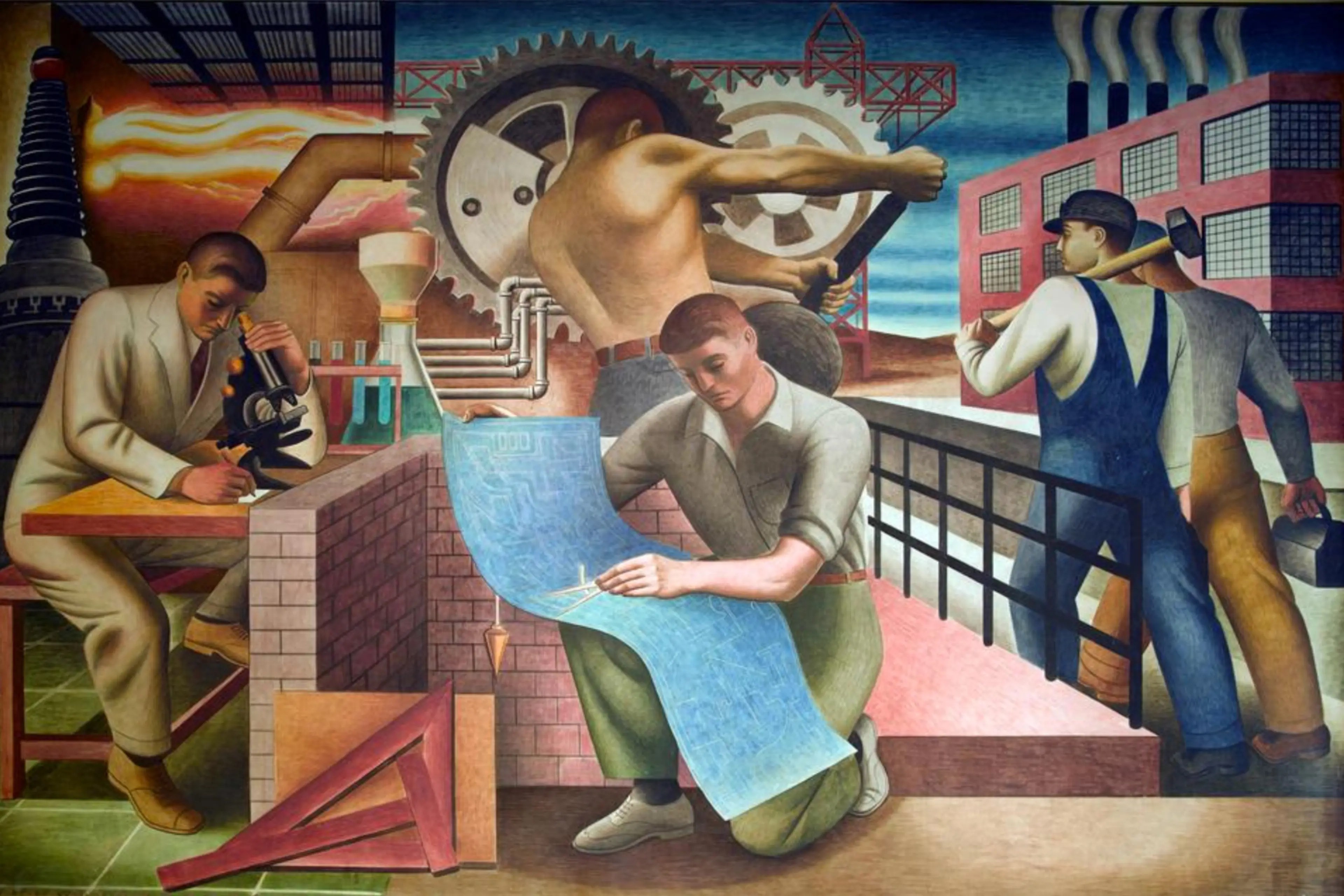
As we try to understand the rifts afflicting our nation and world, many turn to Marx and his framework of class. But in a provocative essay, Catherine Nichols suggests that it was David Hume (in an 1752 essay that identified the unfettering of wealth from land) who identified the origin of our political divisions…
Describing the political map in terms of Left and Right is an accepted convention all over the world, almost to the point of cliché. Yet it is surprisingly complicated to explain whose interests lie on each side of this spectrum. For example, if the Left supports the interests of workers over the interests of employers, why are Left-leaning regions of the United States and elsewhere in the world among the richest? When Japan and South Korea sought to become economic powerhouses in the later 20th century, they adopted Leftist policies such as strong public education, universal healthcare and increased gender equality – if countries seeking to compete in capitalist arenas adopt broadly Leftist policies, then how do we explain why Leftists are always talking about overthrowing capitalism? And if the Left is somehow both the party of workers’ rights and the party of material wealth, then whose interests are supported by the Right? Given such contradictions, how did these terms become so central to modern politics?
The terms ‘left’ and ‘right’ come from the seating arrangements in the National Assembly during the French Revolution, where the combatants used the medieval estate groupings to define their battle lines. According to their writings, land-owning aristocrats (the Second Estate) were the party of the Right, while the interests of nearly everyone else (the Third Estate) belonged to the Left. This Third Estate included peasants working for the landowners but also every other kind of business owner and worker. Decades later, Karl Marx offered a different analysis of capitalism: he put owners of both land and businesses together on one side (the bourgeoisie), while grouping workers from fields and factories on the other side (the proletariat) in a single, world-wide class struggle. The trouble with both these ways of parsing Left and Right is that voting patterns never seem to line up with class. Both historic analyses leave us with questions about the contemporary world – and not just the paradox of why so many Left-leaning places are so rich. Why, for example, do working-class conservatives appear to vote against their material interests, year in and year out, across generations?
The 18th-century philosopher and political theorist David Hume had answers to these questions, though he was writing decades before the French Revolution. While his essay ‘Of Public Credit’ (1752) was a warning about the dangers of Britain’s increasing reliance on debt financing, his apocalyptic vision of the future turned out to describe some features of our current political map surprisingly well. Hume was writing because he believed that debt financing had the power to upend Europe’s traditional power structure and culture by creating a new source of money divorced from tradition or responsibility: stocks and bonds. Unlike land, anyone with some cash could buy war bonds and get an immediate passive income in the form of interest. This was the thin end of the wedge caused by the debt financing that Hume believed was destroying every part of society. The governments of antiquity, Hume argued, saved money to use in battle and then waged wars in self-defence, or else to expand their territory. But the British had invented a new form of warfare that Hume saw no precedent for, even in the merchant states of Nicollò Machiavelli’s Italy: war for trade, funded with money borrowed from private stockholders…
[Nichols unpacks Hume’s observations (centrally, that three groups with stakes in the status quo, heretability, and the sanctity of “family and family hierarchy”tradition”– landowners, aging parents, and want to preserve old power structures, including the family– and traces their relevance, from Hume’s time to ours…]
… There are many reasons for people aligning Right or Left, which is why analyses of class and material interests fall short of describing the realities of people’s politics. Hume foresaw that these specific groups would resent the economic sea-change of the 18th century – and he was correct. Many people would rather have land and power than money and liberty.
Still, the power of the Right hasn’t doomed the Left – no more than the Spanish Inquisition doomed the rise of the Left in 18th-century England and France. As long as governments want to keep the value of their currencies from falling, someone in their ranks will be using the methods of the Left and inventiveness that brought us everything from our banking system to gay marriage. We don’t need to resurrect communism or focus narrowly on class, following Marx. The experiments are far from over, and we should remember that the Left is generally where money comes from in modern times. We give away too much power when we forget it…
Rethinking Right and Left: “Landholder vs stockholder,” from @catherinenichols.bsky.social in @aeon.co.
As for how it’s going at the moment (and further to Hume and the quote in this post’s title), see: “MAGA’s Betrayal of Small Business,” from @pkrugman.bsky.social.
* “shit happens”– often attributed to David Hume, reflecting his skeptical view that human understanding, particularly of cause-and-effect, is limited to habitual belief from experience, implying that unforeseen, messy outcomes (“shit”) inevitably occur in life despite our reasoning.
###
As we sort the Whigs from the Tories, we might recall that it was on this date 1656 that Blaise Pascal (writing under the pseudonym Louis de Montalte) published the first of his Provential Letters (Lettres provinciales), a series of eighteen polemical letters using humor to attack Jesuits for their use of casuistry and their moral laxity. Though the Letters were a popular success, they had little immediate effect on politics or the clergy. But they influenced later French writers like Voltaire and Jean-Jacques Rousseau and ultimately persuaded Pope Alexander to condemn “laxity” in the church and order a revision of casuistic texts.

“All that is solid melts into air”*…

Paul North finds a prescient analysis of the (still only possible) end of the American republic in Karl Marx’s The Eighteenth Brumaire of Louis Bonaparte…
An autocrat takes over. Why does the legislature permit him to hijack government, pervert institutions and norms, and unburden them of their legitimate power? Why would a representative body like the US Congress willingly injure its own authority? Karl Marx gave an answer in 1852, in his fiery postmortem for the French Republic, The Eighteenth Brumaire of Louis Bonaparte.
Marx’s answer to the question of why the powerful willingly abandon their own power is unusual because it does not find a rational plan behind the move. A legislature, faced with a potential autocrat, is caught between two impulses and ends up following the wrong one—one that is, in fact, self-destructive. That Democratic legislators do not stand up to Trump is one thing, but the litmus test, according to Marx, was not the actions of the centrists or leftists but of the true Right. Putatively at least, the Right is in power, as it was in the French Second Republic. While Democrats may see what’s going on but are cowardly or weak, the Right is either simply blind or making a dangerous but rational calculation. In his century, Marx called the Right blind, for interesting reasons.
It is hard to imagine what drives the Right today to support the Trump regime. Take Tom Cole, the 10th-term Republican from Oklahoma’s fourth district, poster child for conservative principles and head of the Appropriations Committee, arguably the most powerful position in the House—at least formerly. Regarding Social Security, Cole’s website states that his goal is to “sustain and protect the program for current beneficiaries and future retirees.” Yet, as a recent article by Russell Berman demonstrates, “even Tom Cole is defending DOGE,” which has the hallowed safety net in its sights…
… It is common to think of The Eighteenth Brumaire as the chronicle of a self-aggrandizing, power-hungry “serious buffoon,” Louis Napoleon Bonaparte. He had failed twice to take power through coups d’état, in 1836 and again in 1840. No one who knew him could deny that coups were his thing. Then, in the confusion after the revolutions of 1848 and on the strength of his name and dynastic ties to his uncle, Louis Napoleon returned to France and, third try’s the charm, became leader of France. No coup was needed this time—he won the new republic’s first presidential election by a wide margin.
In the years that followed, Louis Napoleon engineered a repeal of universal male suffrage, hobbled parliament, and manipulated ministers and generals to his purposes. When it became clear that the Constituent Assembly would not amend the constitution to extend his term in office, he decided (surprise, surprise) to instigate yet another coup: he had opponents arrested by the thousands, constrained the press, and, in November 1852, became emperor of France…
… A coup d’état in miniature every day, to hold the public gaze—parallels between Louis Napoleon and Donald Trump are vivid and many. Peter Gordon drew out the important ones in an essay for the Boston Review. At the most basic level, Trump and Louis Napoleon dress up restoration in the tunic of revolution: both leaders rode in on the backs of the disenfranchised, and both promised a return to a golden age that never existed.
Yet The Eighteenth Brumaire is not primarily the anatomy of an autocrat. For most of its approximately 100 pages, Marx analyzes in detail how other actors in the republic misidentified Louis Napoleon as good for their interests. He focuses particularly on members of the Constituent Assembly, whose influence flowed directly from the existence of the republic itself. Marx skewers assembly members, ministers, and military leadership for their ignorant, self-destructive complicity. The first lesson of his depressing and hilarious pamphlet is not to focus on the autocrat, since it takes a nation to make one, after all…
… New interests do produce vigorous sap, and that sap needs to flow, vigorously, toward something concrete. If we concentrate, as Marx does, not on the Caesar but on the political parties, their platforms, and their representatives in the Constituent Assembly, we can ask how they failed to foresee the obvious and forestall the republic’s end.
All the drama in The Eighteenth Brumaire happens in the assembly. Louis Napoleon may be farcical, but the legislature is tragic. “The history of the Constituent National Assembly since the June days is the history of the domination and the disintegration of the republican faction of the bourgeoisie,” Marx tells us. To avoid a real republic, right-wing elements circumvented checks and balances, first and foremost the constitution. And then, when Louis Napoleon circumvented the assembly itself in 1851 in order to extend his rule, conservatives suddenly remembered the republic. It was republicanism, they realized, that had brought them to power, and republicanism that had allowed them to exercise it. With its end, they ended.
Just a few years before, the Revolution of 1848 had brought down the French king and introduced liberal freedoms of press, speech, association, and assembly, all secured through a liberal constitution. It also brought about universal, unpropertied male suffrage. Some of these freedoms and entitlements were then progressively taken away by the assembly, the rest by the emperor. It wasn’t Louis Napoleon that caused the demise, however. Parliament dissected itself. It took away the basis of its own power by going around the constitution. Marx’s poignant lines evoke a feeling many of us have today that can only be called “rue.” On one side, Marx rues the way “the collective will of the nation” seeks “its appropriate expression through the inveterate enemies of the interests of the masses, until at length it finds it in the self-will of a freebooter.” The people stood with Louis Napoleon, although he was antithetical to their interests. On the other side, the assembly used its power to do away with its power. Two errors made a fatal combination…
… It is a general truth that an autocrat gets into power not by himself but through those who let him. Louis Napoleon came to power by legal means (at least the third time he tried), but he stayed in power through the complicity of those around him. What did they have to ignore in order to continue in their complicity? Marx does not mince words: “If ever an event has, well in advance of its coming, cast its shadow before, it was Bonaparte’s coup d’état.” The coming coup was so obvious, no one could have denied it and remained honest with themselves. This raises some questions. Why did the Right ignore what was in front of their faces? Why, in the presence of real danger, whose long-term effects would be devastating to their political goals, did this group default? Why did they defer to a lesser danger at the cost of denying the existence of a much greater one?…
… What holds a body of consummately rational actors in such an irrational state that they take losses as victories? What allowed the Right in mid-19th-century France to believe the steps they were taking toward irrelevance were in fact steps toward the triumph of their political vision? Marx has two answers. On one hand, behind the self-deception, he sees a simple wish: the bourgeoisie as a whole “longed to get rid of its own political rule in order to get rid of the troubles and dangers of ruling.” On this view, the Party of Order made a semirational choice—that a roiling populace would be worse for order than an autocratic fool. In the end, assembly members could relinquish governing and go back to the business of making money—which, according to Marx, was their material desire anyway: “[T]he bourgeois madly snorts at his parliamentary republic: ‘Rather an end with terror than terror without end!’”
This is a psychoanalysis not of complicity, however, but of capitulation. Marx may be correct about the way things ended. He is talking about the Right’s eventual acceptance of autocratic rule, after it became a fait accompli. Once it was clear that they had lost, they could say “There’s nothing we could have done. This way is better for business. It is what we wanted.” They could declare their actions to have been rational all along and go back to their farms or their industries. But why had parliament succumbed to this debacle in the first place? How did they catch the peculiar malady cretinism?…
Read on for an answer: “He’s a Cretin but We’ll Manage Him,” from @lareviewofbooks.bsky.social. Indeed, eminently worth reading in full.
* “All that is solid melts into air, all that is holy is profaned, and man is at last compelled to face with sober senses, his real conditions of life, and his relations with his kind.” – Karl Marx
###
As we contemplate capitulation, we might ponder the pre-history of the events in question and spare a thought for Louis Joseph, Dauphin of France (the second child and first son of King Louis XVI and Marie Antoinette); he died of tuberculosis on this date in 1789 at age 7… 40 days before the storming of the Bastille. At his death, the title of Dauphin passed to his younger brother Louis Charles, Duke of Normandy (1785–1795), who died during the French Revolution, at the Temple prison in Paris.

“If anything is certain, it is that I myself am not a Marxist”*…

Photographic portraits of Marx don’t suggest a guy who wrote poetry, loved his wife with a passion, doted on his kids, and was once a hellraiser of a student—getting drunk, causing mayhem, and being chased by the police after one too many for the road. He was also scarred in a duel and exiled from Germany, Belgium, and France over his barbed and satiric attacks on these countries often despotic rulers. Marx was a man of action always willing to lead the fight who eventually settled for a life of sedentary toil to produce works that changed the world.
He was also a voracious reader who loved the works of Shakespeare and could quote entire plays by the Bard—just as his children could—and generally took an interest in everything. “Art,” he said, “is always and everywhere the secret confession, and at the same time the immortal movement of its time.” No idea or philosophy or culture was foreign to him, and there was nothing that didn’t keen his interest.
Yet, he could also be bad tempered and foul to those who went against him. And on occasion was anti-semitic and racist—he described one poor frenemy (Ferdinand Lassalle) as a Jewish n-word. No saint, but all human.
Karl also enjoyed playing parlor games like Confessions, which is now probably better known as the set of questions devised by Marcel Proust. In April 1865, Marx was staying with relatives when he as asked by his daughters to answer a set of confessions. Marx’s responses give an interesting (and at times humorous) insight into the great political and economic philosopher, journalist and writer.
Your favourite virtue: Simplicity
Your favourite virtue in man: Strength
Your favourite virtue in woman: Weakness
Your chief characteristic: Singleness of purpose
Your idea of happiness: To fight
Your idea of misery: To submit
The vice you excuse most: Gullibility
The vice you detest most: Servility
Your aversion: Martin Tupper [popular Victorian author]
Your favourite occupation: Glancing at Netchen [“Netchen, or Nannette, was Antoinette Philips, aged 28 at the time, Marx’s cousin and a member of the Dutch section of the International”]
Your favourite poet: Aeschylus, Shakespeare
Your favourite prose-writer: Diderot
Your hero: Spartacus, Kepler
Your heroine: Gretchen
Your favourite flower: Daphne
Your favourite dish: Fish
Your favourite colour: Red
Your maxim: Nihil humani a me alienum puto [Nothing human is alien to me]
Your favourite motto: De omnibus dubitandum [Doubt everything]
A few of his favorite things: “The ‘Confessions’ of Karl Marx.”
* Karl Marx
###
As we hum a few bars of “The Internationale,” we might spare a thought for John Bunyan; he died on this date in 1688. A Puritan preacher and writer, he is best remembered for the Christian allegory The Pilgrim’s Progress, though he wrote nearly sixty titles, many of them expanded sermons.

“They always say time changes things, but you actually have to change them yourself”*…

Andy Warhol enjoyed dressing for parties in drag, sometimes in dresses of his own design. He admired “the boys who spend their lives trying to be complete girls,” so in 1981 he and a photographic assistant, Christopher Makos, agreed to collaborate on a session portraying Warhol in drag. In many ways, they modeled the series on Man Ray’s 1920s work with the French artist Marcel Duchamp, in which the two artists created a female alter ego name Rrose Sélavy for Duchamp.
Warhol and Makos made a number of pictures, both black-and-white prints and color Polaroids, of their first attempt. For the second round of pictures, they hired a theater makeup person. This stage professional better understood the challenge of transforming a man’s face into that of a woman. After the makeup, Warhol tried on curled, straight, long, short, dark, and blonde wigs…
More on Warhols collection of polaroid self-portraits– and more selections from it– at “Oh, You Pretty Thing! Polaroid Portraits of Andy Warhol in Drag.”
* Andy Warhol
###
As we add “Jean Genie” to our playlists, we might note the irony that today is the birthday of both Soren Kierkegaard (1813), the Danish philosopher who was a fierce critic of Hegelianism, and of Karl Marx (1818), the Prussian philosopher (and “father of Communism”), who was one of Hegel’s strongest– and most concretely active– supporters. Thesis… anithesis…

Kierkegaard and Marx
You must be logged in to post a comment.