Posts Tagged ‘hypnosis’
“Life is teleology par excellence; it is the intrinsic striving towards a goal, and the living organism is a system of directed aims which seek to fulfill themselves”*…
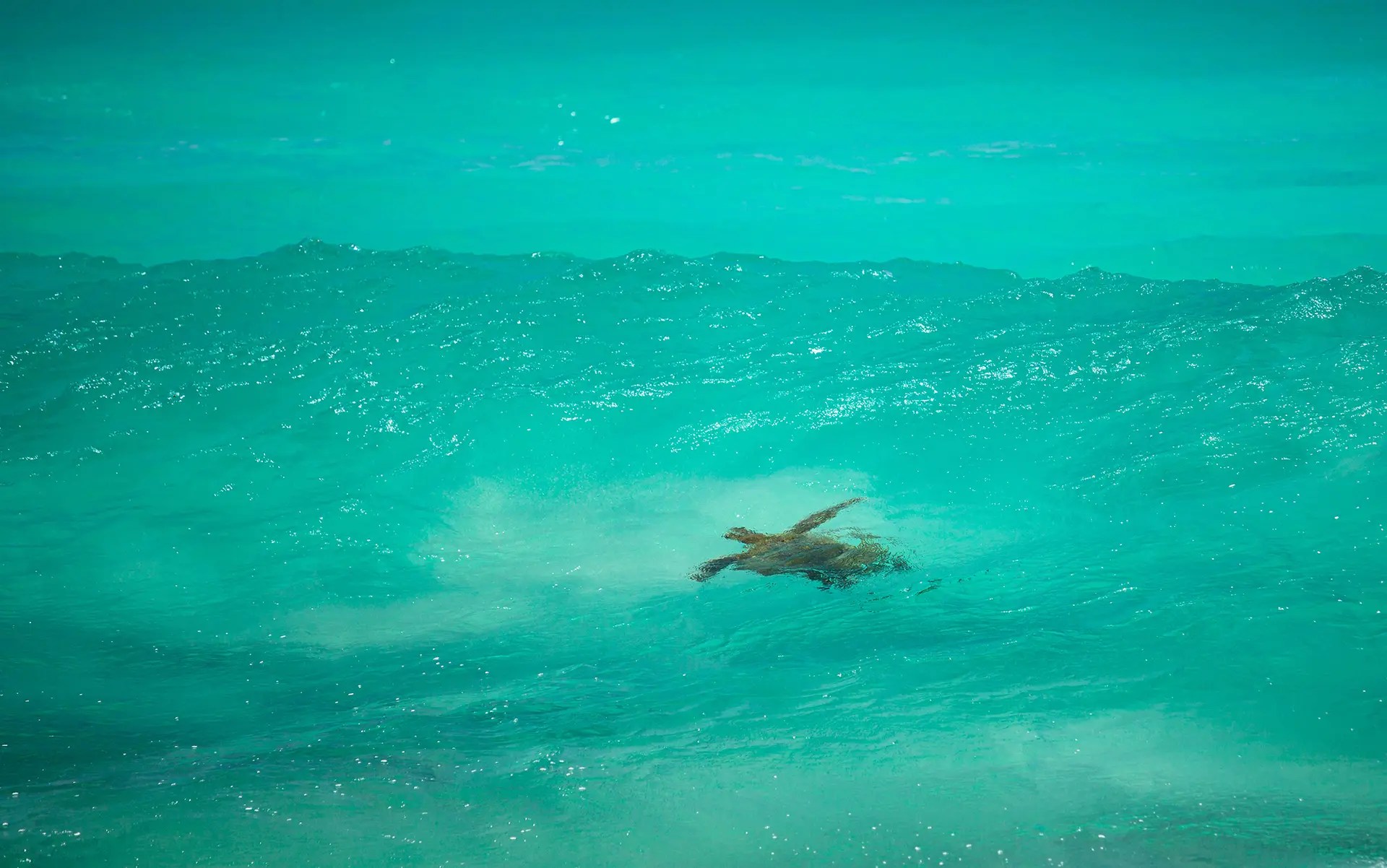
Daniel McShea and Gunnar Babcock argue that everything in the Universe, from wandering turtles to falling rocks, is surrounded by ‘fields’ that guide and direct their movement…
Why do rocks fall? Before Isaac Newton introduced his revolutionary law of gravity in 1687, many natural scientists and philosophers thought that rocks fell because falling was an essential part of their nature. For Aristotle, seeking the ground was an intrinsic property of rocks. The same principle, he argued, also explained why things like acorns grew into oak trees. According to this explanation, every physical object in the Universe, from rocks to people, moved and changed because it had an internal purpose or goal.
Modern science has rejected this ‘teleological’ way of thinking. In the 17th and 18th centuries, scientists and philosophers began to chip away at Aristotle’s seemingly ‘spooky’ notion of intrinsic causes – spooky because they suggested that rocks and creatures were guided by something not entirely material. For those who rejected these Aristotelean explanations, such as Thomas Hobbes and René Descartes, organisms were simply complex machines animated by mechanisms. ‘Life is but a motion of limbs,’ wrote Hobbes in his Leviathan (1651). ‘For what is the heart, but a spring; and the nerves, but so many strings; and the joints, but so many wheels, giving motion to the whole body.’ The heart does not have the goalof circulating blood. It’s just a spring like any other. For many thinkers at the time, this view had real explanatory benefits because they knew something about how machines worked, including how to fix them. It was in this intellectual environment that Newton developed a powerful mechanical worldview, based on his discovery of gravitational fields. In a Newtonian universe, internal purpose doesn’t cause rocks to fall. They just fall, following a law of nature.
Mechanistic explanations, however, struggled to explain how life develops. How does a grass seed become a blade of grass, in the face of endless disturbances from its environment? Long after the mechanistic revolution, the philosopher Immanuel Kant confronted the stubborn problem of teleology and despaired. In 1790, he wrote in the Critique of Judgment that – as commonly paraphrased – ‘there will never be a Newton for a blade of grass.’ Less than a century later, with the publication of On the Origin of Species (1859), Charles Darwin seemed to crack the problem of biological teleology. Darwin’s ideas about natural selection appeared to explain how organisms, from grass seeds to bats, were able to pursue goals. The directing process was blind variation and the selective retention of favourable variants. Bats who sought moths and had an ever-improved capacity to track and catch them were favoured over those who were less goal directed and therefore had lesser capabilities. Though natural selection seemed to illuminate what Descartes, Hobbes and Kant could not, Darwin’s theory answered only half the problem of teleology. Selection explained where teleological systems like moth-seeking bats come from but didn’t answer how they find their goals.
So, how do goal-directed entities do it, moment by moment? How does an acorn seek its adult form? How does a homing torpedo find its target? Mechanistic thinking struggles to answer these questions. From a mechanical perspective, these systems look strangely future oriented. A sea turtle, hundreds of miles out to sea, can find the beach where it was born, a location that lies in its future. A developing embryo, without any thought of the future, constructs tissues and organs that it will not need until much later in life. And both do these things persistently: carried off course by a strong current, the sea turtle persistently finds a trajectory back toward its natal beach; despite errors in cell division and gene expression, an embryo is able to make corrections as it grows into its adult form. How is this possible?
Even though mechanistic thinking has failed to solve this teleological problem, it still dominates scientific thought. Today, we invoke mechanism to explain almost everything – including human goal-directed behaviour. To explain the growth of an acorn, we look to mechanisms in its genes. To explain the ocean voyages of a sea turtle, we look to mechanisms in its brain. And to explain our own thoughts and decisions, we focus on neural pathways and brain chemistry to explain decision-making. We explain behaviour in terms of evolutionary needs, such as survival or reproductive success. We may even think of our genes as ‘blueprints’. For some 20th-century thinkers, such as the US psychologist Burrhus Frederic Skinner, human brains are purely mechanistic. Skinner denied that people have goals at all. More recently, the primatologist Robert Sapolsky, based at Stanford University, and others have painted a mechanistic picture of us that denies we have free will.
And yet, despite centuries of rejection, teleology has not been banished. Most of us still have a deep intuition that there is more to our thinking and action than mere mechanisms. The feeling of being in love isn’t just the mechanical outcome of neurochemistry. We want to believe it is driven by our wants and intentions. Some of us, especially if moved by religious or spiritual impulses, might even see goals in the larger universe: ‘I am here for a purpose,’ you might think to yourself. For many, a world of pure mechanism seems insufficient. And beyond our intuitions about teleology, there are countless areas of science where teleological explanations are commonly deployed, even without any explicit recognition of them. Consider the debate over which parts of a genome are ‘functional’ (ie, they perform roles that are beneficial to an organism) and which are ‘non-functional’ (ie, useless remnants of evolution). The very idea that a gene can either be functional or non-functional implies that certain genes aim towards certain results, or have certain purposes for the organism, while others have no ends and are merely purposeless junk. So, even beyond our intuitions, teleology is so deeply entwined with science that there will be no getting rid of it anytime soon.
So, caught between modern science and our intuitions about teleology, we seem to have only two ways of explaining the apparent goal directedness in some systems: teleology or mechanism. Both are troublesome. Both are inadequate. In recognition of this problem, philosophers of biology and others have, in recent decades, been struggling to find an alternative. We believe we have found it: a third way that reconciles Aristotelian thinking about goal directedness with the mechanistic view of a Newtonian universe. This alternative explains the apparent seeking of all goal-directed entities, from developing acorns and migrating sea turtles to self-driving cars and human intentions. It proposes that a hidden architecture connects these entities. It even explains falling rocks.
We call it ‘field theory’…
Eminently worth reading in full: “Elusive but everywhere,” from @aeonmag.
* Carl Jung
###
As we grapple with goals, we might recall that it was on this date in 184i that James Braid first saw a demonstration of “animal magnetism,” which led to his study of the subject he eventually called “hypnotism” and his contributions to the development of hypnotherapy. Details here.

“What I should have been, you see, is a neurologist”*…

It was in a mood of irritable skepticism that the Scottish surgeon James Braid attended a public demonstration of Animal Magnetism—in which people were said to fall into trances—on the night of November 13, 1841. From everything he had read and heard about the trances that occurred at the bidding of the operator—the person who induced the trances—he reports that he was “fully inclined to join with those who considered the whole thing to be a system of collusion and delusion, or an excited imagination, sympathy, or imitation.” After observing the demonstration, he considered that the trances were quite genuine, but at the same time he felt satisfied “that they were not dependent on any special agency or emanation passing from the body of the operator to that of the patient as animal magnetizers allege.” He returned to the demonstration when it was repeated by popular demand a week later, and on this occasion he felt that he had identified the cause of these mysteriously punctual onsets of “nervous sleep.” He was to devote the last eighteen years of his life to the topic, and under the proprietary title of Hypnotism he explained and redescribed the process in terms which would have been unrecognizable to its eighteenth-century discoverer, Franz Anton Mesmer…
With its intriguing combination of occult powers, clairvoyant trances, and invisible weightless fluids, animal magnetism seemed to guarantee the existence of a reality beyond the world of the senses, and many people saw it as an irresistible alternative to an increasingly mechanized picture of the universe.
The remarkable Jonathan Miller— remembered as a partner of Peter Cook, Dudley Moore, and Allan Bennett in Beyond the Fringe and for his later career as a distinguished stage and opera director, but trained as a doctor– explains how Mesmer’s “animal magnetism” was wrangled by doctors and scientists into “hypnotism,” and how it birthed an understanding of the Unconscious that pre-dates Freud… and that’s undergoing a renaissance, as it’s proving more useful than the psychoanalytic version that obscured it for a century: “Going Unconscious” (an unlocked essay from The New York Review of Books archive).
* Jonathan Miller
###
As we go deep, we might send polymathic birthday greetings to William Whewell; he was born on this date in 1794. A scientist, Anglican priest, philosopher, theologian, and historian of science, he was Master of Trinity College, Cambridge.
At a time when specialization was increasing, Whewell was renown for the breadth of his work: he published the disciplines of mechanics, physics, geology, astronomy, and economics, while also finding the time to compose poetry, author a Bridgewater Treatise, translate the works of Goethe, and write sermons and theological tracts. In mathematics, Whewell introduced what is now called the Whewell equation, defining the shape of a curve without reference to an arbitrarily chosen coordinate system. He founded mathematical crystallography and developed a revision of Friedrich Mohs’s classification of minerals. And he organized thousands of volunteers internationally to study ocean tides, in what is now considered one of the first citizen science projects.
But some argue that Whewell’s greatest gift to science was his wordsmithing: He created the words scientist and physicist by analogy with the word artist; they soon replaced the older term natural philosopher. He also named linguistics, consilience, catastrophism, uniformitarianism, and astigmatism.
Other useful words were coined to help his friends: biometry for John Lubbock; Eocine, Miocene and Pliocene for Charles Lyell; and for Michael Faraday, electrode, anode, cathode, diamagnetic, paramagnetic, and ion (whence the sundry other particle names ending -ion).

You must be logged in to post a comment.