Posts Tagged ‘headlines’
“Writing headlines is a specialty”*…
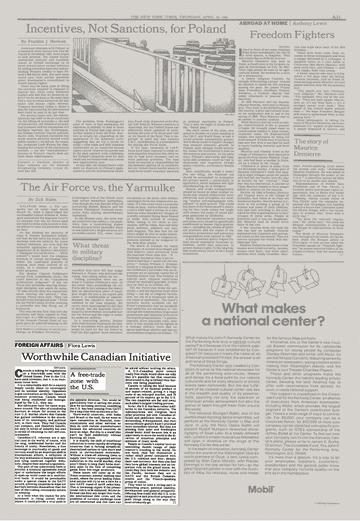
… and some are better at it than others. Greg Ross at Futility Closet illustrates, with an example from kinder, gentler times…
In 1986, Michael Kinsley, editor of The New Republic, spotted the headline “Worthwhile Canadian Initiative” in the New York Times and challenged his readers to come up with a more boring one. This was a tall order: The Times head, someone said, manages to be “not only boring as a whole, but boring word by word.” Submissions included:
- “U.S. Leadership Needed” (New York Times)
- “Trade, A Two-Way Street” (New York Times)
- “Beyond the News, Larger Issues” (New York Times)
- “Thoughts at Graduation Time” (New York Times)
- “Continue Manned Flight in Space” (New York Times)
- “Chill Falls on Warming Relations Between Australia and Indonesia” (New York Times)
- “University of Rochester Decides to Keep Name” (New York Times)
- “Dramatic Changes Fail to Materialize on Hill” (Washington Post)
- “Surprises Unlikely in Indiana” (Chicago Tribune)
- “CIA Analysis Sees Soviet Economy in Need of Changes” (San Diego Union)
- “Prevent Burglary by Locking House, Detectives Urge” (Boston Globe)
- “Methodists Oppose Use of Nuclear Arms” (New York Times)
- “Economist Dies” (Wisconsin State Journal)
- “Turbulent Days for Donald D. Engen” (New York Times)
The winner was found in the New York Times science section: “Debate Goes on Over the Nature of Reality.”
“Strike Up the Bland” (TotH to @frauenfelder.bsky.social and @boingboing.net)
* legendary copy editor Bill Walsh
###
As we reminisce, we might recall that it was on this date in 2022 that the Chinese Communist Party elected Xi Jinping as General Secretary for an unprecedented third term, consolidating his position as China’s paramount leader. The election broke decades of leadership succession tradition (with had limited a supreme leader to two terms) within the Communist Party. A party organ’s headline read “Xi Jinping leads CPC leadership in meeting the press.”

“You are where your brain is but not where a front-page headline is”*…

Headlines in newspapers, teasers for TV new stories “at 11”– from it’s birth, the press has promoted its wares with précis that pique a peruser’s interest. The advent of online journalism has only amplified that phenomenon… and to amusing effect.
Jeva Lange illustrates in “A field guide to identifying what website that headline came from.”
###
As we click on the bait, we might recall that it was on this date in 1920 that the 18th Amendment took effect, and the U.S. became dry. Under 100 years earlier, American’s had been drinking an average of (the equivalent of) 1.7 bottles of hard liquor per week– three times the average these days. A sin tax, levied at the end of the Civil War, moderated consumption a bit– but not enough to satisfy the coalition of women and evangelicals behind the passage and ratification of “The Noble Experiment”– the national ban on the sale, manufacture, and transportation of alcohol that was better known as “Prohibition”– was ratified. Prohibitionists had been after a ban for decades before the 18th Amendment went through. But until the institution of an income tax (in 1913), the federal government depended for the majority of its income on alcohol taxes… so was indisposed to let Prohibition happen.
By the time it was repealed in 1933, organized crime had become a major feature of American city life, and the American public had adopted the invented-for-the-occasion word “scofflaw.”

The Defender Of The 18th Amendment. From Klansmen: Guardians of Liberty published by the Pillar of Fire Church
“When a dog bites a man that is not news, but when a man bites a dog that is news”*…

From “Are Selfies Causing the Spread of Head Lice?” to “Brain Implant Lets One Monkey Control Another,” all the news that amuses: The News Hole.
* Charles Anderson Dana, American journalist, 1819-1897
###
As we read all about it, we might send ink-stained birthday greetings to Ben Hecht; he was born on this date in 1894. A novelist and Oscar-winning screenwriter (Underworld, Scarface, The Twentieth Century, Spellbound, Notorious, Monkey Business, Mutiny on the Bounty— over 70 in all), Hecht began his career as a newspaper reporter and columnist in Chicago– experience he put to good use when he co-wrote (with fellow reporter Charles MacArthur) the hit play The Front Page.

Click bait…

From the ever-exquisite xkcd.
###
As we linger over listicles, we might send almost-but-not-quite existential birthday greetings to Albert Camus; he was born on this date in 1913. A Nobel Prize winning author (The Plague, The Stranger, among others), journalist, and philosopher, he was a creator of Absurdism… a resonant but different variety of philosophical thought from Existentialism. Indeed, Camus firmly rejected the Existentialist label: “I am not an existentialist. Sartre and I are always surprised to see our names linked…”

“If one morning I walked on top of the water across the Potomac River, the headline that afternoon would read: President Can’t Swim…”*

Throughout its first fifty years, The New York Review of Books has asked many questions: What is Art? How Did it Happen? Where Do We Go From Here? Yonder Shakespeare, Who Is He? Tennis Anyone? How Dead is Arnold Schoenberg? Aimez-Vous Rousseau? Is There a Marxist in the House? How Smelly Was the Palladian Villa? Do Fish Have Nostrils?…
… and exclaimed, and teased with indefinite antecedents– and just generally delighted.
Click through the highlights of NYRB‘s first half century at “Yuk! Pshaw! Excelsior! Fifty Years of Headlines from The New York Review.”
* Lyndon B. Johnson
###
As we tip our hats to the tease, we might spare a thought for François-Anatole Thibault; he died on this date in 1924. Better known by his pen name, Anatole France, he was the poet, journalist, and novelist considered the ultimate French “man of letters” of his time. A member of the Académie Française and winner of the Nobel Prize for Literature (1921), France was active in affairs of the state– perhaps most prominently as an ally of Zola’s in the Dreyfus Affair. But he’s in your correspondent”s Pantheon as the model for narrator Marcel’s literary idol Bergotte in Proust’s In Search of Lost Time (or, as your correspondent knew it, Remembrance of Things Past).

You must be logged in to post a comment.