Posts Tagged ‘George Washington’
The Geography of Belief…
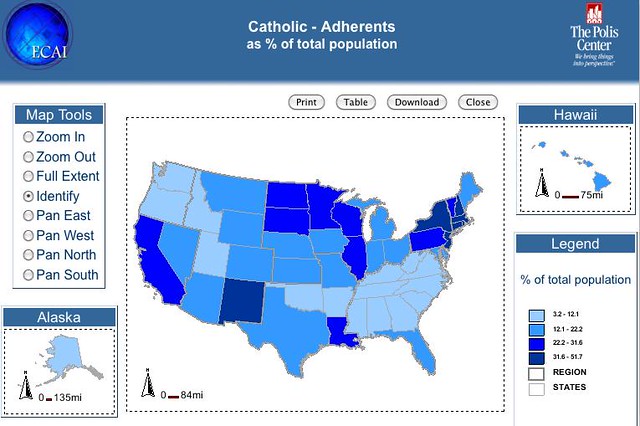
From The Polis Center (a joint venture of Indiana University, Purdue, and Indianapolis University): the North American Religion Atlas, an interactive tool that lets one locate any one of 22 faiths by county, region, or state.
As Rachel Hatch [to whom, TotH] suggests, “an example of the new-ish field, #spatialhumanities”…
As we remember that, as ever, it’s “location, location, location,” we might recall that it was on this date in 1753 that George Washington became a “Master Mason,” the highest rank in the Fraternity of Freemasonry, in his hometown of Fredericksburg, Virginia.
Freemasonry, derived from the practices and rituals of the medieval guild system, gained popularity in the Eighteenth Century, particularly in Great Britain. British Masons organized the first North American Chapter in 1731… arousing considerable suspicion in the early American republic with their mysterious rites and closely held secrets.
But indications are that, for Washington, the Masons were a rite of passage and an expression of civic responsibility. Members were required to express their belief in a Supreme Being and in the immortality of the soul, and expected to obey civil laws, hold a high moral standard, and practice acts of charity.
Besides, their ceremonial dinners routinely ended with the serving of cherry pie.
 Washington the Mason (source: Library of Congress)
I’ll take the low road…
 source: Argonne National Laboratory
Cartoonist Rube Goldberg sketched ironic paeans to parsimony– cartoons depicting the simplest of things being done in the most elaborate and complicated of ways. His whimsy inspired Purdue University to hold an annual Rube Goldberg Contest, in which teams of college students from around the country compete “to design a machine that uses the most complex process to complete a simple task – put a stamp on an envelope, screw in a light bulb, make a cup of coffee – in 20 or more steps.”
New Scientist reports on this year’s meet:
Who ever said a machine should be efficient? The device in this video was deliberately over-engineered to water a plant in 244 steps, while illustrating a brief history of life and the universe in the meantime. Created by students at Purdue University in West Lafayette, Indiana, it sets a new world record for the most complex Rube Goldberg machine – a contraption designed to complete a simple task through a series of chain reactions.
The machine was unveiled in March at the National Rube Goldberg Machine Championships held at Purdue University. The competition, first held in 1949, challenges competitors to accomplish a simple task in under 2 minutes, using at least 20 steps.
Although this machine used the greatest number of steps, it encountered some problems during the contest so was disqualified. But the team tried it again afterwards and it worked – too late to compete in the championships but still valid as a world record entry. They should find out this week if Guinness World Records accepts their record-breaking feat.
For more Rube Goldberg machines, check out our previous coverage of the championships, watch this cool music video by OK Go or see how an elaborate Japanese device could fix you a noodle dinner.
As we savor the sheer silliness of it all, we might recall that The American Academy of Arts and Sciences, which was founded during the Revolutionary War, was chartered on this date in 1780.
Established by by John Adams, James Bowdoin, John Hancock, and other leaders who contributed prominently to the establishment of the new nation, its government, and its Constitution, the Academy’s purpose was (in the words of the Charter) “to cultivate every art and science which may tend to advance the interest, honour, dignity, and happiness of a free, independent, and virtuous people.”
Over the years, just about everyone a reader may have encountered in a U.S. History text has been a member: The original incorporators were later joined by Benjamin Franklin, George Washington, Thomas Jefferson, Charles Bulfinch, Alexander Hamilton, John Quincy Adams, and others. During the 19th century, the elected membership included Daniel Webster, Henry Wadsworth Longfellow, John J. Audubon, Louis Agassiz, Asa Gray, Ralph Waldo Emerson, and Alexander Graham Bell. In the early decades of the twentieth century, membership in the Academy continued to grow as other noted scholars, scientists, and statesmen were elected– including A. A. Michelson, Percival Lowell, Alexander Agassiz and, later, Charles Steinmetz, Charles Evans Hughes, Samuel Eliot Morison, Albert Einstein, Henry Lee Higginson, Woodrow Wilson, William Howard Taft, and Henry Cabot Lodge. (Current members are listed here.)
Today the Academy is (in its self-explanation) “an international learned society with a dual function: to elect to membership men and women of exceptional achievement, drawn from science, scholarship, business, public affairs, and the arts, and to conduct a varied program of projects and studies responsive to the needs and problems of society.”
 The Minerva Seal (source)
Special Holiday Extra: a day of “sincere and humble thanks”…
 from xkcd (where, while Randall deals with illness in his family, Jeffrey Rowland [and others] have stepped in)
From Scenarios and Strategy:
On October 3, 1789, President George Washington issued a proclamation naming Thursday, November 26, 1789 as an official holiday of “sincere and humble thanks,” and the United States celebrated its first Thanksgiving under its new Constitution.
 click image to see enlargement at source; click here to see original manuscript at the National Archives
The holiday became traditional, at least in New England, but was celebrated each year at different times in the late Fall. Then in September of 1863, a magazine editor named Sarah Josepha Hale wrote President Abraham Lincoln, urging him to have the “day of our annual Thanksgiving made a National and fixed Union Festival.” Lincoln responded:
Proclamation Establishing Thanksgiving Day
October 3, 1863
The year that is drawing towards its close, has been filled with the blessings of fruitful fields and healthful skies. To these bounties, which are so constantly enjoyed that we are prone to forget the source from which they come, others have been added, which are of so extraordinary a nature, that they cannot fail to penetrate and soften the heart…
 click image to see enlargement at the National Archive; click here for transcription
(According to an April 1, 1864, letter from John Nicolay, one of President Lincoln’s secretaries, this document was written by Secretary of State William Seward, and the original was in his handwriting. Indeed, on October 3, 1863, fellow Cabinet member Gideon Welles noted in his diary that he had complimented Seward on his work. A year later the manuscript was sold to benefit Union troops.)
Sausage-making? Go ahead and look…
… the educational results– if not the intestine-encased waste products themselves– are good for one’s health.
Sunlight Labs (part of the Sunlight Foundation) is a non-profit, non partisan Washington, DC-based organization focused on digitization of government data and on creating tools and websites to make that data easily accessible. Each year Sunlight Labs runs Design for America, a competition for the best design solutions to the problems facing governance and responsible citizenship in the U.S.
This year’s winner in the “How a Bill Becomes Law” category, by Mike Wirth, is as beautiful as it is instructive:
 click image (or here) to enlarge
See the other entries in this category, and the other categories, by following the links here.
(TotH to Flowing Data)
As we lift the rock in order to peer underneath, we might recall that it was on this date in 1800 that U.S. President John Adams took up residence in Washington, D.C. (in a tavern, as the White House was not yet completed). Congress had passed the Residence Act in 1790, providing for the building of a national capital on the banks of the Potomac River; in 1791, the federal city was named for George Washington, and Pierre Charles L’Enfant began to plan the city. Finally, in 1800, the government began to move into its new home, first the President, then Congress– which met in Washington for the first time in November of 1800.
 White House under construction (White House Museum/Smithsonian Institution)
Quod Erat Demonstrandum…
 Barlow’s Wheel
St. Patrick’s College, Maynooth, Ireland
Today we remember Peter Barlow (1776-1862) for his mathematical tables, the Barlow Lens, and Barlow’s Wheel (1822). Electric current passes through the wheel from the axle to a mercury contact on the rim. The interaction of the current with the magnetic field of a U-magnet laid flat on the baseplate causes the wheel to rotate. Note that the presence of serrations on the wheel is unnecessary.
Thomas Greenslade, a professor emeritus at Kenyon, has a passion for the devices that have been used over the years to teach the principles of physics. Happy for us, he is willing to share: there are hundreds of fascinating exhibits like the one above at “Instruments for Natural Philosophy.”
As we sit back under our apple trees, we might recall that it was on this date in 1790 that the first U.S. patent statute was signed into law by President Washington. Although a number of inventors had been clamoring for patents and copyrights (which were, of course, anticipated in Article I, Section 8, Clause 8 of the Constitution), the first session of the First Congress in 1789 acted on none of the petitions. On January 8, 1790, President Washington recommended in his State of the Union address that Congress give attention to the encouragement of new and useful inventions; and within the month, the House appointed a committee to draft a patent statute. Even then the process worked slowly: the first patent issued under this statute was signed by George Washington– on July 31, 1790, for Samuel Hopkins’ process to make potash and pearl ash.
It’s some measure of the power of IP to create value that, on this date in 1849, Walter Hunt of New York City was issued Patent No. 6,281– the first U.S. patent for a safety pin. Strapped for cash, Hunt spent three hours on his invention, filed, then immediately sold the rights for the $400 that he needed.

You must be logged in to post a comment.