Posts Tagged ‘Fascism’
“You don’t know what you’ve got ’til it’s gone”*…

Why is the most dangerous political crisis in modern American history being met with emotional denial, moral distortion, and cultural distraction? Mike Brock, with a bracing essay…
Two plus two equals four. There are twenty-four hours in a day. And the United States is experiencing a constitutional crisis that threatens to end our democratic experiment.
That sentence—stark, unqualified, devoid of hedging—causes a peculiar form of discomfort. It demands we confront a reality most of us are psychologically unprepared to process: We are living through a slow-motion collapse of constitutional democracy in the United States, and most people—not just average citizens but intellectuals, journalists, and elected officials—are emotionally and cognitively incapable of grasping the scale of this threat.
This is not merely a political problem. It is a moral and psychological crisis of coherence—a collective failure to align our emotional response with objective reality. The distance between the magnitude of what is happening and our capacity to feel its significance represents one of the most dangerous disconnects in American history.
We treat an existential threat to self-governance as if it were merely another election cycle. We discuss the potential end of constitutional democracy in the same register we might debate tax policy or infrastructure spending. We have normalized what should never be normal, accommodated what should never be accommodated, and rationalized what should have provoked immediate, sustained resistance.
The gap between the emergency and our feeling of emergency is not accidental. It is the product of specific psychological defenses, media failures, and deliberate manipulation—all combining to protect us from the emotional and moral burden of confronting our situation honestly…
[Brock unpacks the nature of the emergency and then enumerates the “defenses against reality” that are in play: denial (disguised as normalcy), deflection, bothsidesism and cynicism, performative objectivity, and moral equivalence. Having explained each of these, he locates them in what he calls “The Arendtian Frame: The Banality of Complicity” and explains the ways in which they create a series of “collapses in coherence” that keep us from feeling the gravity of the situation…]
… In the face of this psychological and moral crisis, clarity becomes not just an intellectual virtue but a form of resistance. We must name what is happening, without euphemism, without equivocation, and without the false comfort of neutrality.
This is fascism.
I understand the reluctance to use this word. I acknowledge that it has sometimes been misused by the left, applied too broadly to policies they simply dislike rather than to genuine authoritarian movements. This overuse has created an understandable allergic reaction among many thoughtful people.
But the misuse of a term doesn’t invalidate its proper application. The fact that some have incorrectly diagnosed pneumonia doesn’t mean pneumonia doesn’t exist. And what we face now—the cult of personality, the manipulation of law to serve power, the demonization of minorities, the glorification of strength over principle, the explicit rejection of constitutional constraints—these are the defining features of fascism as a political form.
To refuse this word is not moderation but evasion. It is not caution but complicity. It reflects not intellectual rigor but psychological denial—the desperate need to believe we remain within the bounds of normal politics when we have already crossed into darker territory.
Fascism doesn’t arrive announcing itself with swastikas and goose-stepping troops. It comes draped in familiar symbols, speaking the language of tradition, order, and national renewal. It maintains the forms of democratic governance while hollowing out their substance. It works through existing institutions rather than immediately abolishing them.
What makes our current moment particularly dangerous is how it combines traditional authoritarian features with technological capabilities for surveillance, propaganda, and control that previous fascist movements couldn’t imagine. The fusion of authoritarian intent with algorithmic power creates possibilities for sustained oppression that exceed historical precedents.
This is why clarity matters so urgently. Without the proper diagnosis, we cannot formulate the proper response. If we persist in treating an authoritarian movement as merely another iteration of conservative governance, we will deploy inadequate tools against an existential threat.
The appropriate response to fascism is not normal opposition but moral resistance. Not tactical accommodation but principled confrontation. Not private diplomacy but public witness.
This resistance begins with moral courage—the willingness to speak truth despite social costs, professional risks, or personal discomfort. It requires moral clarity—the capacity to distinguish between normal political disagreement and fundamental threats to democratic governance. And it demands civic resistance—the refusal to normalize or accommodate authoritarian consolidation.
In practical terms, this means:
Refusing to center the wrong stories. When media coverage focuses on trivia while constitutional violations go unremarked, we must insist on proper perspective. When commentators treat fascist rhetoric as merely “controversial” rather than dangerous, we must restore moral clarity.
Refusing to indulge fascist spectacles. The strategy of overwhelming our attention with constant outrages, contradictory claims, and manufactured controversies works only if we allow ourselves to be manipulated by it. We must maintain focus on the core threat rather than chasing each new distraction.
Refusing to treat a slow coup as normal politics. We must reject the pressure to discuss authoritarian consolidation as if it were merely another policy dispute. We must insist on the fundamental distinction between governance within constitutional boundaries and the systematic dismantling of those boundaries.
Most importantly, we must be witnesses—not passive observers but active participants in the maintenance of truth. When someone dismisses constitutional violations as mere politics, we must speak up. When someone equates democratic flaws with authoritarian assaults, we must correct them. When someone retreats into cynicism or bothsidesism, we must insist on moral distinction.
These acts of witness may seem small compared to the scale of our crisis. They may feel inadequate in the face of constitutional collapse. But they represent the essential foundation for any larger resistance. Without the maintenance of truth, without the preservation of moral clarity, no other form of opposition is possible…
… the center cannot hold through denial or deflection. It can only be held through clarity—through the painful but necessary acknowledgment of our true situation.
This clarity begins with saying what is true, even when others aren’t ready to hear it. It continues through the patient, persistent defense of coherence against the forces that would dissolve it. And it culminates in the courage to act on that truth, to align our response with the reality we face rather than the reality we wish existed.
The wire still holds—but only if we walk it. Only if we maintain the tension between truth and power, between principle and expediency, between the republic we’ve inherited and the responsibility to preserve it.
This is not about partisanship. It is not about policy preferences. It is about whether the American experiment in self-governance will continue or whether it will join history’s long list of failed republics—remembered not for what it achieved but for what it surrendered.
The emergency we cannot feel is no less real for our failure to feel it. The collapse we struggle to acknowledge is no less imminent for our reluctance to face it. And the responsibility to resist, to bear witness, to hold the center—that responsibility falls to each of us, whether we’re emotionally prepared for it or not.
Eminently worth reading– and contemplating– in full: “The Emergency We Cannot Feel: On the Psychological Unreadiness for American Collapse” from @brockm.bsky.social.
See also: “Courage versus Complicity” from the estimable Larry Lessig, and “The Nineteen-Thirties Novel That’s Become a Surprise Hit in the U.K.“
And for an extraordinary series of conversations about democracy and authorianism in our moment (and what we can do), visit The Civic Forum, created and moderated by Rory Truex. (TotH to MKM)
Finally, a philosphical (indeed, almost cosmic) perspective on the (broadest understanding of) the context in which the issues above are unfolding: “Reality is evil- Everything eats and is eaten. Everything destroys and is destroyed. It is our moral duty to strike back at the Universe”
* Joni Mitchell, “Big Yellow Taxi”
###
As we face reality, we might recall that it was on this date in 1775 that King George II of Great Britain issued the Proclamation of Rebellion (officially, A Proclamation for Suppressing Rebellion and Sedition), in repsonse to the news of the Battle of Bunker Hill at the outset of the American Revolutionary War. It declared elements of the American colonies in a state of “open and avowed rebellion” and ordered officials of the empire “to use their utmost endeavours to withstand and suppress such rebellion.”

“My spirit will arise from my grave”*…
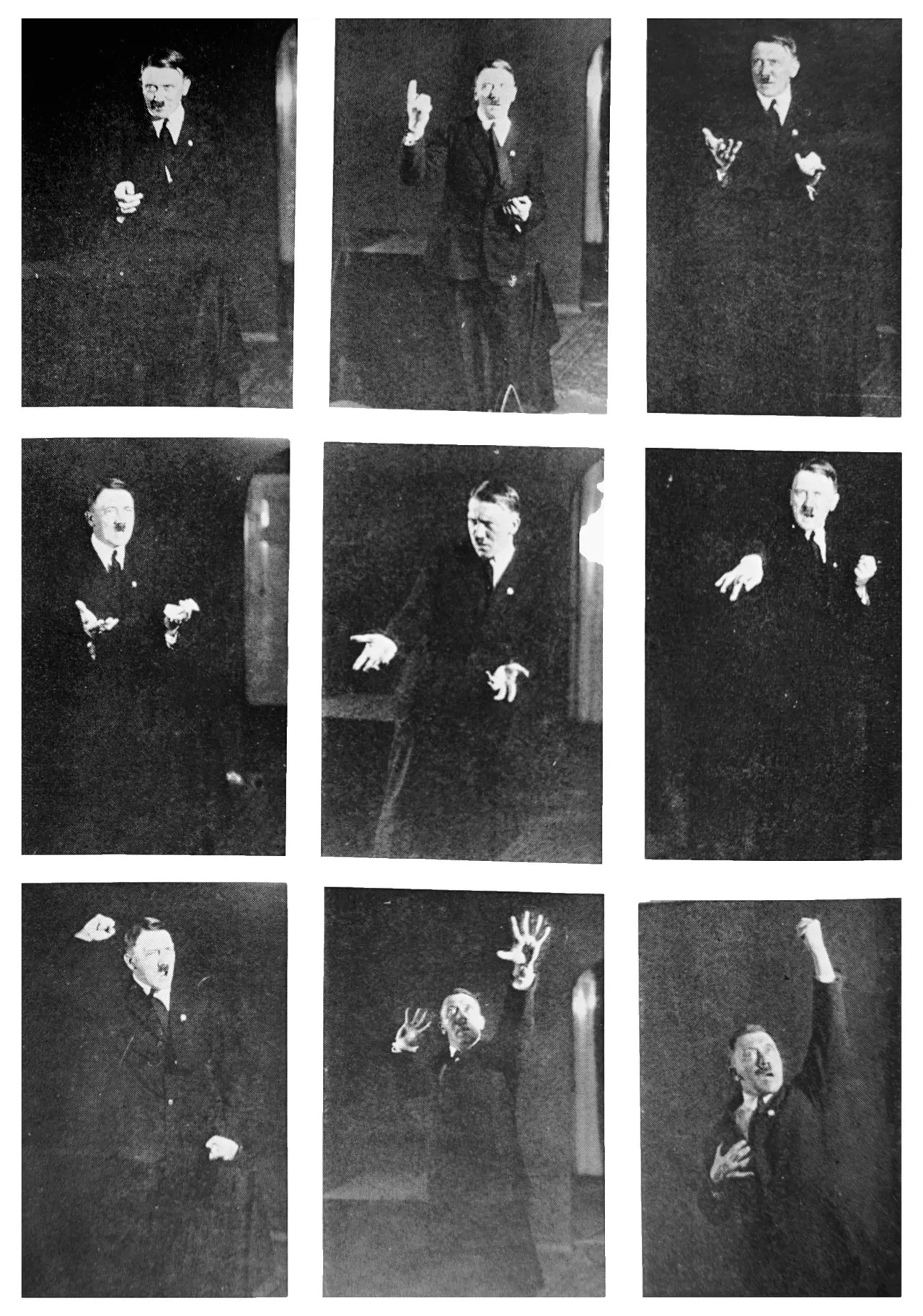
Hitler didn’t seize power; he was given it. As Adam Gopnik reports in a review of Tim Ryback‘s important new book, media lords thought that they could control him; political schemers thought that they could outwit him. The mainstream left had become a gerontocracy. And all of them failed to recognize his immunity to shame…
Hitler is so fully imagined a subject—so obsessively present on our televisions and in our bookstores—that to reimagine him seems pointless. As with the Hollywood fascination with Charles Manson, speculative curiosity gives retrospective glamour to evil. Hitler created a world in which women were transported with their children for days in closed train cars and then had to watch those children die alongside them, naked, gasping for breath in a gas chamber. To ask whether the man responsible for this was motivated by reading Oswald Spengler or merely by meeting him seems to attribute too much complexity of purpose to him, not to mention posthumous dignity. Yet allowing the specifics of his ascent to be clouded by disdain is not much better than allowing his memory to be ennobled by mystery.
So the historian Timothy W. Ryback’s choice to make his new book, “Takeover: Hitler’s Final Rise to Power” (Knopf), an aggressively specific chronicle of a single year, 1932, seems a wise, even an inspired one. Ryback details, week by week, day by day, and sometimes hour by hour, how a country with a functional, if flawed, democratic machinery handed absolute power over to someone who could never claim a majority in an actual election and whom the entire conservative political class regarded as a chaotic clown with a violent following. Ryback shows how major players thought they could find some ulterior advantage in managing him. Each was sure that, after the passing of a brief storm cloud, so obviously overloaded that it had to expend itself, they would emerge in possession of power. The corporate bosses thought that, if you looked past the strutting and the performative antisemitism, you had someone who would protect your money. Communist ideologues thought that, if you peered deeply enough into the strutting and the performative antisemitism, you could spy the pattern of a popular revolution. The decent right thought that he was too obviously deranged to remain in power long, and the decent left, tempered by earlier fights against different enemies, thought that, if they forcibly stuck to the rule of law, then the law would somehow by itself entrap a lawless leader. In a now familiar paradox, the rational forces stuck to magical thinking, while the irrational ones were more logical, parsing the brute equations of power. And so the storm never passed. In a way, it still has not…
Both the review and the book on which it focuses are eminently worth reading in full: “The Forgotten History of Hitler’s Establishment Enablers” (possible paywall; in which case, archived copy here), from @adamgopnik in @NewYorker.
* Hitler, as quoted in a letter from von Ribbentrop (to Churchill and Atlee) sent just before von Ribbentrop was captured at the end of the war
###
As we hear the echo, we might spare a thought for Ludwig van Beethoven; he died on this date in 1827. A crucial figure in the transition between the Classical and Romantic eras in Western music, he remains one of the most famous and influential of all composers. His best-known compositions include 9 symphonies, 5 concertos for piano, 32 piano sonatas, and 16 string quartets. He also composed other chamber music, choral works (including the celebrated Missa Solemnis), a single opera (Fidelio), and numerous songs.
Relevantly to the piece above…
Beethoven admired the ideals of the French Revolution, so he dedicated his third symphony to Napoleon Bonaparte… until Napoleon declared himself emperor. Beethoven then sprung into a rage, ripped the front page from his manuscript and scrubbed out Napoleon’s name. Some modern reproductions of the original title page have scrubbed out Napoleon’s name to create a hole for authenticity’s sake!
Beethoven’s temper and Symphony No. 3 ‘Eroica’
But, of course, it was too late…

“The myth of fascist efficiency has deluded many people”*…
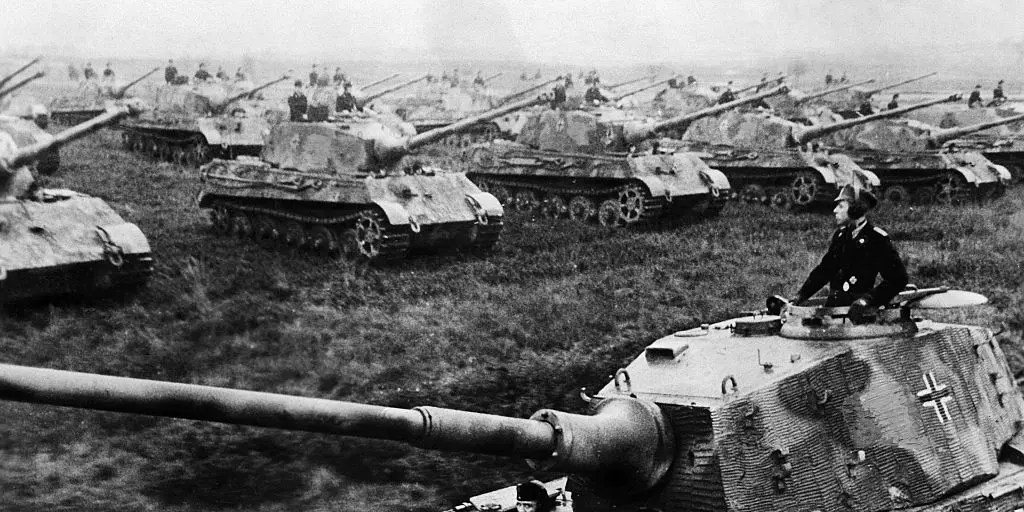
Bret Devereaux makes the case that fascists and fascist governments, despite their positioning, are generally bad at war…
I am using fascist fairly narrowly – I generally follow Umberto Eco’s definition (from “Ur Fascism” (1995)). Consequently, not all authoritarian or even right-authoritarian governments are fascist (but many are). Fascist has to mean something more specific than ‘people I disagree with’ to be a useful term (mostly, of course, useful as a warning).
First, I want to explain why I think this is a point worth making. For the most part, when we critique fascism (and other authoritarian ideologies), we focus on the inability of these ideologies to deliver on the things we – the (I hope) non-fascists – value, like liberty, prosperity, stability and peace. The problem is that the folks who might be beguiled by authoritarian ideologies are at risk precisely because they do not value those things – or at least, do not realize how much they value those things and won’t until they are gone. That is, of course, its own moral failing, but society as a whole benefits from having fewer fascists, so the exercise of deflating the appeal of fascism retains value for our sake, rather than for the sake of the would-be fascists (though they benefit as well, as it is, in fact, bad for you to be a fascist).
But war, war is something fascists value intensely because the beating heart of fascist ideology is a desire to prove heroic masculinity in the crucible of violent conflict (arising out of deep insecurity, generally). Or as Eco puts it, “For Ur-Fascism there is no struggle for life, but, rather, life is lived for struggle…life is permanent warfare” and as a result, “everyone is educated to become a hero.”2 Being good at war is fundamentally central to fascism in nearly all of its forms – indeed, I’d argue nothing is so central. Consequently, there is real value in showing that fascism is, in fact, bad at war, which it is.
Now how do we assess if a state is ‘good’ at war? The great temptation here is to look at inputs: who has the best equipment, the ‘best’ soldiers (good luck assessing that), the most ‘strategic geniuses’ and so on. But war is not a baseball game. No one cares about your RBI or On-Base percentage. If a country’s soldiers fight marvelously in a way that guarantees the destruction of their state and the total annihilation of their people, no one will sing their praises – indeed, no one will be left alive to do so.
Instead, war is an activity judged purely on outcomes, by which we mean strategic outcomes. Being ‘good at war’ means securing desired strategic outcomes or at least avoiding undesirable ones. There is, after all, something to be said for a country which manages to salvage a draw from a disadvantageous war (especially one it did not start) rather than total defeat, just as much as a country that conquers. Meanwhile, failure in wars of choice – that is, wars a state starts which it could have equally chosen not to start – are more damning than failures in wars of necessity. And the most fundamental strategic objective of every state or polity is to survive, so the failure to ensure that basic outcome is a severe failure indeed.
Judged by that metric, fascist governments are terrible at war. There haven’t been all that many fascist governments, historically speaking and a shocking percentage of them started wars of choice which resulted in the absolute destruction of their regime and state, the worst possible strategic outcome. Most long-standing states have been to war many times, winning sometimes and losing sometimes, but generally able to preserve the existence of their state even in defeat. At this basic task, however, fascist states usually fail…
[Devereaux enumerates examples…]
… This is, however, not an invitation to complacency for liberal democracies which – contrary to fascism – have tended to be quite good at war (though that hardly means they always win). One thing the Second World War clearly demonstrated was that as militarily incompetent as they tend to be, fascist governments can defeat liberal democracies if the liberal democracies are unprepared and politically divided. The War in Ukraine may yet demonstrate the same thing, for Ukraine was unprepared in 2022 and Ukraine’s friends are sadly politically divided now. Instead, it should be a reminder that fascist and near-fascist regimes have a habit of launching stupid wars and so any free country with such a neighbor must be on doubly on guard.
But it should also be a reminder that, although fascists and near-fascists promise to restore manly, masculine military might, they have never, ever actually succeeded in doing that, instead racking up an embarrassing record of military disappointments (and terrible, horrible crimes, lest we forget). Fascism – and indeed, authoritarianisms of all kinds – are ideologies which fail to deliver the things a wise, sane people love – liberty, prosperity, stability and peace – but they also fail to deliver the things they promise.
These are loser ideologies. For losers. Like a drunk fumbling with a loaded pistol, they would be humiliatingly comical if they weren’t also dangerous. And they’re bad at war…
“On the Military Failures of Fascism,” from @BretDevereaux.
See also: “How Did the Nazis Really Lose World War II?” (source of the image above)
###
As we penetrate posturing, we might recall that it was on this date in 1940, in the early days of The Battle of the Atlantic during World War II, that British cruiser HMS York stopped the 3,359-ton German steamer Arucas 50 miles south of Iceland. Arucas’ crew of 42 Arucas scuttled the ship.
Arucas had sailed out of Vigo, Spain on 9 Feb in an attempt to break the Allied blockade.

“Our poetry is courage, audacity and revolt”*…

One of your correspondent’s daily delights is Rusty Foster‘s Today in Tabs, a newsletter that informs and provokes as it, inevitably, amuses. Take for example this excerpt from Monday’s installment, subtitled “Today in Fascism”…
“Could the end of the AI hype cycle be in sight?” asked TechBrew’s Patrick Kulp and precisely on time today here’s a doorstop of LinkedIn-brained crypto-(but-not-too-crypto)-fascism from Egg Andreessen titled “The Techno-Optimist Manifesto.” It’s very long, and you should absolutely not read it, but it’s useful for finally making explicit the fascist philosophy that people like Brad Johnson have long argued is growing steadily less implicit in Silicon Valley’s techno-triumphalism.
“Techno-Optimists believe that societies, like sharks, grow or die,” writes Egg, and Rose Eveleth was already like 🤔:

But before going fully mask-off, Andreessen has some crazy things to say about AI.
There are scores of common causes of death that can be fixed with AI, from car crashes to pandemics to wartime friendly fire.
But AI can surely help us kill the right people in war much more efficiently, yes? Still, he needs to make a pseudo-moral case to keep pumping cash into the AI bubble, so we get this:
We believe any deceleration of AI will cost lives. Deaths that were preventable by the AI that was prevented from existing is a form of murder.
Got that, Untermenschen? Regulation == murder. [Followed by the photo at the top]
But let’s get to the good stuff, in the section titled “Becoming Technological Supermen” (I swear I’m not making this up).
We believe in the romance of technology, of industry. The eros of the train, the car, the electric light, the skyscraper. And the microchip, the neural network, the rocket, the split atom.
We believe in adventure. Undertaking the Hero’s Journey, rebelling against the status quo, mapping uncharted territory, conquering dragons, and bringing home the spoils for our community.
To paraphrase a manifesto of a different time and place: “Beauty exists only in struggle. There is no masterpiece that has not an aggressive character. Technology must be a violent assault on the forces of the unknown, to force them to bow before man.”
The first two paragraphs here are just bonkers. He’s horny for trains? I guess he saw North By Northwest at an impressionable age. But that last paragraph contains the only quote in the whole piece that isn’t attributed to a specific source, and it turns out it’s not really a paraphrase, it’s a direct quote from Filippo Marinetti’s 1909 “Futurist Manifesto” with “technology” substituted for the original’s “poetry.” I wonder if Marinetti wrote any other famous manifestos?
In case we somehow still don’t get it, Andreessen specifies that “The Enemy” is “the ivory tower, the know-it-all credentialed expert worldview, indulging in abstract theories, luxury beliefs, social engineering, disconnected from the real world, delusional, unelected, and unaccountable…” and then drops an extended Nietzsche excerpt. You know who else hated the ivory tower and loved Nietzsche?…
“Industrial Society and Its Future (Are Gonna Be Great!),” from @rusty.todayintabs.com. Do yourself the favor of subscribing to Today in Tabs— it’s marvelous.
* Filippo Tommaso Marinetti, Manifesti Futuristi
###
As we reprioritize prudence, we might recall that it was on this date in 1896 that Richard F. Outcault‘s comic strip Hogan’s Alley— featuring “the Yellow Kid” (Mickey Dugan)– debuted in William Randolph Hearst’s New York Journal as a regular feature. While “the Yellow Kid” had appeared irregularly before, it was the first full-color comic to be printed regularly (many historians suggest), and one of the earliest in the history of the comic; Outcault’s use of word balloons in the Yellow Kid influenced the basic appearance and use of balloons in subsequent newspaper comic strips and comic books. Outcault’s work aimed at humor and social commentary; but (perhaps ironically) the concept of “yellow journalism” referred to stories which were sensationalized for the sake of selling papers (as in the publications of Hearst and Joseph Pulitzer, an earlier home to sporadic appearances of the Yellow Kid) and was so named after the “Yellow Kid” cartoons.

“If a ‘religion’ is defined to be a system of ideas that contains unprovable statements, then Gödel taught us that mathematics is not only a religion, it is the only religion that can prove itself to be one”*…

In 1931, the Austrian logician Kurt Gödel pulled off arguably one of the most stunning intellectual achievements in history.
Mathematicians of the era sought a solid foundation for mathematics: a set of basic mathematical facts, or axioms, that was both consistent — never leading to contradictions — and complete, serving as the building blocks of all mathematical truths.
But Gödel’s shocking incompleteness theorems, published when he was just 25, crushed that dream. He proved that any set of axioms you could posit as a possible foundation for math will inevitably be incomplete; there will always be true facts about numbers that cannot be proved by those axioms. He also showed that no candidate set of axioms can ever prove its own consistency.
His incompleteness theorems meant there can be no mathematical theory of everything, no unification of what’s provable and what’s true. What mathematicians can prove depends on their starting assumptions, not on any fundamental ground truth from which all answers spring.
In the 89 years since Gödel’s discovery, mathematicians have stumbled upon just the kinds of unanswerable questions his theorems foretold. For example, Gödel himself helped establish that the continuum hypothesis, which concerns the sizes of infinity, is undecidable, as is the halting problem, which asks whether a computer program fed with a random input will run forever or eventually halt. Undecidable questions have even arisen in physics, suggesting that Gödelian incompleteness afflicts not just math, but — in some ill-understood way — reality…
A (relatively) simple explanation of the incompleteness theorem– which destroyed the search for a mathematical theory of everything: “How Gödel’s Proof Works.”
* John D. Barrow, The Artful Universe
###
As we noodle on the unknowable, we might spare a thought for Vilfredo Federico Damaso Pareto; he died on this date in 1923. An engineer, sociologist, economist, political scientist, and philosopher, he made several important contributions to economics, sociology, and mathematics.
He introduced the concept of Pareto efficiency and helped develop the field of microeconomics. He was also the first to discover that income follows a Pareto distribution, which is a power law probability distribution. The Pareto principle, named after him, generalized on his observations on wealth distribution to suggest that, in most systems/settings, 80% of the effects come from 20% of the causes– the “80-20 rule.” He was also responsible for popularizing the use of the term “elite” in social analysis.
As Benoit Mandelbrot and Richard L. Hudson observed, “His legacy as an economist was profound. Partly because of him, the field evolved from a branch of moral philosophy as practised by Adam Smith into a data intensive field of scientific research and mathematical equations.”
The future leader of Italian fascism Benito Mussolini, in 1904, when he was a young student, attended some of Pareto’s lectures at the University of Lausanne. It has been argued that Mussolini’s move away from socialism towards a form of “elitism” may be attributed to Pareto’s ideas.
Mandelbrot summarized Pareto’s notions as follows:
At the bottom of the Wealth curve, he wrote, Men and Women starve and children die young. In the broad middle of the curve all is turmoil and motion: people rising and falling, climbing by talent or luck and falling by alcoholism, tuberculosis and other kinds of unfitness. At the very top sit the elite of the elite, who control wealth and power for a time – until they are unseated through revolution or upheaval by a new aristocratic class. There is no progress in human history. Democracy is a fraud. Human nature is primitive, emotional, unyielding. The smarter, abler, stronger, and shrewder take the lion’s share. The weak starve, lest society become degenerate: One can, Pareto wrote, ‘compare the social body to the human body, which will promptly perish if prevented from eliminating toxins.’ Inflammatory stuff – and it burned Pareto’s reputation… [source]

You must be logged in to post a comment.