Posts Tagged ‘farming’
“Who is to say plutonium is more powerful than, say, rice?”*…
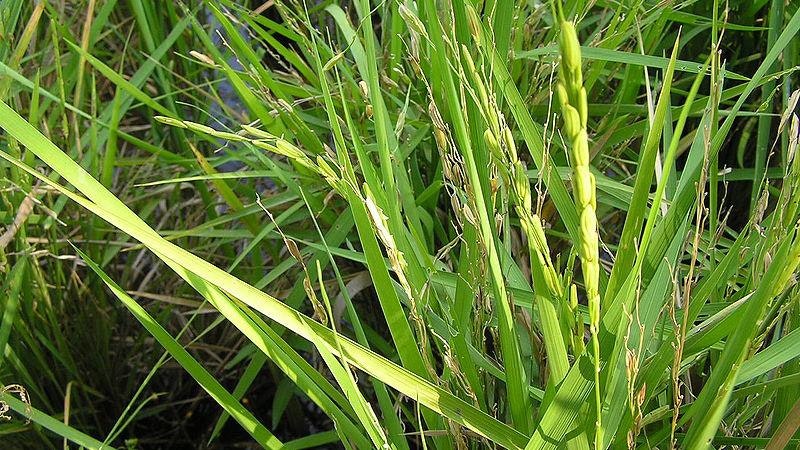
Rice is the most valuable agricultural commodity on the planet. Hundreds of millions of metric tons of it are produced every year, an amount valued at more than $300 billion every year. Billions of people around the world rely on it as a staple of their diets, and have done so for millennia all over East, Southeast, and South Asia, and beyond.
But the rice that’s so popular today has a distinct beginning as a cultivated crop, a beginning that arrived somewhere along the Yangzi River more than 10,000 years ago. (The rice traditionally grown in West Africa, and which was brought across the Atlantic by enslaved people and merchants in the early modern period, stems from a separate domestication event. It’s not as productive as its Asian cousin, and so is less widely cultivated now.)
Ten millennia in the past, rice grew a bit beyond its current range thanks to slightly warmer and wetter climatic conditions at the dawn of the Holocene. The people living around the Yangzi River, and slightly to the north of there, were quite happy to use the stands of wild rice growing in their homeland. Grasses might not seem like the most natural food source for people to exploit, because it requires a great deal of processing (grinding, cooking, etc.) to make it edible. As part of a forager’s diet, however, it offered advantages: It was plentiful, it was reliable when other food sources like wild game came up short, and if properly stored, it could last for years.
Around the Yellow River, northern China’s key waterway, rice didn’t grow. Millet, however, grew in abundant quantities. As their counterparts had done further to the south with rice, the inhabitants of northern China learned to process it. A couple of thousand years of experimentation led from simply collecting wild grasses wherever they were found to planting wild varieties in gardens and fields, then intentionally and unintentionally selecting for traits to make those grasses more productive and less likely to fall off the stalk. Farmers created their crops, the ancestors of the foods we eat today, and the increasing viability of the crops created farming as a way of life.
For a variety of reasons, successful farmers tend to have large numbers of children, who expand outward from their core areas, taking their way of life with them. This process of demic diffusion defines most centers of early agricultural innovation around the world. Farming begets more farmers, who tend to spread out. For this reason, Neolithic China – an environment home to not one but two distinct agricultural traditions – produced a stunning diversity of early farming cultures. Starting around 7000 years ago, after 5000 BC, these farming cultures exploded in numbers, scale, and complexity. They filled up new territories and built more and larger villages. Towns followed, and leaders in the form of chieftains and kings. Social hierarchies and inequality defined these new Neolithic societies, distinctions of rank that could be inherited across generations.
These were the foundations on which organized states, writing, and what we might eventually call “Chinese civilization” built, many thousands of years down the road…
Jared Diamond has argued that the advent of agriculture was “The Worst Mistake in the History of the Human Race“; in any event, it was a watershed moment. Patrick Wyman explores the dawn of agriculture and of the social complexity it spawned: “Neolithic China.”
* “Who is to say plutonium is more powerful than, say, rice? One takes away a million lives, the other saves a hundred times as many.” – N.K. Jemisin, How Long ’til Black Future Month?
###
As we contemplate cultivation, we might recall that it was on this date in 2017 that the U.N. General Assembly adopted 2019-2028 as the Decade of Family Farming. This program aims to serve as a framework for developing and promoting better public policies on family farming– an opportunity to contribute to an end to hunger and poverty as well as to achieve the Sustainable Development Goals (SDGs).
Here’s something that each of us can do to help the neediest.

“Agriculture changes the landscape more than anything else we do”*…
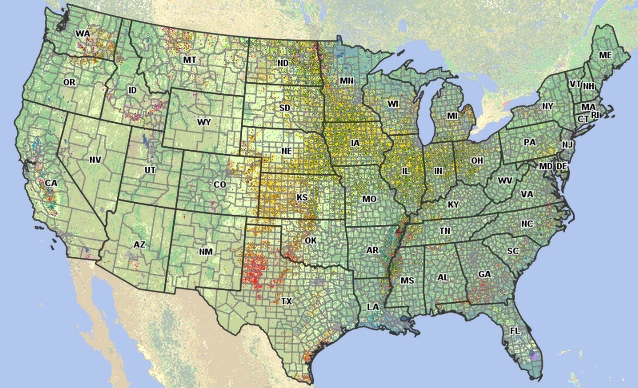
From the USDA, a (zoomable) map of which crops are grown where in the U.S.: “Cropscape.”
* Michael Pollan
###
As we contemplate cultivation, we might note that today is National Animal Crackers Day. Small crackers/cookies baked in the shape of animals, they were imported from England to the U.S. in the second half of the 19th century. then produced domestically by a number of bakers starting in the 1870s.
But by the turn of the century, several of those bakeries had merged to become the National Biscuit Company, which began to produce a branded version, “Barnum’s Animals,” featuring animals from the Barnum and Bailey Circus. While earlier animal cracker were sold to merchants in bulk (to be sold to customers from barrels), Nabisco’s were packaged in a colorful, circus-themed box with a string that allowed it to be hung from a Christmas tree. Initially retailing for 5 cents a package, they were– and remain– a huge hit.

Some of “Barnum’s Animals”
“Too often the concept of nature has been used to explain social inequalities or exploitative relations as inborn, and hence, beyond the scope of social change”*…

Martha Brookes Hutcheson (center) and colleagues at Merchiston Farm, c. 1917
The landscape architect and theorist Martha Brookes Hutcheson (née Brown, 1871–1959) lived in an age when most American women were actively discouraged from entering a profession. Women might consider landscape gardening as a “novel occupation … a congenial, soothing, out-of-doors pursuit to which a woman of taste, who loves flowers, cannot do better than turn her hand.” But any who seriously considered becoming landscape architects were informed that women were too “impatient” to learn the necessary drawing and surveying, the horticultural and business skills, and that the resulting “physical fatigue” would lead to breakdowns. Male colleagues and clients, they were warned, doubted “whether they conceive largely enough to undertake public works like the laying out of great parks or the plotting of plans for new cities.” Female landscape architects were limited to “the ample field of designing beautiful settings for beautiful homes.”
Martha Hutcheson, however, loved the great gardens of Europe and the farm in Vermont where she had summered as a girl, and she saw the potential for landscape design to serve a social agenda in the Progressive Era — to improve lives and conserve natural resources. One of the first women trained at university level in the emerging profession of landscape architecture, she was a founding member of the Woman’s Land Army during World War I, and her experience with a group of WLA “farmerettes” at her home, Merchiston Farm, in Gladstone, New Jersey, convinced her of the impact landscape architects could have by increasing agricultural productivity, improving soils and plant communities, and fostering women’s practical skills and economic autonomy. In her evolving designs for Merchiston Farm, and in her public lectures, writings, and advocacy through the Garden Club of America, Hutcheson argued for the contributions of landscape architects to national education, and explored tensions internal to the design theory of the age — including those between her own progressive agenda and the strictures of her elite social class. In the realm of landscape architecture, she became a leader in “a gallant little group of women who have forged for themselves National reputations.”
Hutcheson’s early writings and garden commissions considered good design as a matter of organization, massing, and proportion, while her later work stressed contextualism within natural systems. In this later and more daring work, she prioritized the use of native plants as a means to support healthy habitats, shift aesthetic preferences, and minimize costs; her practice hybridized sustainable water management and soil science with the normative, Europeanizing geometries of the “country place” garden, and implemented the emerging discipline of ecology on a practical level. Merchiston Farm, Hutcheson’s home for nearly 50 years, served as a workshop for these endeavors. She continually made and remade her property, using the woods, fields, pastures, and gardens to build theory through action.
Reading the evolving design of Merchiston Farm thus allows us to understand Hutcheson’s work as an extended social, political, and ecological project…
For nearly half a century, the pioneering landscape architect Martha Brookes Hutcheson used her own farm to empower women and to build an ecological design theory through action: “Dreaming True.”
* Maria Mies, who also observed: “In a contradictory and exploitative relationship, the privileges of the exploiters can never become the privileges of all. If the wealth of the metropoles is based on the exploitation of colonies, then the colonies cannot achieve wealth unless they also have colonies. If the emancipation of men is based on the subordination of women, then women cannot achieve ‘equal rights’ with men, which would necessarily include the right to exploit others. Hence, a feminist strategy for liberation cannot but aim at the total abolition of all these relationships of retrogressive progress. This mean it must aim at an end of all exploitation of women by men, of nature by man, of colonies by colonizers, of one class by another. As long as exploitation of one of these remains the precondition for the advance (development, evolution, progress, humanization, etc.) of one section of people, feminists cannot speak of liberation…”
###
As we look to the land, we might recall that it was on this date in 1897 that the first issue of La Fronde (The Sling) was published in Paris. A pioneering feminist newspaper, it was founded by Marguerite Durand, a well known actress and journalist (for La Presse and Le Figaro, e.g.), who used her high-profile to attract many notable Parisian women to contribute articles to her daily, the first of its kind in France to be run and written entirely by women.

Marguerite Durand, by Jules Cayron
“The ultimate goal of farming is not the growing of crops, but the cultivation and perfection of human beings”*…

Deb Fallows, who (with her husband Jim) is driving the American Futures project (which readers can– and should– follow here), has just posted a fascinating piece on the way that the local food movement, often assumed to be a (privileged) feature of upscale urban life, is taking hold and changing prospects in the rural U.S.– specifically, in a remote desert town with very modest financial resources, and with a long history of the health problems that arise from poor nutrition.
Ajo, Arizona, the small desert community we have visited several times and written about for American Futures, offers something unique: a thriving local agriculture and food movement in the middle of the Sonoran Desert. For starters, conditions are about as challenging as you can imagine: desert temperatures with freezes in the winter and 110 degrees in the summer; poor soil with low organic and microbial content, high alkalinity and caliche (a natural cement); and four inches of rainfall annually, often arriving in downpours.
Undeterred, the active Ajo community pooled their energy and opportunities to build an intricate, cooperative network around food. Cooperating together in this town of only a few thousand people are the school, the clinic, local gardeners, the farmers’ market, local restaurants, the town’s grocery store, student interns, adult volunteers, the food bank, the CSA, and the anchor of the Sonoran Desert Conference Center, with its spaces for gardens, a chicken coop, celebratory events, teaching and demonstration space, and a newly-finished commercial kitchen…
Read the full story– important and heartening– at “Farming in the Desert.”
###
As we tend our gardens, we might send cultivating birthday greetings to Peter Henderson; he was born on this date in 1822. An immigrant from Scotland, he settled in New Jersey, where he became a market gardener, florist, seedsman, and prolific author, publishing best-selling books like Gardening for Profit and Practical Floriculture. The Henderson Seed Co., which he founded in 1847, operated until 1953… for all of which he is widely known as “the Father of America Horticulture.”

Blah, blah, blah…

When designers lay out a page, they need to fill the spaces that will ultimately be occupied with text with something that looks like the text that will ultimately be there– a field of letters, a filler, that allows the composer to assess the propriety of the font, it’s size and weight, and the like. In the vernacular, this placeholder text is called “Greeking” (as in “it’s all Greek to me”); the most commonly used form is (ironically, because it’s actually Latin), Lorem Ipsum.
 (source)
But while Lorem Ipsum does the job, it’s not very exciting… So, the good folks at Bacon Ipsum have devised a way to add a bit of nitrite-laced spice to one’s mock-up and at the same time, to celebrate the emperor of meats.
One can go for text that’s both meat and filler:
Bacon ipsum dolor sit amet ut chicken venison excepteur. Pork loin shoulder pariatur est voluptate fatback. Exercitation cillum dolore jowl minim, jerky corned beef fugiat labore ham tri-tip pastrami pork belly. Mollit flank bacon commodo. T-bone excepteur tri-tip nulla aute. Reprehenderit commodo nisi spare ribs ut. Mollit shank pancetta cow.
Or more adventurously, for the all-meat version…
Bacon ipsum dolor sit amet headcheese ground round ham swine jowl spare ribs turkey ribeye, andouille short ribs. Pork headcheese ham biltong hamburger shankle bacon. Ribeye rump pig meatball hamburger beef swine. Turkey rump tongue pork loin. Hamburger ball tip corned beef shankle, pig pork fatback pork chop andouille strip steak bresaola biltong ham. Sausage pig strip steak fatback t-bone spare ribs, bacon hamburger jowl salami biltong ham hock. Meatball corned beef spare ribs tail.
Make your layouts luscious at Bacon Ipsum.
As we try to remove the grease stains from our mock-ups, we might recall that it was on this date in 1867 that Lucien B. Smith patented barbed wire (U.S. No. 66,182). Eventually competitors produced more than 1,500 different types of barbed wire; but Smith’s patent gave him pride of invention.. His simple idea that was an artificial “thorn hedge” consisting of wire with short metal spikes twisted on by hand at regular intervals. For prairie farmers and cattlemen natural fencing materials were scarce, so the invention gave them an accessible way keep their cattle safely away from crops. It also created tensions between farmers and ranchers: inexpensive barbed wire allowed farmers to fence in their fields, preventing ranchers’ livestock from feeding off of the farmers’ fields, and making it more difficult for cattle drives to cross farmers’ lands. Ultimately ranchers too recognized the benefits of fencing their herds… and the days of the open range came to an end.
 Copy of Lucien B. Smith’s wire fence improvement (barbed wire) Patent, 66,182, dated June 25, 1867 (source)
You must be logged in to post a comment.