Posts Tagged ‘extinction’
“Extinction is the rule. Survival is the exception”*…

If you’re prone to flights of depressive thoughts in the shower (who isn’t?), you’ve perhaps briefly entertained the notion that, since humans are responsible for every environmental catastrophe, maybe the planet would be better off if we all just died. While you might rid yourself of such a bleak thought by making the water scalding and moving on to thinking about something cruel you did in middle school, there is a group of extremist hippies called the Voluntary Human Extinction Movement (VHEMT, pronounced “vehement”) that actively promotes the idea. Their philosophy is simple: Humans should stop breeding, and allow ourselves to go extinct. As their motto puts it, “Live long and die out.”…

Learn more about VHEMT at “Live Long and Die Out.”
Then, for a very different approach to extinction, consider The Long Now Foundation‘s Revive and Restore Project (of which, to tip your correspondent’s leanings, he is a supporter).
* Carl Sagan, The Varieties of Scientific Experience: A Personal View of the Search for God
###
As we sit with a Sense of an Ending, we might send lofty birthday greetings to the author of today’s title quote, Carl Edward Sagan; he was born on this date in 1934. An astronomer, cosmologist, astrophysicist, astrobiologist (his contributions were central to the discovery of the high surface temperatures of Venus), he is best remembered as a popularizer of science– via books like The Dragons of Eden, Broca’s Brain and Pale Blue Dot, and the award-winning 1980 television series Cosmos: A Personal Voyage (which he narrated and co-wrote), the most widely-watched series in the history of American public television (seen by at least 500 million people across 60 different countries).
He is also remembered for his contributions to the scientific research of extraterrestrial life, including experimental demonstration of the production of amino acids from basic chemicals by radiation.
(Readers can enjoy a loving riff on Cosmos here.)

“There is nothing so American as our national parks”*…


Oh so many more– Yellowstone, Joshua Tree, Yosemite, Death Valley, to name a few– at “I Can’t Stop Reading One-Star Yelp Reviews of National Parks.”
[image above: Greg Heartsfield/Flickr
* Franklin D. Roosevelt
As we as we rethink the first “R” in “R and R,” we might spare a thought for Martha; she died on this date in 1914. As she was the last known passenger pigeon, her death meant the extinction of the species.
(De-extinction efforts are underway.)

Martha
Bye bye…
From Annalee Newitz at io9, “A History of Mass Extinctions on Earth.”
 click on the image above, or here, for an enlarged version
As Annalee suggests,
It’s hard to decide whether this is a pessimistic chart or an optimistic one. Life always manages to find a way, even when there is a serious destruction of the planet.
To that point, note that the line graph in the middle charts “body counts”– how many species survived, which in some cases is nearly zero.
As we get in touch with our inner cockroach, we might wish Alles Gute zum Geburtstag to Austrian/German climate research pioneer Eduard Brückner; he was born on this date in 1862. By analyzing direct and indirect observations of climatic fluctuations, he discovered (1887) the 35-year Brückner climatic cycle of swings between damp-cold and warm-dry conditions. He considered the impact of climate change on the balance of power between nations and its economic significance in agricultural productivity, emigration, river transportation and the spreading of diseases. And perhaps most relevantly to the issues we face today, he initiated scientific debate on whether climate change should be interpreted as a natural function of the Earth system, or whether it was influenced by man’s activities (e.g., in his time, deforestation).
 Brückner (source)
Dogs have owners, cats have staff…
Canine or feline– humanity tends to cleave in its attachment to one or the other. Far be it from your correspondent to try to settle the difference; rather, some background information…

See the entire infographic— all ten informative items– at OnlineSchools.org.
As we endeavor to separate the kibble from the bits, we might recall that it was on this date in 1987 that the last Dusky Seaside Sparrow (Ammodramus maritimus nigrescens, a non-migratory subspecies of the Seaside Sparrow, found in Southern Florida in the natural salt marshes of Merritt Island and along the St. Johns River), died. A victim of DDT poisoning, the species was officially declared extinct in December, 1990.

The miracle(s) of life…
 The Barnados Threadsnake (Leptotyphlops carlae)
In the last issue of The New Yorker, Elizabeth Kolbert’s “The Sixth Extinction?” sounds an alarm. Observing that of the many species that have existed on earth, more than ninety-nine per cent have disappeared, and that these extinctions have tended to come in waves– five of which were especially broad– she ponders the possibility that we are at the lip of the sixth great wave of species disappearance.
While there’s every reason to worry that Kolbert is right, one notes that new species are uncovered every year– even in periods of relative decline in diversity. Indeed, Wired provides a nifty catalogue of “10 Strange Species Discovered Last Year.”
The forces of life and variety fight back!
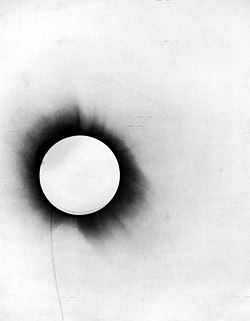
As we celebrate the creative impulse (in all of it forms and products), we might recall that it was on this date in 1919 that Arthur Eddington confirmed Einstein’s light-bending prediction– a part of The Theory of General Relativity– using photos of a solar eclipse. Eddington’s paper the following year was the “debut” of Einstein’s theoretical work in most of the English-speaking world (and occasioned an urban legend: when a reporter supposedly suggested that “only three people understand relativity,” Eddington was supposed to have jokingly replied “Oh, who’s the third?”)
You must be logged in to post a comment.