Posts Tagged ‘DNA’
We are collaborators in creation*…
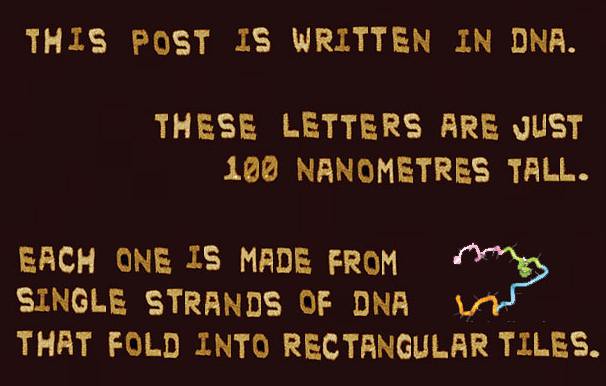
Scientists have developed a way to carve shapes from DNA canvases, including all the letters of the Roman alphabet, emoticons and an eagle’s head.
Bryan Wei, a postdoctoral scholar at Harvard Medical School in Boston, Massachusetts, and his colleagues make these shapes out of single strands of DNA just 42 letters long. Each strand is unique, and folds to form a rectangular tile. When mixed, neighbouring tiles stick to each other in a brick-wall pattern, and shorter boundary tiles lock the edges in place…

Read the story on Nature‘s blog (or the full paper in Nature).
As CoDesign observes,
Creating a DNA alphabet was simply a vivid way for the scientists to demonstrate the flexibility and atomic-level accuracy of their system. But you don’t even need a PhD in order to use it, because they also created a graphical user interface that lets anyone with a mouse (and access to an atomic force microscope, the device that “draws” the DNA) sketch out the shape they want without mucking around with code or technical specs.
Still, the DNAlphabet could actually have intriguing applications of its own. Security-minded (or just plain egomaniacal) researchers could use these microscopic structures to watermark their synthetic-biological products, just like that scene in Blade Runner. Even cooler: “One can imagine we can use the shapes as invisible ink in a secret-agent way,” says Wei. “High density information can be delivered in a test tube or simply as powder.”
* “Our duty, as men and women, is to proceed as if limits to our ability did not exist. We are collaborators in creation.” – Pierre Teilhard de Chardin
***
As we reach for the tweezers, we might recall that it was on this date that Marie Skłodowska-Curie (AKA Madame Curie) went before the examination committee at the University of Paris for her PhD. She was awarded the degree… and later that year, she was awarded the Nobel Prize in Physics for her work on “radioactivity” (a term she coined). She became the first female professor at the University, and went on to win another Nobel (the second, in Chemistry)– the first woman to win a Nobel Prize, the only woman to date to win in two fields, and the only person to win in multiple sciences… on the basis of which, in 1995, she became the first woman to be entombed on her own merits in the Panthéon.
Her work was central to a wave of research that enabled the development of x-ray crystallography, the tool used by Rosalind Franklin in making critical contributions to the project that unravelled the fine molecular structures of DNA (for which Crick, Watson, and Wilkins won the Nobel Prize).

Marie Curie
“Nature uses only the longest threads to weave her patterns, so that each small piece of her fabric reveals the organization of the entire tapestry”*…
Clouds are not spheres, mountains are not cones, coastlines are not circles, and bark is not smooth, nor does lightning travel in a straight line.
—Benoit Mandelbrot, The Fractal Geometry of Nature
Benoit Mandelbrot, Sterling Professor of Mathematics at Yale and the father of fractal geometry, died last Thursday at age 85. As Heinz-Otto Peitgen, professor of mathematics and biomedical sciences at the University of Bremen, observed, “if we talk about impact inside mathematics, and applications in the sciences, he is one of the most important figures of the last 50 years.”
“I decided to go into fields where mathematicians would never go because the problems were badly stated,” Dr. Mandelbrot once said. “I have played a strange role…” Indeed, one hopes that Mandelbrot had the consolation of his own fascination as he contemplated the diffusion pattern of the pancreatic cancer that killed him.
At TED2010, mathematics legend Benoit Mandelbrot develops a theme he first discussed at TED in 1984 — the extreme complexity of roughness, and the way that fractal math can find order within patterns that seem unknowably complicated.
* Richard Feynman
In other sad news, Barbara Billingsley, the avatar of American motherhood in her role as Mrs. Cleaver on Leave it to Beaver, passed away on Saturday.

As we marvel at patterns nested within themselves, we might recall that it was on this date in in 1962 that In 1962, Dr. James D. Watson, Dr. Francis Crick, and Dr. Maurice Wilkins won the Nobel Prize for Medicine and Physiology for their work in determining the double-helix molecular structure of DNA (deoxyribonucleic acid).

Who you callin’ “Cupcake”?…
Cupcakes are, of course, all the vogue. And as their popularity has exploded, they’ve begun to speciate…
There are Periodic Table Cupcakes…

Elmo cupcakes…

Watchmen Cupcakes…

And oh so many others (for a nifty selection, starting with the ones above, poke around at Laughing Squid and at Friday Foodie)…
But cupcakes, in their mainstream “chocolate or vanilla” manifestations, or in these more elaborate guises, have remained… well, dainty.
No longer! Now the formidable folks at Butch Bakery (“Where butch meets buttercream”) offer cupcakes in 12 flavors and six “styles”: Woodland Camo, Wood Grain, Houndstooth, Plaid, Checkerboard or Marble.

Got beer?
As we bench press a baker’s dozen, we might recall that it was on this date in 1953 that James D. Watson and Francis Crick announced to friends that they had determined the chemical structure of DNA; the formal announcement took place on April 25 following publication in the April issue of Nature (published April 2). The not-yet-Nobel-laureates walked into the Eagle pub in Cambridge and announced, “We have found the secret of Life.”

Emergent-cy…

Scripps Research Institute biologist Gerald Joyce (pictured above) and his colleague Tracey Lincoln have built an “immortal molecule.” They have synthesized RNA enzymes – ribonucleic acid enzymes also known as ribozymes – that replicate themselves without the help of any proteins or other cellular components. And since these simple nucleic acids can act as catalysts, the process can continue indefinitely.
As Cosmos reports,
The ultimate goal is to create genetic systems that behave like life, and are for all intents “life” as we know it, but arose without using biological systems.
“The aim is to create systems that have inventive capabilities, that can develop novel solutions to challenges posed by the environment. But that we don’t have yet,” [Joyce] said.
“What we do have is a self-sustained chemical system that undergoes Darwinian evolution. They are synthetic genetic systems, and they are evolving. But they’re not living because they don’t yet show the capacity to invent a whole cloth of functions. The idea is to give them enough information wherewithal [genetic building blocks] so they can start inventing their own solutions rather than just optimizing existing solutions,” he added.
Joyce said it was not practical to synthesize the more complex DNA-based life we know from scratch; it’s too complex and probably beyond today’s science. But it is conceivable to start with a much more basic form of life-like molecules based on RNA, and use evolution to build on them.
Many scientists believe that early life was based on RNA and predated the arrival of life based on deoxyribonucleic acid (DNA) and proteins. RNA, which can both store information like DNA as well as act as an enzyme like proteins, may have supported pre-cellular life.
A leading proponent of this so-called “RNA world” hypothesis, Joyce believes that RNA-based catalysis and information storage may have been the first step in the evolution of cellular life.
Read the whole story here.
As we search our closets for those chemistry sets, we might celebrate the emergence of a technology that took on a life of its own and changed… well, everything: this date in 1455 is the traditionally-given date of the publication of the Gutenberg Bible, the first Western book printed from movable type. The Jikji— the world’s oldest known extant movable metal type printed book– was published in Korea in 1377. Bi Sheng created the first known moveable type– out of wood– in China in 1040.

You must be logged in to post a comment.