Posts Tagged ‘DNA’
“Life is a DNA software system”*…

DNA from discarded cigarette butts and chewed up gum has been used to create a series of life-sized 3D printed portraits for a new exhibition at the Wellcome Collection.
American artist Heather Dewey-Hagborg walked the streets of New York picking up cigarettes and hair for her project called Stranger Visions.
She then analysed the DNA to work out the gender and ethnicity of the people involved as well as their likely eye colour and other traits including the size of their nose, before using face-generating software and a 3D printer to create a series of speculative portraits…
More– and more photos– at “3D printed portraits made with DNA from cigarette butts to feature in new Wellcome Collection display.”
See also the analogically-related “Artificial Intelligence Generates Humans’ Faces Based on Their Voices.”
###
As we noodle on nature and nurture, we might recall that it was on this date in 1981 that the USDA announced the first genetically-engineered vaccine for any animal or human disease: an immunization against Hoof and Mouth Disease (also known as Foot and Mouth Disease, or FMD), created using gene splicing.

“It is not the strongest or the most intelligent who will survive but those who can best manage change”*…

In the near future, we will be in possession of genetic engineering technology which allows us to move genes precisely and massively from one species to another. Careless or commercially driven use of this technology could make the concept of species meaningless, mixing up populations and mating systems so that much of the individuality of species would be lost. Cultural evolution gave us the power to do this. To preserve our wildlife as nature evolved it, the machinery of biological evolution must be protected from the homogenizing effects of cultural evolution.
Unfortunately, the first of our two tasks, the nurture of a brotherhood of man, has been made possible only by the dominant role of cultural evolution in recent centuries. The cultural evolution that damages and endangers natural diversity is the same force that drives human brotherhood through the mutual understanding of diverse societies. Wells’s vision of human history as an accumulation of cultures, Dawkins’s vision of memes bringing us together by sharing our arts and sciences, Pääbo’s vision of our cousins in the cave sharing our language and our genes, show us how cultural evolution has made us what we are. Cultural evolution will be the main force driving our future…
An important essay by Freeman Dyson, emeritus professor of physics at the Institute for Advanced Study in Princeton: “Biological and Cultural Evolution– Six Characters in Search of an Author.”
* Leon C. Megginson (often misattributed to Darwin, on whose observations Megginson based his own)
###
As we agonize over the anthropocene, we might recall that it was on this date in 1968 that James Watson’s The Double Helix was published. A memoir, it describes– with manifest hubris– “perhaps the most famous event in biology since Darwin’s book,” the 1953 discovery, published by Watson and Francis Crick, of the now-famous double helix structure of the DNA molecule.
Crick, however, viewed Watson’s book as “far too much gossip,” and believed it gave short shrift to Rosalind Franklin’s vital contribution via clues from her X-ray crystallography results. It was originally slated to be published by Harvard University Press, Watson’s home university, Harvard dropped the arrangement after protests from Francis Crick and Maurice Wilkins (their supervisor, who shared the Nobel Prize); it was published instead by Atheneum in the United States and Weidenfeld & Nicolson in the UK.
In any case, the book opens a window into the competitiveness, struggles, doubts, and human foibles that were baked into this landmark in science.

“All of today’s DNA, strung through all the cells of the earth, is simply an extension and elaboration of [the] first molecule”*…
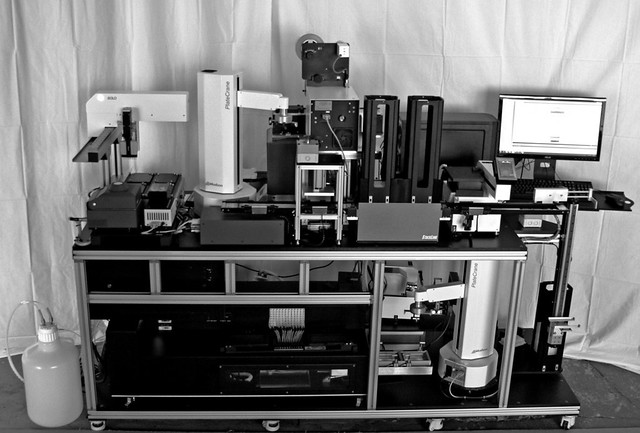
The first biological teleporter sits in a lab on the lower level of the San Diego building that houses Synthetic Genomics Inc. (SGI), looking something like a super-sized equipment cart.
The device is actually conglomeration of small machines and lab robots, linked to each other to form one big machine. But this one can do something unprecedented: it can use transmitted digital code to print viruses.
In a series of experiments culminating last year, SGI scientists used genetic instructions sent to the device from elsewhere in the building to automatically manufacture the DNA of the common flu virus. They also produced a functional bacteriophage, a virus that infects bacterial cells.
Although that wasn’t the first time anyone had made a virus from DNA parts, it was the first time it was done automatically, without human hands.
The device, called a “digital-to-biological converter” was unveiled in May. Though still a prototype, instruments like it could one day broadcast biological information from sites of a disease outbreak to vaccine manufacturers, or print out on-demand personalized medicines at patients’ bedsides…
… or project life-as-we-know it into outer space. More at “Biological Teleporter Could Seed Life Through Galaxy.”
* Lewis Thomas, The Medusa and the Snail
###
As we beam up, we might spare a thought for Sidney Walter Fox; he died on this date in 1998. A biochemist, he was responsible for a series of discoveries about the origin of life. Fox believed in the process of abiogenesis, by which life spontaneously organized itself from the colloquially known “primordial soup,” poolings of various simple organic molecules that existed during the time before life on Earth. In his experiments (which possessed, he believed, conditions like those of primordial Earth), he demonstrated that it is possible to create protein-like structures from inorganic molecules and thermal energy. Dr. Fox went on to create microspheres that he said closely resembled bacterial cells and concluded that they could be similar to the earliest forms of life or protocells.

“The rewards for biotechnology are tremendous – to solve disease, eliminate poverty, age gracefully. It sounds so much cooler than Facebook.”*…
It’s hard to tell precisely how big a role biotechnology plays in our economy, because it infiltrates so many parts of it. Genetically modified organisms such as microbes and plants now create medicine, food, fuel, and even fabrics. Recently, Robert Carlson, of the biotech firm Biodesic and the investment firm Bioeconomy Capital, decided to run the numbers and ended up with an eye-popping estimate. He concluded that in 2012, the last year for which good data are available, revenues from biotechnology in the United States alone were over $324 billion.
“If we talk about mining or several manufacturing sectors, biotech is bigger than those,” said Carlson. “I don’t think people appreciate that.”…
What makes the scope of biotech so staggering is not just its size, but its youth. Manufacturing first exploded in the Industrial Revolution of the 19th century. But biotech is only about 40 years old. It burst into existence thanks largely to a discovery made in the late 1960s by Hamilton Smith, a microbiologist then at Johns Hopkins University, and his colleagues, that a protein called a restriction enzyme can slice DNA. Once Smith showed the world how restriction enzymes work, other scientists began using them as tools to alter genes…
The whole story at “The Man Who Kicked Off the Biotech Revolution.”
###
As we clean our petri dishes, we might recall that it was on this date in 182 that Charles M. Graham was issued the first U.S. patent for artificial teeth. The record, and its details, were lost in the Patent Office fire of December, 1836. Dentures or false teeth had been around for eons. There is evidence Etruscans in what is today northern Italy made dentures out of human or animal teeth as early as 7000 BC; George Washington owned four separate sets of dentures (though none were wooden, despite a myth to that effect). But Graham was the first to patent his approach.

“Pseudoscience often relies on a witches’ brew of scientific terms… half-baked into simplistic metaphors that do not correspond with testable reality”*…

A new wine delivery service called Vinome is promising to deliver “the ultimate personalized wine experience” — customized to your DNA.
There isn’t much (or, really, any) science to back it up. But it’s got a very big name in its corner. Vinome just inked a deal with a startup called Helix, which in turn is backed by the world’s biggest DNA sequencing company, the powerhouse known as Illumina. For the past 15 years, Illumina has been selling machines that can quickly decode the human genome. Medical researchers around the world use them. But the company wants to conquer the consumer market, too. That’s why it spent $100 million to launch Helix, which teams up with app developers who can find creative ways to use a customer’s genetic data. Such as selling them wine.
For about $65 per bottle, Vinome promises to pick out “great wines that are perfectly paired to you” based on an analysis of 10 genetic variants in your DNA, collected via saliva samples. The company — which is based, of course, in Northern California’s wine country — even incorporated the distinctive double helix of DNA into its logo of a corkscrew.
Medical geneticist Dr. Jim Evans isn’t impressed. “It’s just completely silly. Their motto of ‘A little science and a lot of fun’ would be more accurately put as ‘No science and a lot of fun,’” said Evans, who’s a professor and researcher at the University of North Carolina. “I’d put this in the same category as DNA matching to find your soulmate,” he said. “We just simply don’t know enough about the genetics of taste to do this on any accurate basis.”…
For more, pop the cork at: “Fruity with a hint of double helix: A startup claims to tailor wine to your DNA.”
And for more on the larger phenomenon of which Vinome is a part, see “‘Personalized nutrition’ isn’t going to solve our diet problems.”
[Image above sourced here]
###
As we ponder personalization, we might recall that today is International Merlot Day. As Wine Cellar Insider observes…
When asked for the most widely planted grape in Bordeaux , many wine lovers would say Cabernet Sauvignon. That is not the case. There are more hectares devoted to Merlot than any other grape in Bordeaux. To give you an idea on how much Merlot is planted in Bordeaux, close to 62% of all vines in Bordeaux are Merlot taking up about 69,138 hectares. Cabernet Sauvignon is a distant second with about 25% of the region’s planting’s totaling close to 28,347 hectares.
Merlot is not only popular in Bordeaux. In fact, it’s the most widely planted grape in France! Merlot is also successfully planted in Switzerland, Australia, Argentina and numerous other countries, as well as in America…

You must be logged in to post a comment.