Posts Tagged ‘commerce’
“Of course our lives are regulated. When you come to a stop sign, you stop; if you want to go fishing, you get a license; if you want to shoot ducks, you can shoot only three ducks. The alternative is dead bodies at the intersection, no fish, and no ducks. OK?”*…

After a characteristically-clear explanation of the ways in which the “monopoly practice” concerns around Google, Amazon, and the other on-line giants are different from those the U.S. has traditionally tried to manage– they limit/manage choice– the ever-illuminating Tim O’Reilly argues for a fresh approach to anti-trust:
So how are we therefore best to decide if these Big Tech platforms need to be regulated?
In one famous exchange, Bill Gates, the founder and former CEO of Microsoft, told Chamath Palihapitiya, the one-time head of the Facebook platform:
“This isn’t a platform. A platform is when the economic value of everybody that uses it, exceeds the value of the company that creates it. Then it’s a platform.”
Given this understanding of the role of a platform, regulators should be looking to measure whether companies like Amazon or Google are continuing to provide opportunity for their ecosystem of suppliers, or if they’re increasing their own returns at the expense of that ecosystem.
Rather than just asking whether consumers benefit in the short term from the companies’ actions, regulators should be looking at the long-term health of the marketplace of suppliers—they are the real source of that consumer benefit, not the platforms alone. Have Amazon, Apple, or Google
earned
their profits, or are they coming from monopolistic rents?
How might we know whether a company operating an algorithmically managed marketplace is extracting rents rather than simply taking a reasonable cut for the services it provides? The first sign may not be that it is raising prices for consumers, but that it is taking a larger percentage from its suppliers, or competing unfairly with them.
Before antitrust authorities look to remedies like breaking up these companies, a good first step would be to require disclosure of information about the growth and health of the supply side of their marketplaces. The statistics about the growth of its third-party marketplace that Bezos trumpeted in his shareholder letter tell only half the story. The questions to ask are who profits, by how much, and how that allocation of rewards is changing over time…
Data is the currency of these companies. It should also be the currency of those looking to regulate them. You cannot regulate what you don’t understand. The algorithms that these companies use may be defended as trade secrets, but their outcomes should be open to inspection.
An important read: “Antitrust regulators are using the wrong tools to break up Big Tech.”
* Molly Ivins
###
As we bust trusts, we might recall that it was on this date in 1974 that the Supreme Court handed down its unanimous decision in United States v. Nixon, ordering him to deliver tape recordings and other subpoenaed materials to a federal district court. Special prosecutor Leon Jaworski had subpoenaed the tapes as part of on-going impeachment proceedings; the White House had sued to quash; and the decision is widely viewed as a crucial precedent limiting the power of any U.S. president to claim executive privilege.

“The map? I will first make it.”*…

Nautical map of the world by Nicolo di Caverio, 1506
From the fifteenth to the eighteenth century, European powers sent voyagers to lands farther and farther away from the continent in an expansionist period we now call the Age of Exploration. These journeys were propelled by religious fervor and fierce colonial sentiment—and an overall desire for new trade routes. They would not have been possible without the rise of modern cartography. While geographically accurate maps had existed before, the Age of Exploration saw the emergence of a sustained tradition of topographic surveying. Maps were being made specifically to guide travelers. Technology progressed quickly through the centuries, helping explorers and traders find their way to new imperial outposts—at least sometimes. On other occasions, hiccups in cartographic reasoning led their users even farther astray…
How cartography made early modern global trade possible: “First you make the maps.”
* Voss
###
As we find our way, we might recall that it was on this date in 1578– the same day that King Henry III laid the first stone of the Pont Neuf (“New Bridge”), the oldest remaining bridge in Paris– that the Catacombs of Rome were (re-)discovered. Underground burial sites in use mostly in the 2nd and 3rd centuries AD, they were decorated with both iconographic and stylistic paintings and mosaics. After their rediscovery, it took several decades to explore and map them; indeed, new discoveries have been made as recently as the 1950s.

Eucharistic fresco in the Catacombs [source]
“We don’t just borrow words; on occasion, English has pursued other languages down alleyways to beat them unconscious and rifle their pockets for new vocabulary”*…

In the early history of international trade, when exotic goods traveled to new regions, their native names sometimes hitchhiked along with them.
Naturally, the Germans have a term – Wanderwörter – for these extraordinary loanwords that journey around the globe, mutating subtly along the way…
See the map above in larger format, and learn more about each of the examples it illustrates at: “Mapping the Spread of Words Along Trade Routes.” [sourced from Lapham’s Quarterly]
* James Nicoll
###
As we ponder the provenance of our produce, we might recall that it was on this date 1397 that Geoffrey Chaucer “told” The Canterbury Tales for the first time at the court of Richard II.
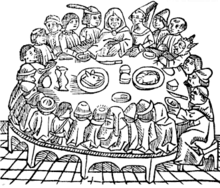
A woodcut from William Caxton‘s second edition of The Canterbury Tales, printed in 1483
“Life without industry is guilt; industry without art is brutality”*…

It is often said that art feeds the soul. But culture and the arts also fuel the economy directly: The arts contribute more than $800 billion a year to U.S. economic output, amounting to more than 4 percent of GDP.
That figure is based on detailed data from the U.S. Bureau of Economic Analysis (part of the Department of Commerce) and the National Endowment for the Arts, summarized in a report released earlier this month.The report tracks the aggregate performance of 35 key arts-and-culture fields, including broadcasting, movies, streaming, publishing, the performing arts, arts-related retail, and more…

The contribution of culture and art to the U.S. economy is bigger than the economic output of Sweden or Switzerland; learn more at “The Economic Power of American Arts and Culture.”
* John Ruskin
###
As we see to our souls, we might spare a pining thought for Petrarch (Francesco Petrarca); it was on this date in 1327, after he’d given up his vocation as a priest, that he first set eyes on “Laura” in the church of Sainte-Claire d’Avignon– an encounter that awoke in him a passion that spawned the 366 poems in Il Canzoniere (“Song Book”).
Considered by many to have been “the Father of Humanism,” and reputed to have coined the term “Renaissance,” Petrarch was most famous in his time for his paeans to his idealized lover (who was, many scholars believe, Laura de Noves, the wife of Hugues de Sade). But Petrarch’s more fundamental and lasting contribution to culture came via Pietro Bembo who created the model for the modern Italian language in the 16th century largely based on the works of Petrarch (and to a lesser degree, those of Dante and Boccaccio).
Laura de Noves died on this date in 1348.

Lura de Noves

Petrarch
“It’s discouraging to think how many people are shocked by honesty and how few by deceit”*…

“Business is the ordinary means of living for nearly all of us,” P.T. Barnum wrote in his 1865 book The Humbugs of the World: An Account of Humbugs, Delusions, Impositions, Quackeries, Deceits and Deceivers Generally, in All Ages. “ ‘There’s cheating in all trades but ours,’ is the prompt reply from the bootmaker with his brown paper soles, the grocer with his floury sugar and chicoried coffee…the newspaper man with his ‘immense circulation,’ the publisher with his ‘Great American Novel,’ the city auctioneer with his ‘Pictures by the Old Masters’—all and everyone protest each his own innocence, and warn you against the deceits of the rest.”
But…
The greatest humbug of all is the man who believes—or pretends to believe—that everything and everybody are humbugs. If you can imagine a hog’s mind in a man’s body—sensual, greedy, selfish, cruel, cunning, sly, coarse, yet stupid, shortsighted, unreasoning, unable to comprehend anything except what concerns the flesh, you have your man. He thinks himself philosophic and practical, a man of the world; he thinks to show knowledge and wisdom, penetration, deep acquaintance with men and things. Poor fellow! he has exposed his own nakedness. Instead of showing that others are rotten inside, he has proved that he is. He claims that it is not safe to believe others—it is perfectly safe to disbelieve him. He claims that every man will get the better of you if possible—let him alone! Selfishness, he says, is the universal rule—leave nothing to depend on his generosity or honor; trust him just as far as you can sling an elephant by the tail. A bad world, he sneers, full of deceit and nastiness—it is his own foul breath that he smells; only a thoroughly corrupt heart could suggest such vile thoughts. He sees only what suits him, as a turkey buzzard spies only carrion, though amid the loveliest landscape. I pronounce him who thus virtually slanders his father and dishonors his mother, and defiles the sanctities of home, and the glory of patriotism, and the merchant’s honor, and the martyr’s grave, and the saint’s crown—who does not even know that every sham shows that there is a reality, and that hypocrisy is the homage that vice pays to virtue—I pronounce him—no, I do not pronounce him a humbug, the word does not apply to him. He is a fool…
Via Lapham’s Quarterly, “The Great American Humbug.”
Blithe Spirit
###
As we honor honesty, we might send licentious birthday greetings to Savinien de Cyrano de Bergerac; he was born on this date in 1619. While he was a bold and innovative author in the 17th century libertine literary tradition, he is better remembered as the title character he inspired in Edmond Rostand’s noted drama Cyrano de Bergerac, which, although it includes elements of the real Cyrano’s life, is larded with invention and myth.
Cyrano was possessed of a prodigious proboscis, over which he is said to have fought more than 1,000 duels. Surely as importantly, his writings, which mixed science and romance, influenced Jonathan Swift, Edgar Alan Poe, Voltaire– and Moliere, who “borrowed freely” from Cyrano’s 1654 comedy Le Pédant joué (The Pedant Tricked).

You must be logged in to post a comment.