Posts Tagged ‘Comic strip’
“Give me juicy autumnal fruit, ripe and red from the orchard”*…
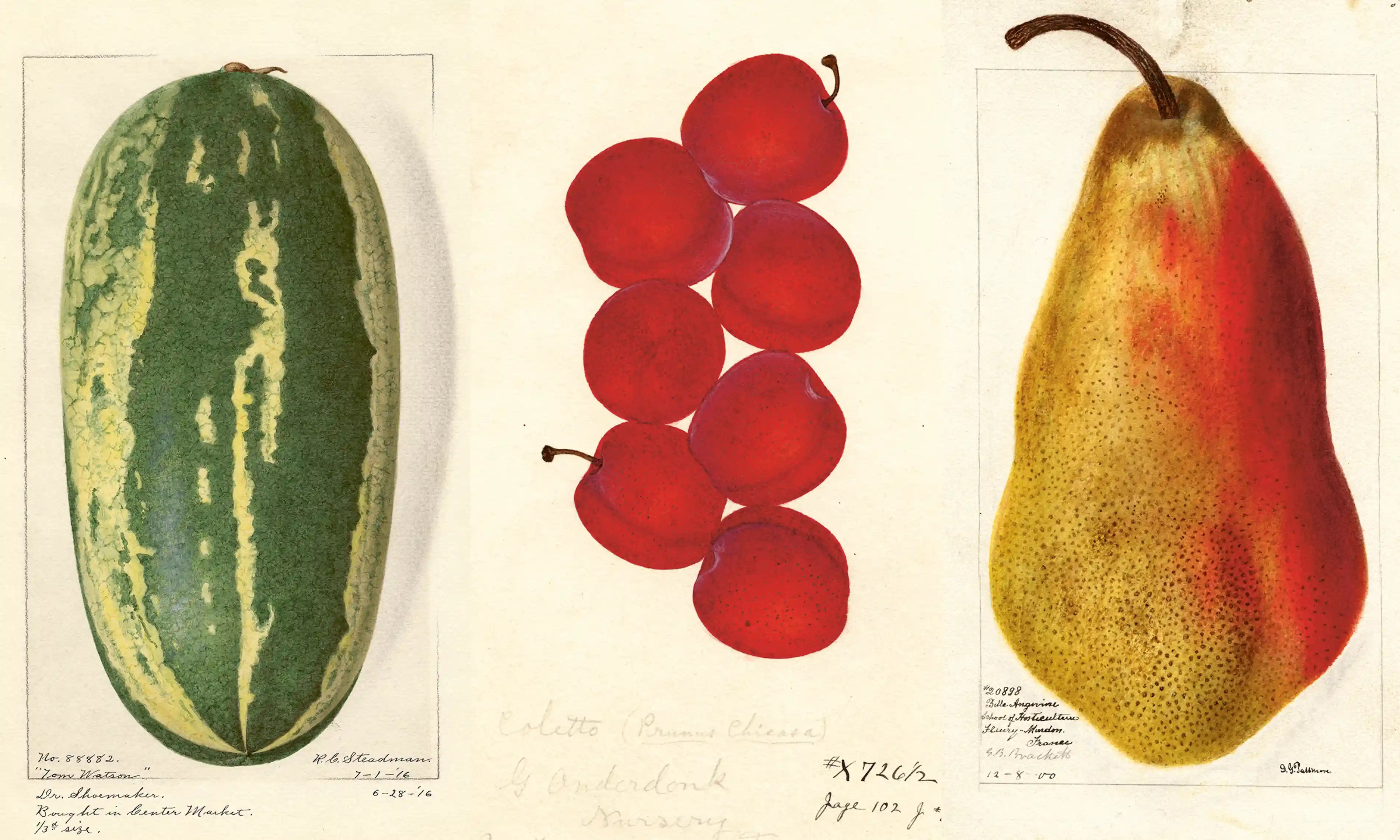
American fruit and nuts…
Pascale Georgiev, editorial director at Atelier Éditions, was researching botanical artwork a few years ago when she came across the US Department of Agriculture’s pomological watercolour collection, an archive of 7,500 watercolours of fruit and nuts grown in the US between 1886 and 1942, mostly created before photography was widespread. The discovery led to a new book, An Illustrated Catalog of American Fruits & Nuts (Atelier, £44), full of images that Georgiev describes as irresistible. “The belle angevine pear… makes my heart sing and I’m partial to a plum named tragedy.” She’s also proud that the book showcases women working in science: “Nine of this US department’s 21 artists were women. A rare thing at the time.” Most of all she’d like readers to think about biodiversity. “I hope they share my delight in discovering the history of the fruit we consume, alongside beautiful artworks.”
A glorious collection: “Get fruity: vintage botanical watercolors,” from @guardian.
* Walt Whitman
###
As we ruminate on ripeness, we might recall that it was on this date in 1950 that the daily comic strip Peanuts premiered in eight newspapers: The Washington Post, The Chicago Tribune, The Minneapolis Tribune, The Allentown Call-Chronicle, The Bethlehem Globe-Times, The Denver Post, The Seattle Times, and The Boston Globe. Its creator, Charles Schulz had developed the concept as a strip (L’il Folks) in his hometown paper, The St. Paul Pioneer Press, from 1947 to 1950. At its peak, Peanuts ran in over 2,600 newspapers, with a readership of 355 million in 75 countries, and was translated into 21 languages.

“What is written without effort is in general read without pleasure”*…

When a man is tired of memes, he is tired of life.
Samuel Johnson’s original observation pertained to his hometown of London, the streets of which he knew better than most. As a man of letters and author of a best-selling dictionary, he wrote volumes [see here]. But nowadays, in the words of one English professor, “Samuel Johnson is one of those figures whom everyone quotes and no one reads.” (The use of “whom” is how you know an English professor wrote that.)
That’s perhaps as it should be: As the subject of the first modern biography [see here], Johnson (1709-84) was known as the best social talker who ever lived. And 228 years after his death, referencing Johnson’s portrait by Sir Joshua Reynolds became a universally recognized expression of this profane sentiment:

Resurrecting history’s most quotable man: “The memeification of Dr. Johnson“
For more on the remarkable Dr. J., see “A Word A Day, the Doctor’s Way.”
* Samuel Johnson
###
As we share the love with Shakespeare, we might recall that it was on this date in 2000 that Charles M. Schulz published the last daily Peanuts strip. (The final Sunday panel ran on on February 13 of that year.)

“We must believe in free will — we have no choice”*…

In March, a group of neuroscientists and philosophers announced that they’ve received $7 million to study the nature of free will and whether humans have it. Uri Maoz, a computational neuroscientist at Chapman University, is leading the project. “As a scientist, I don’t know what it entails to have free will,” he said in an interview with Science. That’s a philosophical puzzle. But once Maoz’s philosopher colleagues agree on a definition, he can get to work to see if it occurs in humans. “This is an empirical question. It may be that I don’t have the technology to measure it, but that is at least an empirical question that I could get at.”…
Or can he? An update on neuroscientific efforts to answer a philosophical question– and an appreciation of your correspondent’s favorite television series, The Good Place: “Can Neuroscience Understand Free Will?”
* Isaac Bashevis Singer
###
As we muse on motivation, we might recall that it was on this date in 1910 that George Herriman‘s signature characters, Krazy Kat and Ignatz Mouse, made their first appearance in the bottom of the frames in Herriman’s The Dingbat Family daily comic strip. They got their own strip three years later, scored a Sunday panel in 1916– and delighted readers with the surreal philosophical questions they raised until 1944.

“What, me worry?”*…

When Tales Calculated to Drive You MAD—Humor in a Jugular Vein first appeared in 1952, it was like nothing ever seen before. The comic book parodied comic books, which were then under assault as purveyors of violence and degeneracy that contributed to delinquency, homosexuality, and, of course, the spread of communism. Mad made fun of all that, too.
Within three years, the publication became Mad Magazine, a name change that allowed it to flaunt the prohibitions of the Comics Code Authority. The CCA was an industry effort to tone down comics and hold state censorship at bay. Soon television, movies, advertising, and politics all joined comics as fodder for Mad’s mordant humor. Indeed, the takeaway of Mad was that all of the above were forms of advertising.
Nathan Abrams argues that Mad’s non-partisan critique of Cold War America had more effect than the more famous New York intellectuals working for Dissent, Commentary, and Partisan Review… No icon was safe: Mickey Mouse, Khrushchev, Joe McCarthy, Superman, George Washington, Norman Rockwell, Madison Avenue, and psychoanalysis all become grist for the writers and artists working in the gap-toothed Alfred E. Neuman’s mill…
“How Mad Magazine Informed America’s Cultural Critique“
* Alfred E. Newman
###
As we honor our elders, we might recall that it was on this date in 1939 that one of Mad‘s targets– Superman– went wide into the culture: the daily Superman comic strip premiered. (Superman, the character, had debuted in the comic Action #1 the prior year.) The strips ran continuously until May 1966; at their peak they were run in over 300 daily newspapers and 90 Sunday papers, with a readership of over 20 million.

“There is no ‘ordinary person'”*…

Tobar Mayo in Abar, the First Black Superman
As Black Panther continues to slay at the box office, a look at one of that blockbuster’s less well-known– indeed, virtually anonymous– antecedents…
Abar, the First Black Superman is truly a cinematic marvel. It has its heart in the right place and fumbles spectacularly in every way possible—the painfully preachy dialogue, the scrappy special effects, the too long running time. But even if it’s not anywhere close to the achievement of Black Panther, it’s a fascinating product of the time and more proof that black superheroes have long existed outside the Marvel universe. And just like Black Panther, their superpowers are almost always political…
An extraordinary story: “One of Cinema’s First Black Superheroes Is Not Who You Think It Is.”
* “The disciplines of physical exercise, meditation and study aren’t terribly esoteric. The means to attain a capability far beyond that of the so-called ordinary person are within the reach of everyone, if their desire and their will are strong enough. I have studied science, art, religion and a hundred different philosophies. Anyone could do as much. By applying what you learn and ordering your thoughts in an intelligent manner it is possible to accomplish almost anything. Possible for an ‘ordinary person.’ There’s a notion I’d like to see buried: the ordinary person. Ridiculous. There is no ‘ordinary person’.” – that most super of superheroes, Ozymandias, in Alan Moore’s Watchmen
###
As we don our capes, we might recall that it was on this date in 1935 that America was introduced to Little Lulu (in the February 23 issue of The Saturday Evening Post), appearing as a flower girl at a wedding and mischievously strewing the aisle with banana peels. Created by Marjorie Henderson Buell (whose work appeared under the name “Marge”), Little Lulu ran as a regular panel in the Post through 1944; then as a comic book and a comic strip into the 1980s. She also appeared in a series of animated theatrical cartoons and in a number of TV series and specials.

You must be logged in to post a comment.