Posts Tagged ‘cities’
“The city’s full of people who you just see around”*…

An archaeologist’s reconstruction of Dvin, one of the most ancient settlements of the Armenian Highland and an ancient capital of Armenia [source], and modern day New York City [source]
Much of the history of the city—its built forms and its politics, the urban experience, and the characteristic moral ambivalence that cities arouse—can be written as a tension between the visible and the invisible. What and who gets seen? By whom? Who interprets the city’s meaning? What should remain unseen?
Rulers of cities have always had an interest in visibility, both in representing their power and in controlling people by seeing them. The earliest cities emerged out of the symbiosis of religion and political power, and the temple and the citadel gave early urbanism its most visible elements…
Warren Breckman‘s fascinating history of the city as a place to see and be seen: “A Matter of Optics.”
* Terry Pratchett, Men at Arms
###
As we wonder, with Juvenal (and Alan Moore), who watches the watchmen, we might recall that it was on this date in 1752 that Benjamin Franklin and his son tested the relationship between electricity and lightning by flying a kite in a thunder storm. Franklin was attempting a (safer) variation on a set of French investigations about which he’d read. The French had connected lightning rods to a Leyden jar, but one of their experiments electrocuted the investigator. Franklin– who may have been a wastrel, but was no fool– used a kite; the increased height/distance from the strike reduces the risk of electrocution. (But it doesn’t eliminate it: Franklin’s experiment is now illegal in many states.)
In fact, (other) French experiments had successfully demonstrated the electrical properties of lightning a month before; but word had not yet reached Philadelphia.

The Treasury’s Bureau of Engraving and Printing created this vignette (c. 1860), which was used on the $10 National Bank Note from the 1860s to 1890s
“I am told there are people who do not care for maps, and I find it hard to believe”*…
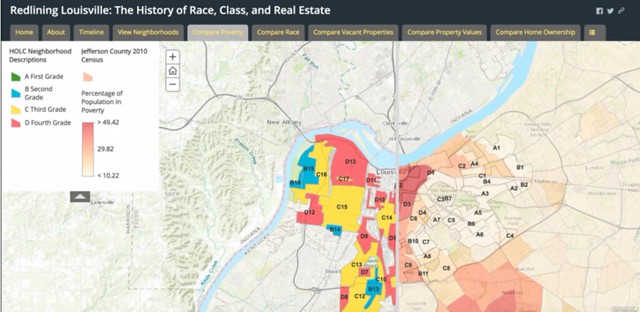
The confluence of different GPS technologies have led to more and more stunning map and data visualizations. Added bonus: casual map lovers have something to explore during periods of procrastination.
Last week, to the joy of data nerds everywhere, the Ash Center for Democratic Governance and Innovation at Harvard University’s Kennedy School of Government launched a database of interactive maps that use public sector data to visualize various city and community services, histories, and statistics. It sounds dry until you check out the selection of 200 mapping projects. Particularly interesting, deep dive-worthy ones include a map of immigrant communities across the U.S., a map of public art in Philadelphia, a visualization of the variety of trees in New York City, a map detailing the history of redlining and other forms of housing discrimination in Louisville, Kentucky [above]. and a map of access to high-speed internet in Kansas City, Missouri…
… and 195 others, including this visualization that answers the question “is the American dream still affordable?” and where:

More background at The Outline and at the Ash Center’s announcement page. Browse at their Data-Smart City Solutions Database search page.
* Robert Louis Stevenson
###
As we celebrate charts, we might send analytic birthday greetings to a man who drew epoch-making maps of a very different sort, Sigismund Schlomo Freud; he was born on this date in 1856. The father of psychoanalysis, he revolutionized the field of psychotherapy– so much so that later practitioners have often failed to recognize Freud’s scientific predecessors. Throughout his work (in such books as Interpretation of Dreams and the New Introductory Lectures on Psychoanalysis) he emphasized the role of unconscious and non-rational functioning, going against most contemporary thought by suggesting that dreams and “mistakes” may have affirmative meaning.

“With cities, it is as with dreams: everything imaginable can be dreamed”*…

The Transect
In 2012, the San Francisco Planning and Urban Research Association. an exhibition, “Grand Reductions: Ten diagrams that changed urban planning.”
The exhibition’s title – Grand Reductions – suggests the simple illustration’s power to encapsulate complex ideas. And for that reason the medium has always been suited to the city, an intricate organism that has been re-imagined (with satellite towns! in rural grids! in megaregions!) by generations of architects, planners and idealists. In the urban context, diagrams can be powerful precisely because they make weighty questions of land use and design digestible in a single sweep of the eye. But… they can also seductively oversimplify the problems of cities…
“The diagram can cut both ways: It can either be a distillation in the best sense of really taking a very complex set of issues and providing us with a very elegant communication of the solution,” [curator Benjamin] Grant says. “Or it can artificially simplify something that actually needs to be complex.”…
The high concepts that have informed the design of cities over the last century: “The Evolution of Urban Planning in 10 Diagrams.”
See also: “The cities and mansions that people dream of are those in which they finally live”*… and of course, Jane Jacob’s The Death and Life of Great American Cities and Christopher Alexander’s A New Theory of Urban Design.
* Italo Calvino
###
As we muse on metropoles, we might send exploratory birthday greeting to Eugene Fodor; he was born on this date in 1905. Noting that travel guides of his time were boring, he wrote a guide to Europe, On the Continent—The Entertaining Travel Annual, which was published in 1936– and became the cornerstone of a travel publishing empire– the Fodor’s Guides. He was elected to the American Society of Travel Agents (ASTA) World Travel Congress Hall of Fame, the only travel editor ever to be so honored.
In 1974, it was revealed that Fodor, a Hungarian-American who had joined the U.S. Army during World War II, had transferred to the Office of Strategic Services (the forerunner of the CIA) and served as a spy behind Nazi lines in occupied Hungary, Czechoslovakia, and Poland.

“I’m completely in favor of the separation of Church and State… These two institutions screw us up enough on their own, so both of them together is certain death”*…

The Redeemed Christian Church of God’s international headquarters in Ogun state has been transformed from a mere megachurch to an entire neighbourhood, with departments anticipating its members’ every practical as well as spiritual need.
A 25-megawatt power plant with gas piped in from the Nigerian capital serves the 5,000 private homes on site, 500 of them built by the church’s construction company. New housing estates are springing up every few months where thick palm forests grew just a few years ago. Education is provided, from creche to university level. The Redemption Camp health centre has an emergency unit and a maternity ward.
On Holiness Avenue, a branch of Tantaliser’s fast food chain does a brisk trade. There is an on-site post office, a supermarket, a dozen banks, furniture makers and mechanics’ workshops. An aerodrome and a polytechnic are in the works.
And in case the children get bored, there is a funfair with a ferris wheel…
In Nigeria, the line between church and city is rapidly vanishing: “Eat, pray, live: the Lagos megachurches building their very own cities.”
* George Carlin
###
As we re-read Max Weber, we might recall that it was on this date in 1545 that Renaissance writer, physician, humanist, monk, and Greek scholar François Rabelais received the permission of King François I to publish the Gargantua series– Gargantua and Pantagruel as we know it. In fact, Rabelais’ wild mix of fantasy, satire, the grotesque, bawdy jokes, and songs had been circulating pseudonymously for years. The censors of the Collège de la Sorbonne stigmatized it as obscene; and in a social climate of increasing religious oppression in a lead up to the French Wars of Religion, it had been treated with suspicion.
Rabelais wrote at a time of great ferment in the French language, and contributed mightily to it– both in coinage and in usage. But his influence was even broader (Tristram Shandy, e.g., is full of quotes from Rabelais) and continues to this day via writers including Milan Kundera, Robertson Davies, and Kenzaburō Ōe.

“The city, however, does not tell its past, but contains it like the lines of a hand”*…

Build your own with The Medieval Fantasy City Generator
* Italo Calvino
###
As we wander within the walls, we might spare a thought for Henry I, King of Castile and Toledo; he died on this date in 1217 when a loose roof tile fell on his head. He had become the monarch two years earlier, at age 10, when his father (Alfonso VIII of Castile) passed away. His mother was Eleanor of England, Queen of Castile, the daughter of Henry II of England and Eleanor of Aquitaine.

You must be logged in to post a comment.