Posts Tagged ‘tariffs’
“Jobs in factories will come roaring back into our country”*…
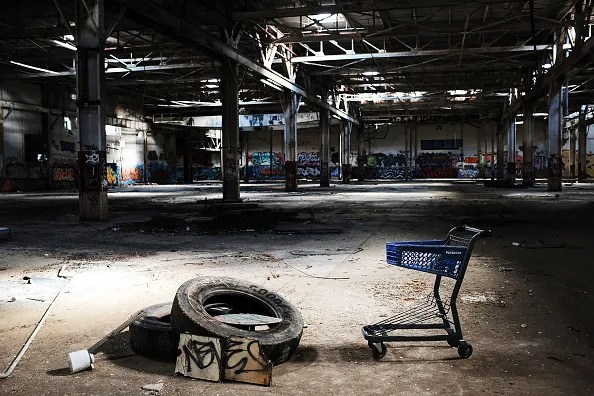
When President Trump announced sweeping tariffs on “Liberation Day” last spring, the promise was that manufacturing– and the jobs it provides– would return to the U.S. Scott Lincicome (from the conservative Cato Institute) assesses the “progress” to date…
US manufacturing ended 2025 with a thud, capping a rough year for the sector. To recap, manufacturers shed 63,000 jobs, according to the latest data from the Bureau of Labor Statistics. It wasn’t just labor that was hurting. The Institute for Supply Management’s manufacturing index clocked in at 47.9 for December, marking the 10th consecutive month of contraction as new orders were especially weak and costs at historically elevated levels.
Then there’s the Federal Reserve’s Beige Book of regional economic conditions and surveys from the regional Fed banks, which have repeatedly documented cases of manufacturers delaying hiring and investment amid weak market conditions, rising costs, shrinking profit margins and persistent uncertainty. As for the “hard” data, manufacturing capacity and output, while incomplete, sagged through the Fall.
Overall, the evidence reveals a sector that’s stagnant at best, and a long way from the manufacturing renaissance President Donald Trump promised when he took office for a second time a year ago. No wonder administration officials have pivoted from predicting a factory boom in 2025 to now saying it will happen in 2026 and beyond.
Better tax, regulatory, and monetary policy should indeed provide a tailwind for manufacturing, but the sector will probably continue to struggle. If so, Trump’s tariffs will be a big reason why…
[Lincicome unpacks the several ways that Trump’s tariffs have confounded domestic manufacturing: increased costs (especially on materials/compnents not available in the U.S.) and tariff and policy/regulations that might be politely called “inconsistent” (or less politely, “flighty”); last year, the US tariff code was amended 50 times)– which has added management/coordination costs (Federal Reserve economists estimate that domestic manufacturers will pay $39 billion to $71 billion annually to comply with the new regime, representing time and money they can’t spend on their businesses); but perhaps even more damagingly, has created uncertainty that has slowed corporate action/investment. Lincicome concludes…]
… The harms to manufacturers are consistent with research on past tariff episodes and help to explain why the sector struggled in 2025 — and why things might not get much better this year. Recent forecasts also suggest caution, with manufacturers and supply chain professionals predicting continued headwinds due to the costs, uncertainty and complexity of tariffs. And the Supreme Court won’t save them. If it invalidates Trump’s “emergency” tariffs in the coming days, administration officials have promised to invoke alternate authorities to recreate them.
Global supply chains took years to develop. They’ll take even longer to reorganize and will do so at great cost if, that is, they don’t break altogether in the meantime…
“America’s Manufacturing Renaissance Is Missing in Action,” (gift article) by @scottlincicome.bsky.social in @opinion.bloomberg.com.
Relatedly, Trump’s immigration policy was (like the “manufacturing boom”) supposed to have reduced the federal deficit. The Administration is deporting immigrants at a brisk clip– but at an extraordinary cost, both economically and constitutionally. That’s not to mention the costs to the targeted immigrants themselves, to their familires and to the companies and economies of which they have been preponderantly positive and productive parts. Indeed, a different group at Cato recently published a thorough study demonstrating that– far from being a drag on the economy– immigrants have reduced federal (and state and local) deficits by $14.5 Trillion since 1994… though, of course that contribution is now, thanks to the ICE storm, slowing down.
The immigration crackdown was also supposed to turbo-charge job growth (for the U.S.-born); it has not. Indeed, the climate of fear and the difficulty in securing visas has led to a hiring boom abroad: “Silicon Valley can’t import talent like before. So it’s exporting jobs.”
It’s easy to see Trump’s election and the imposition of his economic and immigration policies as America’s Brexit. That abrupt rupture of social, cultural, and economic conventions is now about a decade old… and the results aren’t pretty…
Brexit, the United Kingdom’s decision to withdraw from the European Union, is a rare contemporary example of a major developed economy raising trade barriers and more generally pulling back from international economic integration. When the Brexit referendum took place in 2016, academic and professional economists generally forecast that the policy about-face would result in a negative hit to the United Kingdom’s economy of about 4% of GDP over the long-term. Rather than a sudden, visible economic shock following the vote, the costs of Brexit have been gradual and cumulative. Now, almost a decade later, new research aims to assess Brexit’s actual impact on the United Kingdom’s economy, which involves the challenging task of comparing the country’s economic indicators to what they would have been if the United Kingdom had remained in the European Union. This research finds that, ten years on, the economic cost of Brexit has been larger than analysts predicted and that prolonged policy uncertainty contributed importantly to the magnitude of the impact… We estimate that by 2025, Brexit had reduced UK GDP by 6% to 8%, with the impact accumulating gradually over time… Understanding the ways in which Brexit resulted in a drag on economic growth for the United Kingdom provides potential lessons about the costs of abruptly pulling back from the global economy for other countries… – “The Economic Costs of Brexit on the UK” (where there is much more detail)
* Donald Trump
###
As we interrogate empty promises (and lest we think that history doesn’t rhyme), we might recall that it was on this date in 1856 that the Know Nothing Party (dba, “the American Party” and “Native American Party”) convened in Philadelphia to nominate its first presidential candidate. A nativist (and largely anti-Catholic) group composed of anti-immigrant/Old Stock breakaways from the American Republican and Whig parties, the Know Nothings nominated Millard Fillmore.
The last member of the Whig Party to serve as President, Fillmore had been a Congressional Representative from New York who was elected to the Vice Presidency in 1848 on Zachary Taylor’s ticket. When Taylor died in 1850, Fillmore became the second V.P. to assume the presidency between elections.
Fillmore’s signature accomplishment was the passage of the Compromise of 1850 passed, a bargain that led to a brief truce in the battle over slavery– but was so ill-conceived (it contained the Fugitive Slave Act) and unpopular that Fillmore failed to get his own party’s nomination for President in the election of 1852, which he sat out. Unwilling to follow Lincoln into the new Republican Party, he got the nomination of the Know Nothings– though he was not a member of the party and hadn’t sought it; he was out of the country during the convention. Fillmore finished third in the 1856 election. By the 1860 election, the Know Nothings were no longer a serious national political movement.

“What protectionism teaches us to do to ourselves in time of peace is what enemies seek to do to us in time of war”*…

This post, written on July 29, is dropping on August 1, the deadline set by President Trump for the imposition of “reciprocal tariffs.” Here, in spirit of a search for a silver lining, Paul Kedrosky with an argument that, while the traiffs are both prima facie and fundamentally a bad idea, they could lead to a good place…
Tariffs are dumb. They distort trade, favor inefficient local producers, cause trading partners to retaliate, and make people worse off than a world without them. On these points, economists almost universally agree.
But tariffs are not useless. They may even be sort of, almost, kinda, a … good idea in these very weird U.S. circumstances.
Hear me out, because three things are going on, so it can get messy:
- The U.S. is, as the line goes, an insurance company with an army, which has straitjacketed its budget, which I’ve written about previously.
- The U.S. hates taxes, and most voters are innumerate, so it finds silly ways to hide them.
- Tariffs are a kind of horrible, second-best solution to the above problems.
The first two points are mostly self-explanatory. Entitlements plus defence are now around 70% of the U.S. budget—see also, insurance company with an army—leaving little room to do much other than cut, unless you find new revenue. But new revenue is hard, because Americans hate income taxes, and have long resisted carbon taxes or a value-added tax (VAT). They aren’t coping well with what I’ve called life under 2%.
Enter tariffs. They raise money because consumers buy things. We can argue about whether the producing companies pay the tariff (they mostly don’t), or whether consumers pay it via higher prices (they mostly do), but the effect is the same: consumers buying things increases government revenue. That is tariff income.
So far, so … suboptimal. Because tariffs aren’t a good tool for this. I will come to why they aren’t very good in a few paragraphs, but they distort, create weird incentives, invite retaliation, etc.
A much better tool is a value-added tax (VAT), a broad tax applied to consumer purchases of goods and services. Most countries have one, including all of the OECD except for the U.S.
It is generally agreed that VATs are a good idea, that they can be less distorting than income taxes. And, most importantly, if you’re a government, they produce gobs of income for countries that have them. How much income? The average nation’s VAT income is around 6% of GDP.
So, why doesn’t the U.S. have a VAT of its own? After all, the country has what are often obfuscated as significant long-term fiscal challenges. These mostly revolve around trying to run a costly modern social democracy on a low-tax system. This mathematically intractable “challenge” is made worse by a healthcare system unrivaled for all the looting intermediaries demanding to be seen instead as paragons of competition and capitalism.
There are various reasons for having no U.S. VAT, but the most important is in the name: it is a tax. And Americans hate taxes. Just ask them. The U.S. government cheerily indulges them in their hatred of taxes by cutting the taxes they can see, like income taxes, and hiding the ones they can’t, like the pre-tax corporate deductibility of healthcare premiums (costing $300b and 1.5% of GDP). This has costly & malign effects, like a 6+% structural budgetary deficit and the most screwed-up and expensive healthcare system in the world…
… The U.S. is foregoing approximately $2.8 trillion annually in potential VAT revenue at an OECD-average rate. Even at half that rate—because, America!—a U.S. VAT might produce, all else equal, around $1.4 trillion a year.
To put that in a kind of context, the current U.S. budget deficit is around $1.8-trillion a year. A VAT set at even half of OECD average levels would nearly zero out the U.S. deficit. (And, of course, reforming U.S. healthcare by eliminating premium pre-tax deductibility, instituting universal Medicare Lite, and requiring catastrophe insurance would flip the U.S. to surpluses, but I digress.)
Let’s now turn to tariffs. Like a VAT, they are broad consumption taxes, just not applied defensibly. They are applied only to imports, not to everything bought and sold in the country. This makes no sense, unless you think tariffs aren’t taxes (they are), and you think tariffed companies pay them (they don’t). So, Americans.
But tariffs are a species of VAT, albeit a poorly designed one. A universal tariff on imported goods—say, at 15%—would raise VAT-lite revenues. Based on recent data, U.S. annual imports are around $4 trillion. Applying a uniform 15% tariff to manufactured goods, which is 80-ish% of that. might yield roughly $300-$400 billion annually. While this is a fraction of the revenue of an actual VAT, it is real money. The choice then is not between a perfect VAT and an imperfect tariff, but between an imperfect tariff and continued reliance on deficit financing or distortionary taxes on labor and capital income.
Whoa, whoa, whoa, you might rightly protest. This is just a bad solution. Sure, but it is, in practical terms, a “second-best solution”, even if it is also perhaps the second-worst.
We should want more second-best solutions, economics tells us, if the alternative is doing nothing. There is a framework, with which I won’t bore you, that says it’s okay to do something less than perfect, if by doing so you counteract some of the problems preventing you from doing the best thing.
In this case, American politics prevents an actual VAT from happening, so perhaps tariffs aren’t so bad, if the alternative real distortion is structural deficits. To that way of thinking, distorting trade via a uniform tariff (a second distortion) may increase overall welfare relative to the status quo (deficits), despite being shitty trade policy.
And, if we want to spitball here, tariffs could even lay the groundwork politically and psychologically for a future transition to an actual big-boy VAT. Citizens and businesses might recognize that consumption taxation you can see is better than consumption taxation that you can’t. A future administration could leverage dissatisfaction with tariffs to propose replacing them with a more economically efficient and lower-rate VAT. Politically, the VAT would then become not a “new” tax but rather a tax cut (in rate terms only) eliminating import tariffs.
The debate over tariffs versus VATs is about the current structural problem in U.S. budget, a refusal to recognize life under 2%. Economically ideal policies frequently fail politically, leaving policymakers with second-best solutions. Tariffs, undeniably flawed and distortionary, are a usefully ugly compromise. They generate meaningful revenue, shift some production domestically, and potentially serve as a stepping-stone toward a VAT.
[Lest we got our hope up too high… Kedrosky is addressing the revenue half of the equation. But where and how that money is spent (whether raised by tariffs or a VAT) obviously matters absolutely. It’s clear from the examples he cites along the way, that Kedrosky would see that income most usefully applied to the social infrastructure that, as he observes, we have (to put it politely) neglected. Sadly, the “Big Beautiful Bill” and the rhetoric that surrounds it suggest that the Trump administration has other, darker plans, beefing up Defense and Homeland Security and creating a “sovereign wealth fund“… all of which could all-too-easily (and obviously) go horribly wrong, creating more damage in the form of social infrastructure destruction, and souring the public on the very idea of Federal action. Still, as Kedrosky concludes…]
Hey, a boy can dream, can’t he?…
Tariffs are a bad idea.. but could they lead somewhere good? “Tariffs are Dumb Enough to (Almost) Work,” from @paulkedrosky.com.
###
As we search for silver linings, we might recall that it was on this date in 2023, that Justice Deartment Special Counsel Jack Smith unveiled the case alleging that then-former President Donald Trump broke several laws in his attempts to overturn the 2020 election…
On June 8, 2023, a grand jury in the Southern Florida U.S. District Court indicted Trump on 37 felony counts, including charges of willful retention of national security material, obstruction of justice and conspiracy, relating to his removal and retention of presidential materials from the White House after his presidency ended. Thirty-one of the counts fell under the Espionage Act.
On August 1, 2023, a grand jury for the District of Columbia U.S. District Court issued a four-count indictment of Trump for conspiracy to defraud the United States under Title 18 of the United States Code, obstructing an official proceeding and conspiracy to obstruct an official proceeding under the Sarbanes–Oxley Act, and conspiracy against rights under the Enforcement Act of 1870 for his conduct following the 2020 presidential election through the January 6 Capitol attack.
Trump pleaded not guilty to all charges in both indictments. Trials were scheduled but never held.
On July 15, 2024, U.S. District Judge Aileen Cannon dismissed the classified documents prosecution against Donald Trump, siding with the former president’s argument that special counsel Jack Smith was unlawfully appointed.
On November 25, 2024, Smith announced that he was seeking to drop all charges against Donald Trump in the aftermath of Trump’s victory in the 2024 United States presidential election. The Justice Department, by policy, does not prosecute sitting presidents of the United States.
Smith submitted his final report to the Justice Department on January 7, 2025, and resigned three days later…
… [In fact] The special counsel prepared a two-volume final report: the first volume about the election obstruction case, and the second volume about the classified documents case.
Trump’s lawyers were allowed to review Smith’s final report from January 3–6, 2025 in a room where they could not use their electronic devices. They objected to the report’s release. On January 6, Walt Nauta and Carlos De Oliveira (who could still face criminal charges in the classified documents case asked the 11th Circuit Court of Appeals to stop its release to avoid influencing their case, and the next day, Judge Aileen Cannon blocked the report’s release until three days after the 11th Circuit decided. Later in the evening on January 7, the special counsel provided both volumes to the attorney general, and the next day, the Department of Justice said it would release the first volume publicly and may provide a redacted version of the second volume for a limited review by select members of Congress. On January 9, the 11th Circuit allowed the release of the first volume, and on January 13, Cannon said she would likewise allow it, given that her own authority was limited to the classified documents case. On January 14, the 137-page first volume was released.
– source
The 137-page report that was released is here.
The matter did not, of course, rest there. In 2024, in Trump v. United States, filed in response to the Smith indictments, the Supreme Court determined that presidential immunity from criminal prosecution presumptively extends to all of a president’s “official acts” – with absolute immunity for official acts within an exclusive presidential authority that Congress cannot regulate. (In practice, as we’ve seen in 2025, his immunity seems to extend even to things that Congress is supposed to regulate.)

“The drums have hogged a lot of the credit. We’re as much — or more — cymbal players, as we are drummers”*…

Members of the Ziljan family have been making the cymbals-of-choice for drummers since before humans learned the Earth revolves around the sun. They’ve weathered challenges of all sorts, from the inevitable trials of a family business to the vagaries of international trade. As Cullen Hendrix explains, they’re battening down the hatches for another period of turbulence– one that could impact both their fortunes and those of the drummers they serve…
North America’s two largest cymbal producers share a family lineage and approaches to cymbal making. What they don’t share is a country of origin. One is US-based, the other Canadian. The similarities between the two companies and their products provide a unique window into how US tariffs on Canadian goods would affect consumer choices and prices—both for the worse.
As I write, the 25 percent tariffs imposed on Canada and Mexico have been paused for all US-Mexico-Canada Agreement–compliant products until April 2, when they are expected to be reinstituted along with reciprocal tariffs against a larger list of countries. Before the tariffs were imposed, Canadian-made SABIAN cymbals entered the United States duty-free.
Zildjian (USA) and SABIAN (Canada) are the dominant cymbal brands in the US market and part of the “big four” globally, which include Paiste (Switzerland) and MEINL (Germany). Both Zildjian and SABIAN trace their cymbal-making history to 1623, when Avedis Zildjian founded Zildjian Cymbals in Constantinople. The Zildjian family immigrated to North America in the 1920s, beginning production at their Massachusetts plant in 1929.
In 1968, Zildjian opened a second plant in the Canadian province New Brunswick. Initially intended to produce a budget-oriented line, the exploding popularity of rock music led Zildjian to quickly scrap those plans and begin producing the emerging industry standard Zildjian cymbals in both factories. As can happen with family businesses, the succession plan led to a schism between two of the Zildjian brothers and a lengthy court battle. One branch took control of the Massachusetts plant, the other New Brunswick, leading to SABIAN’s founding in Canada in 1981. Helped along by early endorsers like Phil Collins and Vinnie Paul of Pantera, SABIAN quickly became Zildjian’s number one rival in North America.
Their family drama is a social scientist’s gold. Assessing the effects of tariffs for many consumer goods requires making apples-to-oranges comparisons. The Chevrolet Corvette is in the same market segment as the German Porsche 911 and Japanese Nissan GT-R, but differences in drivetrains, interior appointments, and styling add myriad variables to consumer choices and complicate efforts to discern the effects of tariffs on consumer behavior.
With SABIAN and Zildjian, you have two companies formed from one, making competing products made to near-identical specifications and using knowledge and techniques developed by the same family and at the same facilities over centuries. The biggest difference is that one is doing so in Norwell, Massachusetts, and the other in Meductic, New Brunswick.
Zildjian and SABIAN each produce a “standard” set of professional-grade cymbals—the A line in Zildjian’s parlance, AA in SABIAN’s—suitable for a broad range of musical styles. These cymbals can be heard on recordings by some of drumming’s leading lights, including Carter Beauford of the Dave Matthews Band and Chad Smith of the Red Hot Chili Peppers. Stripped of their logos, even a seasoned audio engineer would be hard-pressed to tell the difference between the two lines. My first set of “real” cymbals, purchased in 1995, were SABIAN AAs…
… SABIAN’s prices are higher, but the differences are relatively small, between 3 and 6 percent. How would a 25 percent tariff affect US retail prices for Canada’s finest cymbals? Tariff pass-throughs, i.e., the share of the tariff’s increase in prices paid by the end consumer, are typically calculated on the basis of cost insurance and freight (CIF) prices, rather than retail prices. So, a 25 percent tariff would not translate into a 25 percent increase in the retail price…
… At 100 percent (50 percent) pass-through, the SABIAN cymbals would now be 12 to 14 percent (7 to 10 percent) more expensive than the corresponding Zildjians. On the face of it, this would seem to be bad news for SABIAN and good news for Zildjian. This is how protectionism as industrial policy works: By making imported goods more expensive relative to domestically produced goods, tariffs should shift demand toward domestic producers.
But would this be good news for US-based drummers? No. First, US-based drummers would have more limited choices. Instead of choosing on aesthetics, what their favorite drummer plays, or perceived (extremely minor) differences in sound, there would be drummers who would prefer to play SABIANs but find themselves buying Zildjians instead. But that scenario doesn’t factor in Zildjian’s response. With its closest competitor now charging higher prices, what incentive would Zildjian have not to increase their prices as well? If the evidence from US tariffs on Chinese washing machines is any indication, the answer is none. And if Canada were to reciprocate, the mirror image of this situation would obtain in Canada: Zildjian loses market share and/or SABIAN increases prices. And these calculations simply account for the narrow price effects. They don’t include potential product boycotts as a form of protest and national solidarity.
These scenarios are complicated by the availability of competing imported products from China, Germany, Switzerland, and Turkey, but there are few reasons to think US tariffs would not eventually touch those products as well (if they haven’t already). The math would be more complicated, but the end result would likely be the same: higher prices, less consumer choice, and decidedly mixed benefits even for domestic producers that aspire also to sell in foreign (and now reciprocally protected) markets.
The schism in the Zildjian family ultimately left drummers better off, with more options and competition to keep prices affordable. The same won’t be said of a more sustained US-Canada trade war…
The trade war comes for music: “US tariffs could crash the market for North American drummers,” from @cullenhendrix.bsky.social and @piie.com.
* Peter Erskine (A Zildjan user)
###
As we ponder the impact of protectionism on percussion, we might send rhythmic birthday greetings to Derek McKenzie; he was born on this date in 1962. He’s best known as the drummer of Jamiroquai who had the 1993 UK No.1 album Emergency on Planet Earth and the 1998 UK No.1 single ‘Deeper Underground.’ Jamiroquai have sold more than 26 million albums worldwide and won a Grammy Award in 1998. He remains active as a drummer and as a producer and a DJ; he is a SABIAN user.

“The only thing that will redeem mankind is cooperation”*…

Industrial policy is on the rise around the world, as nations (and sometimes regions) create laws and policies that prioritize domestic competitiveness and economic benefit over free trade, using tools like investment, regulation, and tariffs. Increasingly these policies are being animated not only by economic, but also security concerns. (See, e.g., here and here.)
The traditional worry about policies like these is that they create barriers (thus tensions) between countries… which, at a time when the world desperately needs collaborative responses to global challenges like climate change, could be deeply problematic. But Nathan Gardels argues that industrial policy might be precisely what we need to set the stage for meaningful cooperation…
The remarkable story future historians will tell about the late 20th and early 21st century is how inviting a Communist Party-state to enter a global economy built on the capitalist principles of free trade and markets ended up transforming the neoliberal West into a bastion of protectionism and state-directed industrial policy of the same kind now condemned as unfairly advantaging China’s rise.
They will also note the further irony that the logic of opening to China in the 1970s — and of China’s opening to the West — had a national security premise of checkmating the Soviet Union. Half a century on, the Middle Kingdom is more closely aligned with Russia than in the later stages of the Cold War, primarily as a way to do the opposite: checkmate America’s continuing dominance of the very world order that enabled its rapid ascent.
Adding more complexity to this reversal of history are the related global challenges that have arisen in both East and West: decarbonization of fossil-fuel dependency to mitigate climate change while coping with the disruptions of the digital revolution and the advent of artificial intelligence.
These threads of deglobalization, climate and technological revolution have all converged in the competitive assertion of “industrial strategies” in which nation-building is integrally bound up with international security concerns. China is driven by the fear of not catching up, the United States by alarm at losing the upper hand and Europe by the angst of falling behind both and losing its strategic autonomy.
China’s industrial strategy is called “dual circulation,” essentially a policy of self-reliance and resilience in the face of newfound Western hostility. It is aimed at bolstering domestic consumption and production, including conquering the latest AI technologies with its own resources, while off-loading manufacturing overproduction abroad and expanding trading ties in the global South.
The U.S. strategy, as crafted by President Joe Biden, encompasses a broad array of protective tariffs and subsidies. The CHIPs Act and related policies seek to foster homegrown microchip production while denying frontier technologies to China and restructuring supply chains to friendly nations. The Inflation Reduction Act promotes extensive new investment in the green energy transition. Incongruously, at the same time, a tariff of 100% has been imposed on the import of Chinese electric vehicles. Further tariffs on component inputs, such as batteries sourced in China, are already on track.
Following the U.S, the European Union is also set to raise its own stiff tariff hikes on Chinese EVs as it pursues a European Green Deal to transition to renewables on its own terms. Europe also seeks to blunt the impact of the “buy American” restrictions of the IRA so that fleeing capital looking to exploit the subsidized U.S. market does not hollow out its own green industries before they can be firmly established.
Earlier this month, the former European central banker and one-time Italian prime minister, Mario Draghi, has gone the next step and plotted out a detailed, long-term “industrial strategy” to close the gap with the U.S. and China, which he calls “an existential challenge” to the European way of life.
“If Europe cannot become more productive,” Draghi writes in his report, “we will be forced to choose. We will not be able to become, at once, a leader in new technologies, a beacon of climate responsibility and an independent player on the world stage. We will not be able to finance our social model. We will have to scale back some, if not all, of our ambitions.”…
[Gardels unpacks both European and Australian industrial policy..]
… For all these divergent industrial strategies to succeed in the end depends largely on whether sustained nation-building investment outstrips the duration of protective measures that ought to be only a temporary respite from asymmetrical conditions while they are rebalanced.
To the extent these decoupled initiatives do succeed, they will, paradoxically, come to be regarded not as the antithesis of global cooperation, but as the precondition for it. Only when the power centers of China, the U.S. and Europe are assuredly in control of their own destiny will they be secure enough to open up and cooperate on the global issues that impact them all equally…
The case that divergent “industrial strategies” in the U.S., China, and Europe can create the security to open up: “The Precondition for Global Cooperation,” from @NoemaMag.
* Bertrand Russell
###
As we reconfigure, we might spare a thought for a man who provided an important part the foundation on which opponents of industrial policy base their arguments: Pierre Le Pesant, sieur de Boisguilbert (or as he is more commonly known, simply Boisguilbert); he died on this date in 1714. A French Enlightenment law-maker and economist, he was the first of the great continental liberals– a proponent of laissez-faire and minimalist government and an early opponent of mercantilist “Colbertisme.” He is considered one of the fathers of the notion of an economic market.

You must be logged in to post a comment.