Posts Tagged ‘Lizzie Magie’
“An imbalance between rich and poor is the oldest and most fatal ailment of all republics”*…

Plutarch’s warning is one to take seriously–as then, now. So, how is the American Dream doing?…
In late 20th-century music, the elusiveness of the American Dream is a recurring theme. From Stevie Wonder’s ode to a boy “born in hard time Mississippi” in 1973 to Bruce Springsteen’s anthems to the working class in factory-shuttered towns in the 1980s, frustration with people’s inability to outgrow their circumstances is rife. The timing of the peak of that genre is no coincidence: whereas nearly all American children born in 1940 could still expect to do better than their parents, only two in five could by 1984…
… A new study by Raj Chetty, of Harvard University, and colleagues provides fresh data on how America’s landscape of opportunity has shifted sharply over the past decades. Although at the national level there have been only small declines in mobility, the places and groups that have become more (or less) likely to enable children to rise up have changed a lot. The most striking finding is that, compared with the past, a child’s race is now less relevant for predicting their future and their socioeconomic class more so.
The greatest drops in mobility have been not in the places evoked in song, but on the coasts and the Great Plains, which historically provided pathways up (see maps). “Fifteen years ago, the American Dream was alive and well for white children born to low-income parents in much of the North-east and West Coast,” says Benjamin Goldman of Cornell University, one of the co-authors. “Now those areas have outcomes on par with Appalachia, the rustbelt and parts of the South-east.”
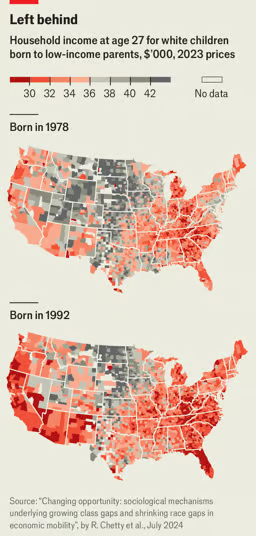
The fact that white children have become more likely to remain in poverty than before, whereas for black children the reverse is true, raises many questions. The finding comes from tracing the trajectories of 57m children born in America between 1978 and 1992 and looking at their outcomes by the age of 27. “This is really the first look with modern big data into how opportunity can change within a place over time,” says Mr Goldman. For children born into high-income families, household income increased for all races between birth cohorts. Yet among those from low-income families, earnings rose for black children and fell for white children.
A black child born to poor parents in 1992 earned $1,400 a year more than one born in 1978. A similar white child earned $2,000 less than one born in 1978. But on average, a poor white child still earned $9,500 more than a poor black child.
This pattern has played out in virtually every county, though with big regional differences. As a result, the earnings gap between rich and poor white children (the “class gap”) grew by 27%, whereas the earnings gap between poor white and poor black children (the “race gap”) fell by 28%…
… None of this means that race is no longer relevant for Americans’ chances in life. Although the reversal of the direction of travel is striking, a young black American born in 1992 to poor parents was still four percentage points more likely to remain in poverty than a poor white peer, down from a 15 percentage-point gap for those born in 1978. And while the near doubling in rates of mortality among young, lower-income white Americans is deeply alarming, mortality rates for their black counterparts have increased too, and they are still (a bit) more likely to die young…
… Convergence has not yet brought equality. Despite improvements across America for poor black children, there is still no county where their outcomes match those of poor white ones. Yet the decline of the white working class is steep, and bound to cause grief. Telling a young white man with lower life outcomes than previous generations that he is still doing better than the average black peer is about as useful as telling a young black man that he’s doing well “for a black man”.
Another possible misconception is that social mobility is a zero-sum game: that poor white children are doing worse because poor black children are doing better. The authors tackle this by showing how in places where black children have done well, white children’s outcomes have remained stable; and in places where white children have done particularly poorly, their black peers have also not thrived.
In his previous work Mr Chetty demonstrated [see here for a summary of his 2018 study] just how much a child’s chances of outperforming their parents depended on their race and where they grew up. One of the questions the authors were left with was how “sticky” these effects would be over time: could opportunities for the next cohorts of children change within these same places, or were they fixed? The new study’s most hopeful finding is that, far from being fixed, opportunities within a place can change significantly and rapidly. Neither history nor place is destiny…
… Americans love a rags-to-riches story. In his acceptance speech [at the Republican Convention], Mr Vance pledged to “make this country a place where every dream…will be possible once again”. In his bestselling book “Hillbilly Elegy” he writes that the assumption “that only a truly extraordinary person could have made it to where I am today…I think that theory is a load of bullshit.”
But the story of Mr. Vance, who grew up in a poor part of the rustbelt, rose to be a venture capitalist and now, at 39, is a potential American president, remains extraordinarily rare. While there has been a reshuffling of opportunities for Americans trying to escape the lowest rung, there has been no progress at all for routes into the upper class. For the vast majority of poor black children, who continue to have a 3% chance of rising from the bottom to the top quintile, and poor white children, whose chances have fallen from 14% to 12%, that door remains firmly shut…
“Class, race and the chances of outgrowing poverty in America,” a big-data analysis– a gift article from @TheEconomist.
* Plutarch
###
As we optimize opportunity, we might send mortgaged birthday greetings to Charles Darrow; he was born on this date in 1889. He designed (in 1933) and patented (in 1935) the board game Monopoly. He later sold his patent to Parker Brothers, which credits him as its creator.
In fact, the history of Monopoly is much longer. It can be traced back to 1903, when American anti-monopolist Lizzie Magie created a game called The Landlord’s Game that she hoped would explain the single-tax theory of Henry George. It was intended as an educational tool to illustrate the negative consequences of concentrating land in private monopolies.
After losing his job at a sales company following the Stock Market Crash of 1929, Darrow worked at various odd jobs. Seeing his neighbors and acquaintances play a board game in which the object was to buy and sell property, he decided to publish his own version of the game.
In fact, Darrow and his friends were just a few of many people in the American Midwest and East Coast who had been playing a game of buying and trading property– all based on Magie’s original… but most having morphed as warnings of that sort too often do) into the opposite of Magie’s intent– a celebration of accumulation. The game was used by college professors and their students, and another variant, called The Fascinating Game of Finance, was published in the Midwest in 1932. From there the game traveled back east, where it had remained popular in Pennsylvania, and became popular with a group of Quakers in Atlantic City. Darrow was taught to play the game by Charles Todd, who had played it in Atlantic City, where it had been customized with that city’s street and property names– to wit Monopoly‘s nomenclature.

You must be logged in to post a comment.