Posts Tagged ‘Marcel Duchamp’
“Dada was a bomb… can you imagine anyone, around half a century after a bomb explodes, wanting to collect the pieces, sticking it together and displaying it?”*…
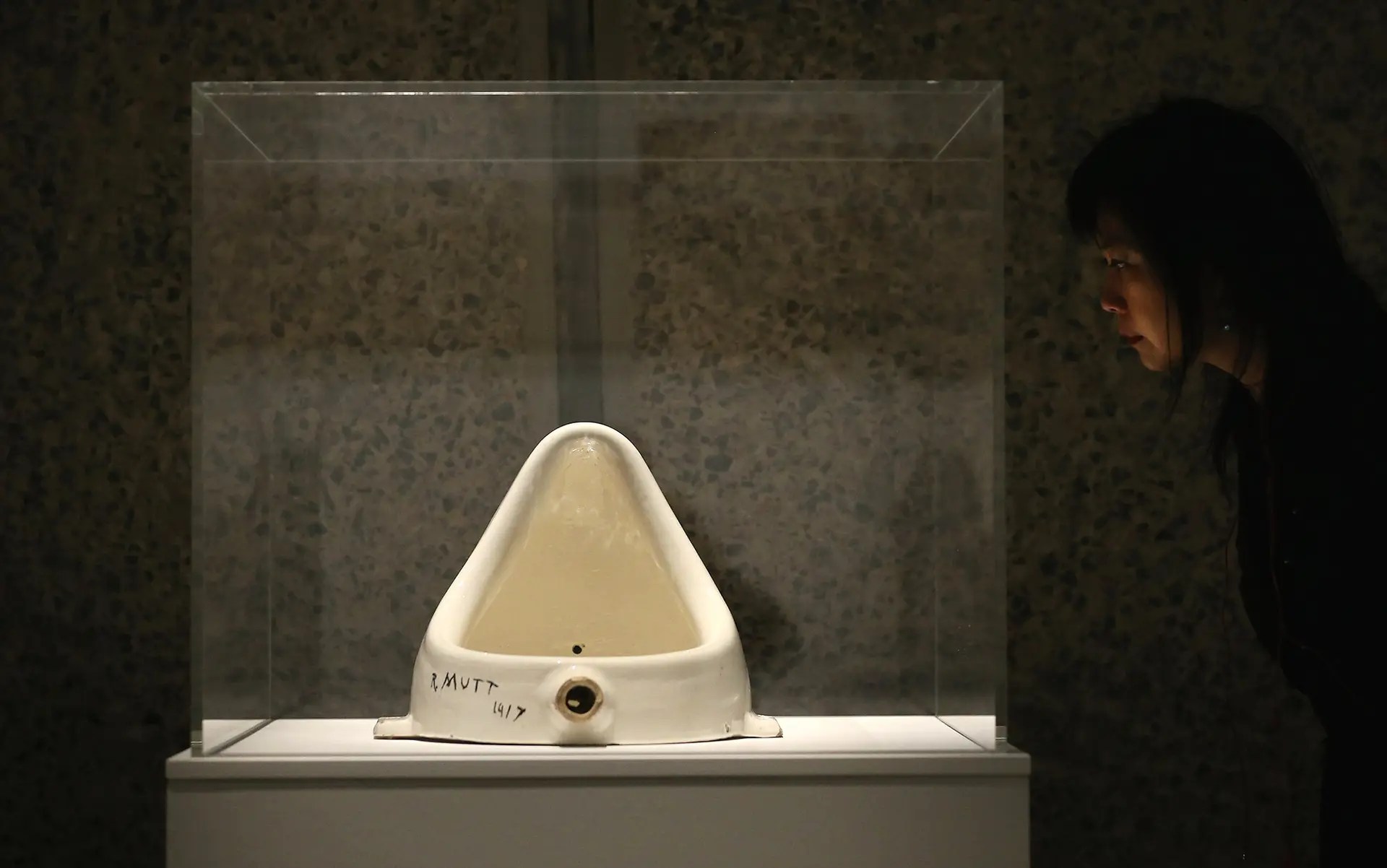
Marcel Duchamp was hugely influential in the revolutionary developments in the arts in the early 20th century. After helping establish Cubism, he turned to what he called “Readymades,” “found objects” which he selected and presented as art. By far the most famous of these was the piece he entitled “Fountain.” Damon Young and Graham Priest recount the stir that ensued… and unpack the work’s philosophical comment, making a case for why it resonates to this day…
In 1917 a pivotal event occurred for art and philosophy: Marcel Duchamp unveiled his artwork Fountain in Alfred Stieglitz’s New York studio. This was simply a porcelain urinal, signed ‘R. Mutt’.
Fountain was notorious, even for avant-garde artists. It has become one of the most discussed works of art of the 20th century. The Society of Independent Artists rejected it, though every artist who paid the exhibition fee was supposed to have their work shown. For almost a century, it has remained a difficult artwork. The philosopher John Passmore summed up Fountain as: ‘a piece of mischief at the expense of the art world’, though many have taken it very seriously.
No doubt there was some tomfoolery involved – Duchamp did not choose a urinal randomly. Yet there is more to Fountain than nose-thumbing. What makes this artwork so striking is its philosophical contribution.
Commentators often highlight the influence of Fountain on conceptual art, and this most ‘aggressive’ readymade, as Robert Hughes put it, has certainly had an enduring legacy. In 2004, it was voted the most important 20th-century work by hundreds of art experts. From Andy Warhol to Joseph Beuys to Tracey Emin, this urinal inspired artists to reconsider the traditional artwork. Instead of paintings and sculptures, art was suddenly Brillo boxes, an unmade bed, or a light-bulb plugged into a lemon: ordinary objects, some readymade, removed from their original contexts and placed on display in art galleries. The art critic Roberta Smith sums it up this way: ‘[Duchamp] reduced the creative act to a stunningly rudimentary level: to the single, intellectual, largely random decision to name this or that object or activity “art”.’ As we will see, Duchamp’s choice was not random at all, but Smith’s description points to the broader shock that Duchamp’s work prompted: if this can be art, then anything can.
Since then, scholars have discussed Fountain to demonstrate a shift away from aesthetics to thought. As the philosopher Noël Carroll notes, it’s possible to enjoy thinking about Duchamp’s work without actually looking at it, which cannot be said for Henri Matisse’s vivid paintings or Barbara Hepworth’s dignified stone sculptures.
These traditional ideas, as we will see, are all important to Fountain. But they do not go far enough. They treat Fountain as art, but of a mocking sort: a kind of intellectual heckling that nudged artists to taunt and scoff more academically at their own field. Our explanation of the artwork’s power is much more controversial: we believe that Fountain is art only insofar as it is not art. It is what it is not – and this is why it is what it is. In other words, the artwork delivers a true contradiction, what’s called a dialetheia. Fountain did not simply usher in conceptual art – it afforded us an unusual and intriguing concept to consider: a work of art that isn’t really a work of art, an everyday object that is not just an everyday object…
Marcel Duchamp’s ‘Fountain’ is not just a radical kind of art; it’s a philosophical dialetheia: a contradiction that is true: “It is and it isn’t,” from @damonyoung.com.au and Graham Priest @aeon.co. Eminently worth reading in full.
We might note that it’s not altogether clear that the dialetheia which the authors celebrate was what Duchamp had in mind. In any case (in line with the quote at the top) Duchamp, a father of Dada, was not entirely pleased with the influence that his work had:
This Neo-Dada, which they call New Realism, Pop Art, Assemblage etc. [Duchamp is referring to Andy Warhol and Roy Lichtenstein], is an easy way out and lives on what Dada did. When I discovered readymades I thought to discourage aesthetics. In Neo-Dada they have taken my readymades and found aesthetic beauty in them. I threw the bottle-rack [here] and the urinal in their faces as a challenge and now they admire them for their aesthetic beauty…
– Duchamp in a 1962 letter to Hans Richter
And as this is the centenniel of Dada’s “child,” Surrealism, we might peruse “The Small Magazines That Birthed Surrealism.”
###
As we ponder paradox, we might raise a glass in celebration of National Cartoonists Day, observed on this day each year. The date was chosen to recognize the first appearance (in color) of the mischievous cartoon character “The Yellow Kid” in the New York World newspaper (on May 5, 1895).

“Chess pieces are the block alphabet which shapes thoughts”*…

In Amritsar, at India’s oldest and largest chess manufacturing company, artisans have hand-carved the most complicated pieces in the game for generations. Roxanne Hoorn reports…
In the bustling streets of Amritsar, India, the markets are lined with shops full of colorful tapestries and sweet treats like warm local chai served in clay mugs. But the real treasures are kept behind closed doors. Beyond stacks of gnarled logs, inside unsuspecting brick buildings off the main streets, generations of master craftsmen carefully carve, sand, and polish intricate chess pieces, carrying on a long legacy in the country where the earliest versions of chess were played over 1,500 years ago.
These are no basic sets. The pieces make up elaborate professional and collector’s chess sets that sell for up to $4,000 U.S. dollars on the international market. That price is well deserved. Each set is a collective labor of love, with every component handcrafted by a man who specializes in one type of chess piece. (Traditionally, women are not chess carvers.) There are pawn makers, queen craftsmen, and the most coveted—the knight carvers.
“The knight carvers are only knight carvers,” says Rishi Sharma, CEO of the Chess Empire, India’s oldest and largest chess manufacturing company, which was founded in 1962. “The person who is making the queen, we don’t give him the pawn. Otherwise, he’s going to ruin it.”
Of all the chessmen, knights are considered the most difficult and require the most skill to carve. While pawns and other pieces can be shaped under lathes, the knights—resembling horse heads usually with wild flowing manes—are carved completely by hand. A chess carver won’t graduate from pawn to knight or any easier piece to harder ones, but instead will learn his craft from the start of his career, usually from their father or a mentor from one of the well-established chess companies. Surinder Pal, a knight carver at the Chess Empire, learned from his father at 18 years old. Now, he has been working on the craft for over 35 years. With his advanced and highly specialized skill, he can make up to 30 simple knights a day, or spend up to three days on a single ornate knight.
Today, chess pieces are carved from local species like boxwood or imported trees like rose and dogwood. But they were once made of a far more elusive and illicit material. Amritsar was originally known for its ivory carvers, who produced everything from hair combs and jewelry to furniture and sculptures. And of course, chess sets. After the international trade of ivory was banned in the 1990s, the craftsman turned to the similarly smooth but far more accessible medium.
With raw materials readily available, it’s the demand for these fine chess sets that determines how many are produced. And demand has fluctuated in recent years. The COVID-19 pandemic left many people secluded in their homes, leading to a boost in demand for many indoor games, says Sharma. In October 2020, that enthusiasm for chess was compounded by the release of The Queen’s Gambit, a series about a fictional American chess prodigy. “The Queen’s Gambit had a very big role in spreading awareness of chess,” Sharma says. “And after that, we see a big boom.” Despite the show’s creator stating they have no plans for a second season, Sharma stays hopeful. “We hope the next season comes as soon as possible.”…
Equipping the Royal Game: “Masters of the Knight: The Art of Chess Carving in India,” from @atlasobscura.com.
###
As we prize the pieces, we might recall thatt it was on this date in 1996 that then-world chess champion Garry Kasparov and an IBM supercomputer called Deep Blue played game four the first of their two six-game chess matches. They played to a draw. Kasparov won the match– but by a margin of only 4-2 (two draws and a loss to the computer). They met for a rematch the following year, and Big Blue beat Kasparov (3 1/2- 2 1/2).

All the views that’s fit to print…

June 20, 1965: “Young fans holding aloft bats they were given by the Yankees yesterday at the stadium,” read a caption the day after the team lost a double-header to the Minnesota Twins. The crowd, numbering 72,244, was the largest in four years, provoking the organist to serenade fans with the tune “We’re in the Money.”
For generations, most of the photographs housed in the newsroom archive of The New York Times — known affectionately as “the morgue” — have been hidden away from the public eye in filing cabinets and manila folders.
There are exceptions, of course. The newspaper runs archival photographs every day. Then there are those photos Lens has featured in “The Lively Morgue,” an occasional series we introduced in September 2010. So far, we’ve published 17 collections, ranging in subjects from saucy publicity shots to the art of washing windows.
But we haven’t even made a dent. If we published 10 of our archival images everyday, it would be at least the year 3935 before we’d shown off the entire collection. That’s one of the reasons we launched “The Lively Morgue,” an all-archives, all-the-time feed on the social blogging site, Tumblr…

An archival photo from The New York Times shows news pictures being sorted in the newspaper’s photo “morgue,” which houses millions of images. Here they are — several each week — for you to see. Welcome to The Lively Morgue.
The Lively Morgue is here.
As we express our gratitude to the Gray Lady, we might recall that it was on this date in 1919 that a less successful editorial venture launched in New York City: Man Ray published the first (and only) issue of TNT an anarchist journal. An aspiring artist, he had been moved by the famous 1913 Armory Show, and had befriended Marcel Duchamp. For the next six years or so, Ray (born Emmanuel Radnitzky) had done his best to marry his political convictions with his creative impulse (e.g., contributing illustrations to Emma Goldman’s Mother Earth). But with the failure of TNT, Ray turned more fully to art; his next whack at publishing was New York Dada, a collaboration with Duchamp. That too failed to make a second number– and Ray departed for France… where he became part of the Surrealist circle– and an important practitioner of and influence on fine art photography.
 Salvador Dali and Man Ray in Paris (source)
Just let me hear some of that rock and roll music…
… and not just any old way you choose it, but selected and explicated by that master of American music– both classical and popular– Leonard Bernstein:
Inside Pop – The Rock Revolution is a CBS News special, broadcast in April 1967. The show was hosted by Leonard Bernstein and is probably one of the first examples of pop music being examined as a “serious” art form. The film features many scenes shot in Los Angeles in late 1966, including interviews with Frank Zappa and Graham Nash, as well as the now-legendary Brian Wilson solo performance of “Surf’s Up.”
As we tap our toes, we might recall that it was on this date in 1859 that Paul Morphy, an American chess prodigy who became the world’s leading grandmaster, just returned from a competitive tour of Europe, gave up the game. Morphy was so dominant that he’d taken to spotting his opponents– other masters and grand masters– a pawn and a move, or playing blindfolded… or both. After reviewing his games, Bobby Fischer considered Morphy so talented as to be “able to beat any player of any era if given time to study modern theory and ideas.” And Marcel Duchamp, who abandoned art to become a chess expert, found inspiration in Morphy’s open style and opportunistic strategy in crafting his theory of the endgame… which means that Morphy was indirectly a contributor to Duchamp’s friends and collaborators Samuel Beckett (whose Endgame is rooted in Duchamp’s thinking) and John Cage (with whom, in 1968, Duchamp played at a concert entitled “Reunion;” music was produced by a series of photoelectric cells underneath the chessboard).
Morphy’s retirement from chess (an amateur’s game in those days) came the day after he was hailed by Dr. Oliver Wendell Holmes as “the World Chess Champion” at a banquet in Morphy’s honor attended by Henry Wadsworth Longfellow, Louis Agassiz, Boston mayor Frederic W. Lincoln, Jr., Harvard president James Walker, and other luminaries. Morphy attempted then to start a law practice, but was side-tracked by the outbreak of the Civil War. Still, with the resources of a family fortune, he lived comfortably in New Orleans until his death in 1884 in the ancestral mansion– the site today of Brennan’s Restaurant (at which, your correspondent suspects, several readers have breakfasted).
 Morphy at the board (source)
You must be logged in to post a comment.