Posts Tagged ‘Halloween’
“All that we see or seem is but a dream within a dream”*…
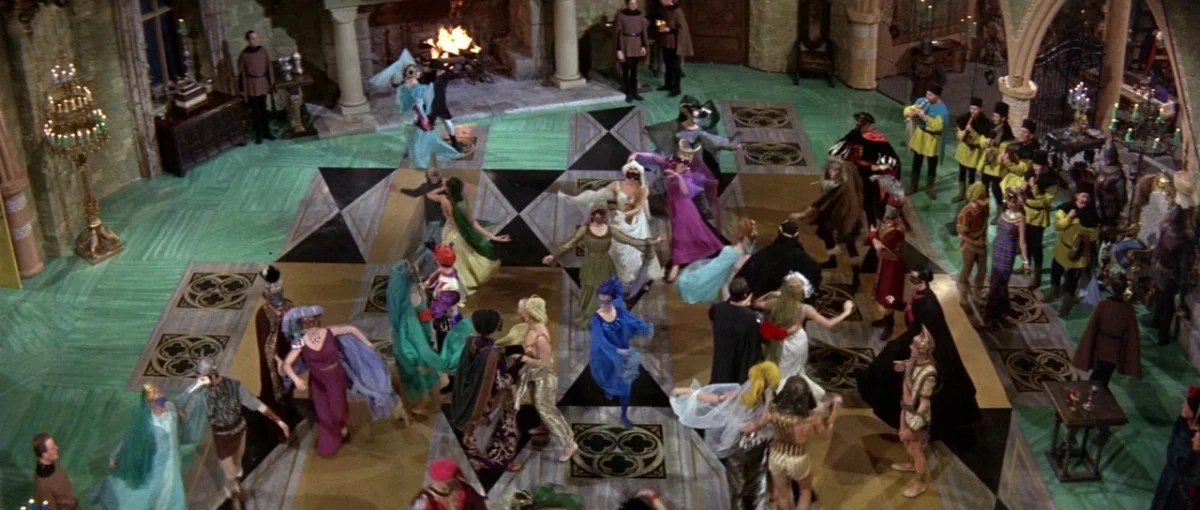
As All Saint’s Eve approaches, Karina Wilson weighs in (on her lovely blog, Horror Film History) on the remarkable series of films created by Roger Corman from the works of seasonal “hero” Edgar Allan Poe…
Corman was fond of literary adaptations, especially if the original was in the public domain. He mined Edgar Allan Poe’s short stories for some of his most memorable work between 1960 and 1964…
… In 1960 AIP execs Arkoff and Nicholson asked Roger Corman to make yet another pair of low-budget black and white horror films. He told them he had a better idea, a movie adaptation of Edgar Allan Poe’s The Fall of the House of Usher. Nicholson and Arkoff initially balked at the concept, which differed wildly from their then-staple trade in monster B-pics aimed at drive-in adolescent audiences. “Where’s the monster?” asked Arkoff.
Corman reassured them the house was the monster (“The house lives. The house breathes”). He was becoming more and more interested in Freudian theory and wanted the adaptation to reference psychoanalytic theory. To Corman, the dark corridors and gaping portals of the decaying mansion were unmistakably female spaces. He was fascinated by the concept that buildings (or at least movie sets) can reflect the ego and the id. Daily activities happen as normal in the sunlit upper rooms of a mansion while shapeless terrors ooze within the gloom of the basement .
If a yonicentric set wasn’t enough to draw the crowds (at least subconsciously), Corman insisted Poe stories had built-in teen appeal thanks to the efforts of English Literature teachers everywhere (“He’s read in every high school”). Corman wanted to tap into widespread familiarity with the tales and the ongoing love affair with gothic horror fuelled by television reruns of Universal movies from the 1930s. He also wanted to make more lavish movies instead of perpetually budgeting on a shoestring. Always mindful of the market, he believed a classic literary adaptation could give AIP productions more mainstream (and adult) appeal and compete with the technicolor horror films being produced by Hammer in the United Kingdom and as part of the nascent Giallo movement in Italy. Arkoff and Nicholson, fully aware of Corman’s proven ability to deliver low budget quality in a timely fashion, agreed to the experiment.
For House of Usher (1960), Corman teamed up with actor Vincent Price, whose sonorous cod-Shakespearean vowels became synonymous with the storybook theater narration that would become emblematic of this cycle. Price had supposedly sworn off making horror movies after The Fly (1958) because he claimed he couldn’t keep a straight face on set. Corman lured him back to the genre with the prospect of playing Roderick Usher, a meaty, actorly role – and the rest is history. Corman tapped screenwriter Richard Matheson, (who was doggedly building his reputation as a master of the genre) for the script, which stuck quite closely to the original, adding a romance between Philip and Madeline. House of Usher was Corman’s first foray into color movies and cost a luxurious $270,000 ($50,000 of which reportedly went to Price). The production schedule was still tight (15 days) and Corman made the most of his expensive star by framing him against production designer Daniel Haller’s skilfully scavenged yet sumptuous looking sets. The result was a commercial and critical hit, grossing $2 million that summer and elevating American International Pictures’ aesthetic beyond Poverty Row. Arkoff and Nicholson, naturally, wanted more of the same.
Between the House of Usher (1960) and The Tomb of Ligeia (1964), Corman made seven Poe-related movies for AIP. Premature Burial in 1962 featured Ray Milland in the lead role but all the others starred Vincent Price (who would go on to make The Oblong Box in 1969, for AIP but without Corman). Matheson supplied scripts for The Pit and the Pendulum (1961), Tales of Terror (1962), The Raven (1963), while his friend Charles Beaumont wrote The Premature Burial, The Haunted Palace (1963), and The Masque of the Red Death (1964). Future Academy Award winner Robert Towne (Chinatown) penned the final entry, Tomb of Ligeia.
While he relied heavily on tried-and-trusted AIP personnel, Corman tried to switch things around tonally with each movie. This ensured a different experience for the audience each time rather than simply replicating what had gone before. Tales of Terror is quite cynical, even humorous in tone and The Raven is outright comedy-horror [and noteworthy as a rung on Jack Nicholson’s climb to stardom]. The Haunted Palace isn’t even based on a Poe story – it’s actually an adaptation of H. P. Lovecraft’s The Case of Charles Dexter Ward. AIP wanted to market it as part of the cycle, so they gave it the title of one of Poe’s poems, and bookended the action with narrated lines…
Read on… “Roger Corman’s Poe Cycle (1960-1964)” from @karinalw.bsky.social.
* Edgar Allan Poe, “A Dream Within a Dream“
###
As we scream, we might recall that it was on this date in 1988 that Lair of the White Worm was released in the U.S. A “supernatural comedy horror film” loosely based on the 1911 Bram Stoker novel of the same name, it was written, produced, and directed by the remarkable Ken Russell, and starred Amanda Donohoe, Hugh Grant, Catherine Oxenberg, and Peter Capaldi; it follows the residents in and around a rural English manor that are tormented by an ancient priestess after the skull of a serpent that she worships is unearthed by an archaeologist.

“No one prospers without rendering benefit to others”*…

Revisiting a topic we last considered about six years ago: the modern zipper was invented (or, at least, first patented) in 1913. But, as Michael Knispel explains, story of the zipper-as-we-know-it began in Japan in 1934…
Here’s a test you can do right now. Look down at your jacket. Your jeans. Your bag. Find a zipper—any zipper—and check the pull tab. Three letters. YKK.
Try another. Your backpack. Your hoodie. Your tent, if you’ve got one nearby. YKK.
It’s everywhere. And once you start noticing, you can’t stop. It’s like discovering a secret language written into the fabric of modern life.
Those three letters stand for Yoshida Kōgyō Kabushikigaisha—Yoshida Manufacturing Corporation. And they represent one of the most successful, least-known companies in the world.
YKK produces roughly half of all zippers made globally. Seven billion zippers a year. In some markets—Japan, for instance—their share approaches 90%. If you’ve ever zipped anything, there’s a better-than-even chance it was theirs.
But here’s what fascinates me: they didn’t get there through aggressive expansion or undercutting competitors. They got there by being better. By obsessing over a component most people never think about. By treating the humble zipper not as a commodity, but as a craft.
And after ninety years of that obsession, they’re not resting. They’re constantly evolving—pushing the zipper into territory it’s never been before.
Let me tell you the story…
[And tell it, he does: the company’s remarkable history, turning the to a survey of recent innovations…]
… For most of YKK’s history, innovation meant incremental improvement. Better corrosion resistance. Smoother sliders. More durable coils.
But in the past few years, something’s shifted.
YKK isn’t just refining the zipper anymore. They’re rethinking it entirely.
After ninety years of mastering the fundamentals, they’re finally asking: what else could a zipper be?..
[Knispel recouns recent developments– the “AiryString” (tapeless) zipper, the self-propelled zipper– concluding with “The Revived Collection”…]
… Here’s the most important innovation—and it’s not a single product. It’s a philosophy.
The YKK Revived Collection is a series of repair-focused components designed to keep zippers functional and maximize a product’s lifecycle. The goal is simple but radical: the zipper should never be the reason a product is thrown away.
YKK has developed three main components in the Revived series, each targeting a specific failure mode. Together, they represent a fundamental shift in how YKK thinks about their products—not just as components to be manufactured and sold, but as systems to be maintained and repaired.
Traditional center-front zippers—the kind you find on jackets and hoodies—have a problem. When the slider breaks or the pull tab snaps off, you’re stuck. The standard repair requires cutting off the top stop, that metal or plastic piece that keeps the slider from flying off the end, and replacing the entire slider. It’s destructive, time-consuming, and often requires specialized tools.
The Revived Top Stop changes that. It looks like a standard top stop, but with a zigzag groove pattern cut through it. That channel allows you to orient the slider through the stop and derail it, removing it without cutting anything…
[Knispel explains the ingenious fixes for regular zippers, pocket and accessory zippers, and bag zippers. Then he draws the wisdom they embody…]
… Here’s what ties the Revived Collection together: YKK is building repair infrastructure.
They’re not just selling replacement parts. They’re designing zippers to be repairable from the start, and they’re working with brands, warranty centers, third-party repair shops, and even consumers to make those repairs accessible.
“We’re targeting this for warranty and quality centers, third-party repair centers, potentially in-store retail repairs, and eventually consumer repairs,” says John Holiday, YKK’s Senior Product Development Manager. “We want to make sure the fastener or the zipper is not the reason a product is no longer in use or why it needs to be warrantied.”
That’s a shift. Traditionally, YKK sells zippers to manufacturers in bulk—cut zippers or chain-and-slider assemblies. The Revived components are sold as standalone parts, which means YKK is rethinking its distribution model to make replacement parts available outside traditional manufacturing channels.
I started this piece with a test: look at your zippers. Three letters. YKK.
Now you know why they’re there. Not because of aggressive marketing or locking out competitors. Because a man in 1934 Tokyo decided that if you make something genuinely better—more reliable, more consistent, more thoughtful—success follows naturally.
Ninety years later, YKK still operates on that philosophy. They’re still privately held. Still vertically integrated. Still obsessing over a component most people never think about.
And it looks like they’re not done. They’re constantly evolving…
“The Company That Zips the World | YKK’s Ninety-Year Obsession,” from @carryology.bsky.social.
###
As we zip it, we might that on this date– Halloween– in 2005, Gary Estrada, met his goal to visit at Walt Disney World’s Magic Kingdom Haunted Mansion 999 times. Estrada had begun riding in January of that year and finished on Halloween in just ten months. Why 999 times? Because that is how many “happy haunts” are said to live there.

“Every day is Halloween, isn’t it? For some of us.”*…

Tomorrow’s the big day– by some counts, the second biggest holiday of the year. The National Retail Federation’s annual Halloween survey of more than 7,900 consumers found 72% plan to celebrate the holiday with 67% of those planning to hand out candy. We’ll an average of $103.63 (about $4.62 less than last year’s record of $108.24), the survey found. In total, Halloween spending is expected to reach $11.6 billion, with candy sales at an estimated $3.5 billion.
Axios on how those sugary purchases are allocated…
Chocolate is America’s favorite Halloween candy, with Reese’s Peanut Butter Cups once again the top choice in an overwhelming majority of states, according to data from Instacart.
The big picture: The chocolate peanut butter candy was the top-selling candy in 40 states based on Instacart grocery sales last year. Chocolate was a key ingredient in eight of the top 10 candies.
After Reese’s, regular M&M’s were the next most popular candy andthe favorite in northwestern and midwestern states like Montana, Nebraska, North Dakota and South Dakota. Peanut M&M’s were the most purchased Halloween candy in Hawaii, Idaho and Utah, Instacart found.
… Reese’s is also the reigning king of Easter candy, with its eggs ranked as the top purchased candy and cups the No. 3 candy, based on 2023 Instacart data.
Candy corn was the most-searched candy in 34 states between Sept. 3 and Oct. 3, according to Google Trends. Candy corn accounts for 84% of all searches around Halloween candy, according to Captify search data shared with Axios…
– source
The estimable Ernie Smith weighs in on the mawkish mock maize as part of a meditation on Butterfingers…
… In the process of my research into the fragility of Butterfinger bars, I ran across an interesting fact about trying to recreate Butterfingers in your own kitchen that I didn’t think fit into the above narrative, but is worth diving into separately. Simply put, one of the most popular ways to make homemade Butterfingers involves using candy corn. It apparently does a good job of recreating the flavor of a Butterfinger, if not the exact texture.
The nice thing about candy corn, in the context of this recipe, is that it includes most of the main ingredients of the toffee part of butterfingers. That makes it possible to greatly simplify the recipe for people who want to make Butterfingers at home. (Plus, the orange-and-yellow parts of candy corn make for a decent food-coloring match to the innards of Nestlé-era Butterfingers, even if the cornflakes, key to the texture, aren’t part of the recipe.)
Now, finding out that candy corn can be used as a key ingredient in a Butterfinger recipe is sort of like finding out that your favorite dessert is made of candle wax. (Fun fact: Despite its generic-seeming nature, it’s mostly sold by a single manufacturer, Brach’s.)
But there’s a method to the madness.
See, when broken down, candy corn is made of fondant and confectioner’s glaze. Another way of putting it: A piece of candy corn is essentially the candy form of the chalky icing used on wedding cakes, which is then covered in waxy insect secretions. Awesome.
Find that last part kind of gross? Well, you should stop eating Milk Duds, Whoppers, Raisinets, and jelly beans, because they all use it. You’ve been eating food-grade shellac all your life and didn’t even know it.
So, let’s spend a minute talking about shellac: The fact that so many candies use this is actually a significant problem for the globalization of candy. In India, for example, it’s likely to leave out entire classes of consumers, as shellac isn’t considered vegetarian. Periodically, as noted in this 2009 Scientific American piece, we’ve looked for alternatives to confectioner’s glaze, but given that it remains a surprisingly large industry to this day—a recent Business Insider video put the sector’s value at $167 million. (Ironically, shellac was discovered in India, and remains the largest manufacturer of the material.)
If you’re OK with all that, making your own Butterfingers at home is apparently way easier if you use melted candy corns as a base. Just note that shellac isn’t usually part of the ingredient list..
– source
Apposite: “Stephen Follows on the horror movie boom.”
* Tim Burton
###
As we dish out the delights, we might recall that it was on this date in 2003 that a thousand Halloween costumes were inspired– Wicked premiered on Broadway. A musical with music and lyrics by Stephen Schwartz and a book by Winnie Holzman, it is a loose adaptation of the 1995 Gregory Maguire novel Wicked: The Life and Times of the Wicked Witch of the West, which in turn is based on L. Frank Baum‘s 1900 novel The Wonderful Wizard of Oz and its 1939 film adaptation.
The show was nominated for ten Tony Awards in 2004, including Best Musical, Book, Orchestrations, Original Score, Choreography, Costume Design, Lighting Design, Scenic Design, with two nominations for Best Actress – for Idina Menzel and Kristin Chenoweth. Menzel won the Best Actress award, and the show also won the Award for Best Scenic Design and Best Costume Design (notably losing Best Book, Original Score and ultimately Best Musical to Avenue Q). The same year, the show also won 6 Drama Desk Awards out of 11 nominations, including Outstanding Musical, Book, Director, and Costume Design.

“To be what you want to be: isn’t this the essence of being human?”*…

… Ah, but what does one– should one– want to be? Jules Evans, with a history of the transhumanist-rationalist-extropian movement that has ensorcelled many of technology’s leaders, one that celebrates an elite few and promises an end to death and taxes…
Once upon a time there was an obscure mailing list. It only had about 100 people on it, yet in this digital village was arguably the greatest concentration of brain power since fifth-century Athens. There was Hans Moravec, pioneer in robotics; Eric Drexler, pioneer of nanotechnology; Eliezer Yudkowsky, father of the Rationalist movement; Max More, father of modern transhumanism; Nick Bostrom, founder of Long-Termism and the study of Existential Risks; Hal Finney, Nick Szabo and Wei Dai, the inventors of cryptocurrency; and Julian Assange, founder of Wikileaks. Together they developed a transhumanist worldview — self-transformation, genetic modification, nootropic drugs, AI, crypto-libertarianism and space exploration. It’s a worldview that has become the ruling philosophy of the obscenely rich of California.
It all started in Bristol, England. There, a young man called Max O’Connor grew up, and went to study philosophy at Oxford. But Max wanted more, more excitement, more life, more everything. He changed his name to Max More, and moved to California, where the future is invented. His dreams took root in the soil prepared by Californian transhumanists of the 1970s. Many of them were members of an organization called L5, dedicated to the colonization of space by a genetic elite — its members included Timothy Leary, Marvin Minsky, Isaac Asimov and Freeman Dyson, and its magazine was named Ad Astra — which was what Elon Musk named his school for SpaceX kids in 2014.
Max was also inspired by Robert Ettinger, an American engineer who argued that humans would soon become immortal superbeings, and we should freeze ourselves when we die so we can be resurrected in the perfect future. While doing a PhD at the University of Southern California, Max got a job at the Alcor Foundation for cryonic preservation, and in 1989 he started a magazine with his fellow philosophy grad, Tom Morrow, called Extropy: Journal of Transhumanist Thought. ‘Do you want to be an ubermensch?’ the first issue asked.
‘Ubermensch’ (overman or superman) is the German word used by Friedrich Nietzsche to describe the individual (male or female) who has overcome all obstacles to the perfection of him or herself…
A history and an explanation: “How did transhumanism become the religion of the super-rich?” from @JulesEvans11.
* David Zindell
###
As we ponder the (presumptuous) preference for perfection, we might recall that it was (tradition holds) on this date in 1517– All Hallows (All Saints) Eve– that Martin Luther, a priest and scholar in Wittenberg, Germany, upset by what he saw as the excesses and corruption of the Roman Catholic Church (especially the papal practice of taking payments– “indulgences”– for the forgiveness of sins), posted his 95 Theses on the door of Castle Church. Thus began the Protestant Reformation.

Martin Luther (source)
Today, of course, All Hallows (All Saints) Eve, is celebrated as Halloween, which is (if it is, as many scholars believe, directly descended from the ancient Welsh harvest festival Samhain) the longest-running holiday with a set date… and (usually, anyway) the second-biggest (after Christmas) commercial holiday in the United States.

“Here we are now, entertain us”*…

It’s that time of year again…
Tom BetGeorge, professional light show artist, is showing his amazing haunted light show in real life, using his house as the backdrop.
This year’s spooky display includes a Halloween take on Nirvana’s “Smells Like Teen Spirit” (above). Using tens of thousands of lights, he offers a 2-hour viewing on the weekends for locals to take it all in. Luckily he lets us outsiders watch some of it from afar, and it’s spectacular, even online.
BetGeorge has been uploading his light show videos to his YouTube channel (where you can get the address to his IRL extravaganza) for seven years, and they’re not only Halloween displays. He donates proceeds to McHenry House, a shelter for homeless families.
“This at-home haunted light show gives a whole new meaning to Nirvana’s ‘Smells like Teen Spirit’,” from @Carla_Sinclair @BoingBoing via @LaughingSquid
* Nirvana, “Smells Like Teen Spirit”
###
As we hum along (and contemplate what we’ll be offering trick-or-treaters), we might recall that today is National Chocolate Covered Insect Day.

You must be logged in to post a comment.