Posts Tagged ‘Ottoman Empire’
“Turkey: A large bird whose flesh, when eaten on certain religious anniversaries has the peculiar property of attesting piety and gratitude”*…

Your correspondent is hitting the road, so (Roughly) Daily will be in hiatus for ten days ro so. Regular service should resume on (or about) May 24…
Tal Lavin devotes the latest installment of The Sword and the Sandwich, the wonderful newsletter he co-authors with David Swanson, to the quintessentially-American fowl, the turkey…
There are very few occasions in life in which someone gets to choose their own name: confirmation, conversion, or, in my case, transition from female to male. Out of all the names in the world, I chose my own; I wanted to pick something that would allow me to present as my male self, that would erase confusion, that would say something essential about me. Choosing your own name is not to be taken lightly.
In the case of the turkey—that busty bird whose thinly-sliced meat is a ubiquitous filler for club sandos, Thanksgiving-leftover feasts and deli lunch-hour specials—the ability to choose its own name might have been a mercy, and avoided a tremendous amount of confusion. The etymological journey of why a turkey is called a turkey makes the fraught rite of transgender name-choosing seem like a cake walk (or bird strut).
The turkey, meleagris gallopavo, is a big galumphing bird indigenous to the Americas, famous for its huge breast, commanding carriage, and bland but abundant meat. In English, it is named after Turkey, which is a country across an entire ocean from its native stomping grounds. In Turkish, the language of Turkey, a turkey is called a hindi, which means “from India.” In Hindi, the language of India, a turkey is called a टर्की (Ṭarkī). In Slovak and Albanian, its name means “chicken from overseas.” In Scandinavian languages and Dutch, it’s named for Calicut, a major trading post along India’s Malabar Coast. In Welsh, it’s twrci. In Polish, Russian and Ukrainian, it’s indyuk, indyk or indeyka—Indian bird.
In other words, languages across the entire world are eager to praise (or blame) the wrong country for this entirely American bird. And they can’t even agree on what wrong country to attribute it to. Linguists and historians have put their heads together on why this is, and it seems to come down to a fowl case of mistaken identity.
What’s undoubtedly central to this geographical misunderstanding is the role the Ottoman Empire played in trade to Europe around the period of the Columbian Exchange…
Read on the rest of the fascinating story: “Turkey,” from @swordsjew.bsky.social.
* Ambrose Bierce, The Devil’s Dictionary
###
As we gobble, we might recall that it was on this date in 1607 that a group of 104 colonists from England arrived in what we now know as Virginia and established the first permanent English colony in America. They named the settlement Jamestown in honor of King James I.
We might also recall that we have this group (as it grew)– not the New England pilgrims– to thank for Thanksgiving.
The first documented English Thanksgiving in North America happened in Virginia in 1619, one year before the Pilgrims even arrived at Plymouth Rock. This first Thanksgiving lasted “10, 15 minutes,” according to Graham Woodlief, the president of the Virginia Thanksgiving Festival. No Native Americans were invited, no women were present, and there’s scant evidence of turkeys or yams.

We might also note that it was on this date in 1968 that Frank Zappa released his debut solo album, Lumpy Gravy on MGM’s Verve Records label (an early version of the album had been issued by Capitol Records on 4-track cartridge in August 1967).

“But enough about me, let’s talk about you…. what do you think of me?”*…

The 21st century is the most important century in human history.
At least that’s what a number of thinkers say. Their argument is pretty simple: Mostly, it’s that there are huge challenges that we have to surmount this century to get any future at all, making this the most consequential of all centuries so far. Furthermore, a solution to those challenges would likely mean a future farther from the brink of destruction — which makes this century more pivotal than future centuries, too…
[The case for this century as most important, unpacked]
Sure, we have some pretty good arguments for the importance of our era. But … doesn’t everybody? Are the arguments for the 21st century really that much stronger than the arguments for the 1st century, or for centuries yet to come?
Under this view, sure, we have some serious challenges ahead of us. But it’s a mistake to think we’re in a unique moment in history. There’s every reason to think that the challenges faced in future centuries will be as significant…
[The cases for other periods as most important, explored]
But it’s not just an abstract philosophy argument… If this is the crucial moment in human history, foundations that’ll be around for centuries aren’t a top priority. If humanity’s biggest problems are best left to our grandchildren and their grandchildren, then it doesn’t seem so strange to try to set up enduring human institutions with the power to influence successive generations. If this is the critical moment, the balance of our efforts should probably be spent less on long-term priorities questions and more on action — like political efforts to reverse course on dangerous human activities, and research on how to mitigate the immediate dangers of present threats…
A philosophic argument over the relative importance of our present era (and why it matters): “Is this the most important century in human history?”
(Your correspondent would note that, even if this is the most important century in human history so far, it doesn’t follow that there won’t centuries that are at least as important to come… so it’s surely prudent to invest energy and resources in assuring that foundational institutions and infrastructure, options, and resources are available to our successors…)
* variously attributed to “CC Bloom” (Bette Midler in Beaches) and NYC Mayor Ed Koch, among others
###
As we take the long view, we might recall that it was on this date in 1520 that Suleiman I (AKA Suleiman the Magnificent) was proclaimed Sultan of the Ottoman Empire. The tenth and longest-reigning Sultan, he ruled over at least 25 million people at the apex of Ottoman economic, military, and political power, and at the broadest range of its geographical reach. A distinguished poet and goldsmith, he also became a great patron of culture, overseeing the Golden Age of the Ottoman Empire in its artistic, literary and architectural development.

“I long, as does every human being, to be at home wherever I find myself”*…

So … what if everyone went back where they came from?
The always-illuminating Nathan Yau, of Flowing Data, demonstrates that in the U.S., almost everyone comes from somewhere else. See his explanation at “If We All Left to ‘Go Back Where We Came From’.”
* Maya Angelou
###
As we contemplate commonality, we might recall that it was on this date in 1648 that Mehmed IV became Sultan of the Ottoman Empire… at the age of 6 (as a result of his father’s overthrow). He went on to become the second longest reigning sultan in Ottoman history (after Suleiman the Magnificent). Under his reign the empire reached the height of its territorial expansion in Europe.

The Ottoman Empire at its greatest extent in Europe, under Sultan Mehmed IV in the late 17th century

Imperial dreams…
I met a traveller from an antique land
Who said: Two vast and trunkless legs of stone
Stand in the desert. Near them, on the sand,
Half sunk, a shattered visage lies, whose frown
And wrinkled lip, and sneer of cold command
Tell that its sculptor well those passions read
Which yet survive, stamped on these lifeless things,
The hand that mocked them and the heart that fed.
And on the pedestal these words appear:
“My name is Ozymandias, king of kings:
Look on my works, ye Mighty, and despair!”
Nothing beside remains. Round the decay
Of that colossal wreck, boundless and bare
The lone and level sands stretch far away.– “Ozymandias” Percy Bysshe Shelly (1818)
The Roman Empire encircled the Mediterranean:

The Mongol Empire once stretched from the Pacific to the Danube:

More recently, the Ottoman Empire was almost as large:

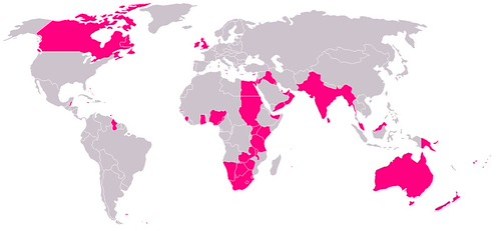
While the British Empire was the most widely dispersed:
As we remark with Shelley that empires come and empires go, we might recall that it was on this date in 1781 that the Articles of Confederation and Perpetual Union were finally ratified, and the Second Continental Congress became the Congress of the Confederation of the United States of America.

You must be logged in to post a comment.