Posts Tagged ‘Germany’
“My spirit will arise from my grave”*…
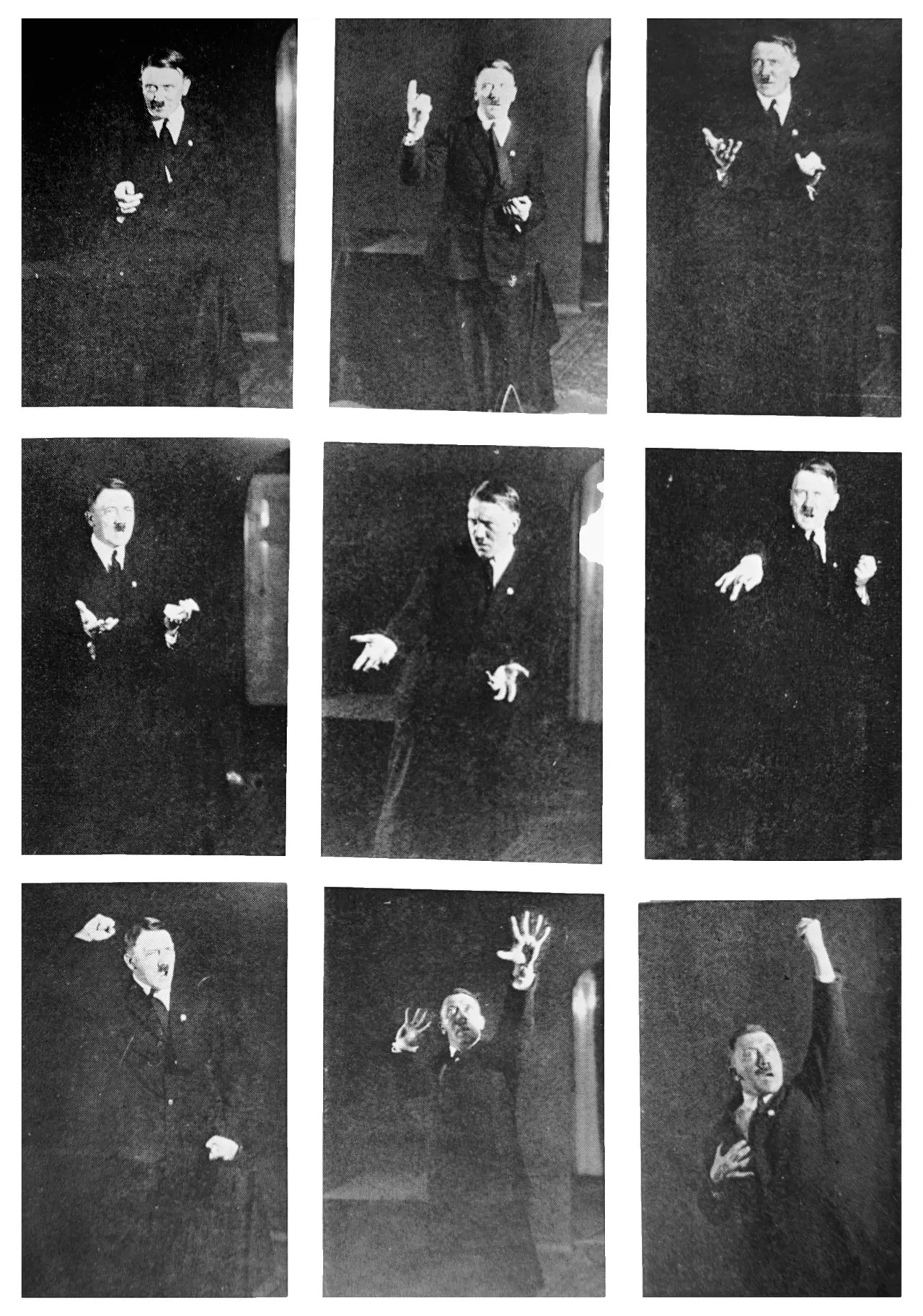
Hitler didn’t seize power; he was given it. As Adam Gopnik reports in a review of Tim Ryback‘s important new book, media lords thought that they could control him; political schemers thought that they could outwit him. The mainstream left had become a gerontocracy. And all of them failed to recognize his immunity to shame…
Hitler is so fully imagined a subject—so obsessively present on our televisions and in our bookstores—that to reimagine him seems pointless. As with the Hollywood fascination with Charles Manson, speculative curiosity gives retrospective glamour to evil. Hitler created a world in which women were transported with their children for days in closed train cars and then had to watch those children die alongside them, naked, gasping for breath in a gas chamber. To ask whether the man responsible for this was motivated by reading Oswald Spengler or merely by meeting him seems to attribute too much complexity of purpose to him, not to mention posthumous dignity. Yet allowing the specifics of his ascent to be clouded by disdain is not much better than allowing his memory to be ennobled by mystery.
So the historian Timothy W. Ryback’s choice to make his new book, “Takeover: Hitler’s Final Rise to Power” (Knopf), an aggressively specific chronicle of a single year, 1932, seems a wise, even an inspired one. Ryback details, week by week, day by day, and sometimes hour by hour, how a country with a functional, if flawed, democratic machinery handed absolute power over to someone who could never claim a majority in an actual election and whom the entire conservative political class regarded as a chaotic clown with a violent following. Ryback shows how major players thought they could find some ulterior advantage in managing him. Each was sure that, after the passing of a brief storm cloud, so obviously overloaded that it had to expend itself, they would emerge in possession of power. The corporate bosses thought that, if you looked past the strutting and the performative antisemitism, you had someone who would protect your money. Communist ideologues thought that, if you peered deeply enough into the strutting and the performative antisemitism, you could spy the pattern of a popular revolution. The decent right thought that he was too obviously deranged to remain in power long, and the decent left, tempered by earlier fights against different enemies, thought that, if they forcibly stuck to the rule of law, then the law would somehow by itself entrap a lawless leader. In a now familiar paradox, the rational forces stuck to magical thinking, while the irrational ones were more logical, parsing the brute equations of power. And so the storm never passed. In a way, it still has not…
Both the review and the book on which it focuses are eminently worth reading in full: “The Forgotten History of Hitler’s Establishment Enablers” (possible paywall; in which case, archived copy here), from @adamgopnik in @NewYorker.
* Hitler, as quoted in a letter from von Ribbentrop (to Churchill and Atlee) sent just before von Ribbentrop was captured at the end of the war
###
As we hear the echo, we might spare a thought for Ludwig van Beethoven; he died on this date in 1827. A crucial figure in the transition between the Classical and Romantic eras in Western music, he remains one of the most famous and influential of all composers. His best-known compositions include 9 symphonies, 5 concertos for piano, 32 piano sonatas, and 16 string quartets. He also composed other chamber music, choral works (including the celebrated Missa Solemnis), a single opera (Fidelio), and numerous songs.
Relevantly to the piece above…
Beethoven admired the ideals of the French Revolution, so he dedicated his third symphony to Napoleon Bonaparte… until Napoleon declared himself emperor. Beethoven then sprung into a rage, ripped the front page from his manuscript and scrubbed out Napoleon’s name. Some modern reproductions of the original title page have scrubbed out Napoleon’s name to create a hole for authenticity’s sake!
Beethoven’s temper and Symphony No. 3 ‘Eroica’
But, of course, it was too late…

“Comparisons are odious”*…

… but sometimes instructive in the very ways that they fail…
The innovations which make their appearance in East Asia round about the year 1000 … form such a coherent and extensive whole that we have to yield to the evidence: at this period, the Chinese world experienced a real transformation. … The analogies [with the European Renaissance] are numerous – the return to the classical tradition, the diffusion of knowledge, the upsurge of science and technology (printing, explosives, advance in seafaring techniques, the clock with escapement …), a new philosophy, and a new view of the world. … There is not a single sector of political, social or economic life in the eleventh to thirteenth centuries which does not show evidence of radical changes in comparison with earlier ages. It is not simply a matter of a change of scale (increase in population, general expansion of production, development of internal and external trade) but of a change of character. Political habits, society, the relations between town and country, and economic patterns are quite different from what they had been. … A new world had been born.
Jacques Gernet. A History of Chinese Civilization, pp. 298-300
Doug Jones, on what the remarkable story of the Song Dynasty can and can’t tell us about other periods…
Scholars contemplating the sweeping economic, social, and political transformation of China under the Song dynasty (960-1279) seem compelled to draw analogies with later dramatic occurrences in Europe – with the Renaissance (as in the quote above) or with the Economic Revolution in England on the eve of the Industrial Revolution.
The changes are dramatic. Population roughly doubles, from about 50 million to about 100 million. Cities grow. Both internal and external trade boom. The division of labor advances, with different households and different parts of the country specializing in “goods such as rice, wheat, lighting oil, candles, dyes, oranges, litchi nuts, vegetables, sugar and sugarcane, lumber, cattle, fish, sheep, paper, lacquer, textiles and iron.” In a number of fields of technology – iron production, shipbuilding – China reaches heights which the West will not attain for many centuries.
With changes in the economy come changes in the relation between society and state. Taxes come to be mostly collected in cash rather than kind, Eventually revenues from taxes on commerce, including excise taxes and state monopolies, will greatly exceed those from land tax. A Council of State will put constitutional checks on the power of the emperor.
Yet Imperial China will ultimately follow a different, less dramatic developmental pathway than Europe. Some reasons why…
On the ways in which history doesn’t repeat itself: “A cycle of Cathay,” from @logarithmic_h.
* Proverb
###
As we listen for the rhyme, we might recall that today is Schicksalstag (“Day of Fate”) in Germany. On this date five momentous events took place: Robert Blum, a leader in the Vienna revolts, was executed in 1848; Kaiser Wilhelm II resigned, marking the end of German monarchies in 1918; the Hitler’s Beer Hall Putsch failed in 1923; Kristallnacht (the Night of Broken Glass) and the Nazi antisemitic pogroms raged in 1938; and the Berlin Wall fell in 1989.

East and West Germans at the Brandenburg Gate in 1989 (source)
“The law of unintended consequences pushes us ceaselessly through the years, permitting no pause for perspective”*…

Catherine Merridale with the cautionary tale of of a Ukrainian millionaire businessman, lauded for his business acumen, who made an enormous contribution to the twentieth-century’s dark history of violence – he was instrumental in supporting Lenin’s return to Russia to foment revolution…
Who has not dreamed, this year at least, of watching Putin’s fall from power? Who has not hoped to see the day the Russians get to organise and push him out themselves? And which spy team, in thinking that, has not looked for some Russian they might sponsor for that job, some active oppositionist who has coherent plans?
If any spy is reading this, I have a message now. The whole trick has been tried before, and it did not go well. A century ago, indeed, in the midst of another deadlocked war, the German Foreign Service backed a whole string of assorted anti-Tsarist nationalists, Marxists, adventurers, and crooks. The most successful of these was Lenin (a warning in itself, of course). But the most colourful was another Bolshevik, a millionaire businessman and bon viveur called Alexander Helphand. Both mastermind and sad buffoon — well-read, unscrupulous, and vastly fat — this man helped shape his century. He died forgotten all the same, his many fortunes spent. To picture him — he deserves that — imagine Orson Welles…
The remarkable tale: “Alexander Helphand — impresario of revolutionary disaster who smoothed Lenin’s return to Russia.”
* Richard Schickel
###
As we tread with care, we might recall that it was on this date in 1918 that Moisei Uritsky was assassinated. A Bolshevik leader and head of the Cheka (the first in the string of Soviet secret police organizations), he was shot by a military cadet, Leonid Kannegisser (who was executed soon after).
Uritsky’s death, followed closely (on August 30) by an attempt on Lenin by Fanny Kaplan, led the Bolsheviks to begin a wave of repression and persecution known as the Red Terror.

“Great necessities call out great virtues”*…

Fatebenefratelli Hospital, Tiber Island, Rome
Behind the closed doors of the Fatebenefratelli hospital in Rome was a ward filled with patients being treated for K Syndrome. This new and unfamiliar disease – whose name evoked Koch Syndrome (tuberculosis) – was a strong deterrent to the occupying Nazi soldiers who carried out routine searches of the hospital for Jews, partisans and anti-fascists. Fearing infection, the Nazis did not dare enter the ward, turning their attention elsewhere.
Patients in this ward had been hospitalised and classified as suffering from K Syndrome in late 1943. On 16 October of that year, the Nazis combed the Jewish ghetto and other areas of Rome, deporting about 1,200 Jews. Only 15 survived the camps. After this, the hospital’s doctors and friars welcomed ever-increasing numbers of patients. These patients were, however, refugees. K Syndrome was an invented illness…
The remarkable story of hundreds hidden from the Nazis: “K Syndrome, the Disease that Saved.”
* Abigail Adams
###
As we admire audacity, we might recall that it was on this date in 1932 that Germany held a Presidential election. With six million unemployed, chaos in Berlin, starvation and ruin, the threat of Marxism, and a very uncertain future, the German people turned to Hitler by the millions.
Incumbent President Paul von Hindenburg was 84 years old and in poor health. Never enthusiastic about the presidency (or public office in general), Hindenburg had planned to stand down after his first term. But the prospect of Adolf Hitler being elected President of Germany persuaded the reluctant incumbent to seek a second term. In the first round of voting, Hindenberg received 49.6% of the vote, just shy of the majority necessary to avoid a run-off. Hitler polled 30%; Thälmann, the Communist candidate, 16%, and other candidates, 7%.
Hitler took to the skies, criss-crossing Germany by airplane in the run-off campaign. He raised his total to 37% of the vote. Although Hitler lost the presidential election of 1932, he achieved his goals when he was appointed chancellor on January 30, 1933. Then on February 27, Hindenburg paved the way to dictatorship and war by issuing the Reichstag Fire Decree which nullified civil liberties. Hitler succeeded Hindenburg as head of state upon Hindenberg’s death in 1934, whereafter he abolished the office entirely, and replaced it with the new position of Führer und Reichskanzler (“Leader and Reich Chancellor”), cementing his rule.

1932 Ballot
“To clarify, ADD data”*…

1939 World’s Fair– The World of Tomorrow– under construction, on the site of a former Queens (New York City) wetland
Who dreams of files? Well, I do, to be honest. And I imagine Herman Melville, Emily Dickinson, Franz Kafka, and Le Corbusier did, too. It’s not only the files and cabinets themselves that enchant, but their epistemological and political promise; just think of what you can do with all that data! The dream has survived as a collective aspiration for well over a century — since we had standardized cards and papers to file, and cabinets to put them in — and is now expressed in fetishized data visualization and fantasies about “smart cities” and “urban science.” Record-keeping and filing were central to the World of Tomorrow and its urban imaginary, too…
Shannon Mattern on the way in which the 1939 World’s Fair anticipated our current obsession with urban data science and “smart” cities: “Indexing the World of Tomorrow.”
[TotH to Rebecca Onion]
* Edward Tufte
###
As we dream of spires, we might spare a thought for Andreas Felix von Oefele; he died on this date in 1780. A historian and author (most notably of the 10 volume work Lebensgeschichten der gelehrtesten Männer Bayerns, “Life stories of the most learned men of Bavaria”), von Oefele was the first “Electoral Councillor, Bibliothecarius and Antiquarius”– the first head of the Bavarian Court and State Library and Secret Archives.

You must be logged in to post a comment.