Posts Tagged ‘Parable of the Sower’
“Before beginning, plan carefully”*…

The marvelous Matt Levine on one of the vexing challenges facing those who preserve themselves cryogenically…
See, if you go to a regular trusts and estates lawyer, she will ask you questions like “if your spouse and children die before you, whom do you want to inherit your estate,” but if you go to a science fiction trusts and estates lawyer, she will ask you questions like “if your frozen head cannot be attached to a fresh body and reanimated in 200 years, but your consciousness can be cloned in a computer simulation, would you like your estate to go to the cloned consciousness or stay with the frozen head?” Meanwhile I suppose if you go to a regular financial planner, he will ask you questions like “how much equity risk are you comfortable taking between now and retirement,” while if you go to a science fiction financial planner, he will ask you questions like “where are you most comfortable investing for the next 200 years, given that you will not be able to change your asset allocation decisions during that time, because you’ll be dead?”
When you are a kid, science fiction is fun because it imagines amazing futuristic technologies. And then you grow up and you realize that what’s really fun are the legal and financial technologies that are called into being by those physical technologies: Sure sure sure reviving a frozen head is great, but how does the frozen head get a credit card? Bloomberg’s Erin Schilling reports:
Estate attorneys are creating trusts aimed at extending wealth until people who get cryonically preserved can be revived, even if it’s hundreds of years later. These revival trusts are an emerging area of law built on a tower of assumptions. Still, they’re being taken seriously enough to attract true believers and merit discussion at industry conferences.
“The idea of cryopreservation has gone from crackpot to merely eccentric,” said Mark House, an estate lawyer who works with Scottsdale, Ariz.-based Alcor Life Extension Foundation, the world’s largest cryonics facility with 1,400 members and about 230 people already frozen. “Now that it’s eccentric, it’s kind of in vogue to be interested in it.”
He and others are trying to answer questions that at times seem more like prompts in a philosophy class.
Can money live indefinitely?
Are you dead if your body is cryonically preserved?
Are you considered revived if you have only your brain?
And if you’re revived, are you the same person?
So many good legal questions — “House considers the revived person to be different in the eyes of the law, in part because a person can’t be the beneficiary of their own trusts” — but also great financial ones.
Here’s one: Should you buy Bitcoin for your long sleep? The argument for Bitcoin is that you can hold it, indefinitely, without relying on anyone else: If you put 10 Bitcoin in a wallet and only you know the private key, and then you die and get frozen and come back in 200 years, no one will have taken your Bitcoin, legal rules about inheritance and perpetual trusts don’t matter, and you don’t need some succession plan for the trustees and financial advisers who will take care of your assets. You just have to make sure you remember your private key as you’re dying. Legal rules can change, human institutions can change, but your Bitcoin is immutable.
The argument against Bitcoin is, of course, what if people stop valuing Bitcoin? Putting your money in Bitcoin is a hedge against change in other human institutions, but it puts a lot of eggs in the basket of one human institution, “treating Bitcoin as money.” It’s a bit weird to bet that that’s more permanent than anything else.
More generally, what is money anyway? “It may be difficult to know what role money will play in a post-[artificial general intelligence] world,” says OpenAI to its investors, and what if OpenAI gets to artificial general intelligence before anyone gets around to unfreezing the heads? You might be leaving your future self all the wrong stuff…
Very long-term planning: “Cryogenics Law,” from @matt_levine via Ingrid Burrington’s wonderful newsletter, “Perfect Sentences” (in this instance, “Sure sure sure reviving a frozen head is great, but how does the frozen head get a credit card?).
* Marcus Tullius Cicero
###
As we chill, we might recall that it was on this date in 1983 that the coldest (natural) temperature ever recorded on Earth was registered by the research station at Vostok, Antarctica: -128.5 degrees Fahrenheit (-89.2 degrees Celsius).

We might also note that today– July 20, 2024– is the date on which the action in Octavia Butler’s Parable of the Sower begins: “…in 2024, when society in the United States has grown unstable due to climate change, growing wealth inequality, and corporate greed…”

“So many books, so little time”*…
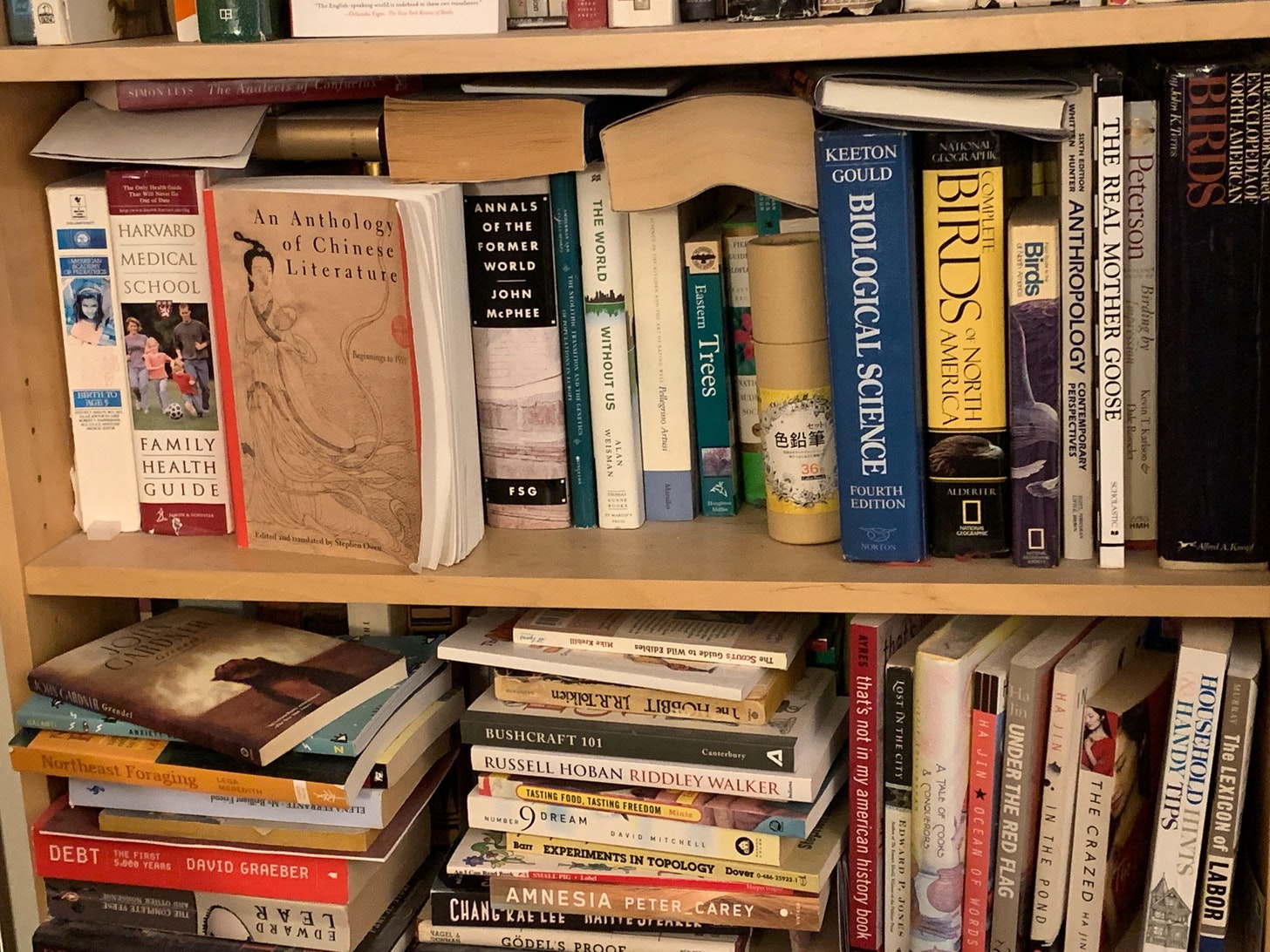
Dear The Sophist,
I own a lot of books, and nearly enough shelves to fit them. I haven’t read most of them—has anyone with a lot of books read most of them?—yet I still get impulses to buy more. Can you please tell me why it’s OK for me to buy more books? I should add that I live with a partner who doesn’t own a lot of books, but tolerates mine so far. So far.
—Tome-escent
Dear Volume Purchaser,
Books are ridiculous objects to buy, aren’t they? For the sake of spending a day or two, maybe a week, with some author’s thoughts and words, you take custody of this physical item that sticks around, and around, as more and more others accumulate along with it. You look at them, almost unseeingly, day after day; the walls of your rooms press in; you pay extra money to the movers to drag the extra weight around from one dwelling to the next, all because you read an interesting review once or a cover caught your eye in a bookstore.
You know what else is ridiculous? The sheer impermanence of thought. The constant yet ephemeral flickering of partial understanding across the synapses in our wet and mortal brains, and the dry circuits of the junky and even more short-lived electronic ersatz brains we rely on for backup. A book is an investment against forgetting and death—a poor investment, but it beats the alternatives. It is a slippery yet real toehold on eternity,,, If you stop the flow of new books, you stop this flow of possibilities…
Too many books? Tom Scocca (@tomscocca) explains that there’s no such thing as too many books. (via the ever-illuminating Today in Tabs)
And lest one fear that the only option is to buy books, remember the Public Library…

* Frank Zappa
###
As we reorganize our shelves, we might spare a thought for someone whose works definitely deserve places of honor thereon, Octavia Estelle Butler; she died in this date in 2006. An African American woman science fiction author, she was a rarity in her field. But her primary distinction was her extraordinary talent, as manifest in novels and stories that stretch the imagination even as they explore the all-too-real truths of the human condition. She was a multiple recipient of both the Hugo and Nebula awards, and became (in 1995) the first science-fiction writer to receive a MacArthur Fellowship.
It’s measure of her insight that her work– perhaps especially her “Parable” series— is being re-discovered as painfully prescient of our current times.

“The future is there… looking back at us. Trying to make sense of the fiction we will have become”*…

Tim Maughan, an accomplished science fiction writer himself, considers sci-fi works from the 1980s and 90s, and their predictive power. Covering Bruce Sterling, William Gibson, Rudy Rucker, Steven King, P.D. James, an episode of Star Trek: Deep Space Nine, and Bladerunner, he reserves special attention for a most deserving subject…
When you imagine the future, what’s the first date that comes into your mind? 2050? 2070? The year that pops into your head is almost certainly related to how old you are — some point within our lifetimes yet distant enough to be mysterious, still just outside our grasp. For those of us growing up in the 1980s and ’90s — and for a large number of science fiction writers working in those decades — the 2020s felt like that future. A decade we would presumably live to see but also seemed sufficiently far away that it could be a world full of new technologies, social movements, or political changes. A dystopia or a utopia; a world both alien and familiar.
That future is, of course, now…
Two science fiction books set in the 2020s tower over everything else from that era in their terrifying prescience: Octavia Butler’s Parable of the Sower (1993) and Parable of the Talents (1998). These books by the late master kick off in 2024 Los Angeles and are set against a backdrop of a California that’s been ravaged by floods, storms, and droughts brought on by climate change. Middle- and working-class families huddle together in gated communities, attempting to escape the outside world through addictive pharmaceuticals and virtual reality headsets. New religions and conspiracy theory–chasing cults begin to emerge. A caravan of refugees head north to escape the ecological and social collapse, while a far-right extremist president backed by evangelical Christians comes to power using the chillingly familiar election slogan Make America Great Again.
Although it now feels like much of Butler’s Parable books might have been pulled straight from this afternoon’s Twitter or tonight’s evening news, some elements are more far-fetched. The second book ends with followers of the new religion founded by the central character leaving Earth in a spaceship to colonize Alpha Centauri. Butler originally planned to write a third book following the fates of these interstellar explorers but, sadly, passed away in 2005 before she had a chance. She left us with a duology that remains more grounded and scarily familiar to those of us struggling to come to terms with the everyday dystopias that the real 2020s seem to be already presenting us.
Not that this remarkable accuracy was ever her objective.
“This was not a book about prophecy; this was an if-this-goes-on story,” Butler said about the books during a talk at MIT in 1998. “This was a cautionary tale, although people have told me it was prophecy. All I have to say to that is I certainly hope not.”
In the same talk, Butler describes in detail the fears that drove her to write this warning: the debate over climate change, the eroding of workers’ rights, the rise of the private prison industry, and the media’s increasing refusal to talk about all of these in favor of focusing on soundbite propaganda and celebrity news. Again, these are fears that feel instantly familiar today…
What Blade Runner, cyberpunk– and Octavia Butler– had to say about the age we’re entering now: “How Science Fiction Imagined the 2020s.”
* William Gibson, Pattern Recognition
###
As we honor prophets, we might recall that it was on this date in 1984 that Apple aired an epoch-making commercial, “1984” (directed by Blade Runner director Ridley Scott), during Superbowl XVIII– for the first and only time. Two days later, the first Apple Macintosh went on sale.
You must be logged in to post a comment.