Posts Tagged ‘cult’
“Mangoes will make you forget anything but mangoes”*…
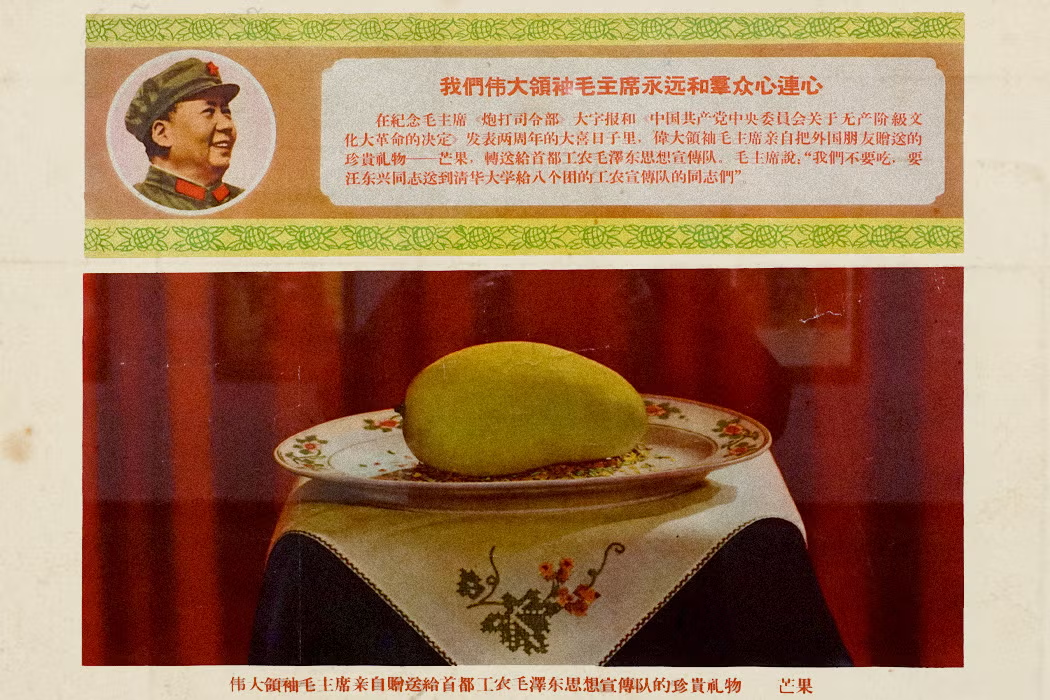
… Or not. As Christin Bohnke explains, sometimes a mango is more than just a mango…
What happens when ideologies are destroyed? When beliefs that shaped generations dissolve overnight? In the wreckage of old traditions, new symbols are created, and meaning is projected onto what was previously trivial. But not all of these new symbols are coherent or easily legible. Some are outright weird. Few events in history demonstrate the absurdity of political symbolism as clearly as the Mao Mango Mania that swept China during the infancy of the Cultural Revolution.
In 1966, Mao Zedong, Chairman of the Communist Party and China’s supreme leader, set in motion the Great Proletarian Cultural Revolution, a campaign to realign China with his revolutionary vision. His goal was to transform society, both economically and ideologically, by purging everything deemed traditional or capitalist. Over the next ten years, the Cultural Revolution changed the country in profound and painful ways, leading to more than a million estimated deaths as well as to immense human suffering.
Historian Lü Xiuyuan describes the period between 1966 and 1968 as the most destructive years of the entire movement. Following Mao’s directive to destroy the “Four Olds” (ideas, cultures, customs, and habits), his paramilitary youth groups, the Red Guards, swept the country with violence. They identified, tortured, and killed so-called “counterrevolutionaries,” raided temples and schools, and destroyed priceless artifacts. In 1968, university campuses, middle schools, and other public spaces became the sites of bloody battles, not only between Red Guards and alleged counterrevolutionaries but also between revolutionary factions. The chaos of the “Red Terror” couldn’t continue indefinitely, so Mao determined that Chinese workers would help suppress the Red Guard, restore order, and continue the revolution in a more measured manner. In this endeavor, Mao was helped, improbably, by a box of yellow-fleshed fruit.
In August 1968, a visiting foreign minister from Pakistan, Mian Arshad Hussain, gave Mao a box of mangoes as a gift during a state visit. Presenting mangoes has a long tradition in Pakistan, but in China, the fruit was virtually unknown. Mao passed the box to workers occupying the Tsinghua campus in Beijing, who were attempting to control the Red Guards stationed there. The scholar of Chinese visual culture Alfreda Murck writes that the mangoes carried an implicit message: from now on, the workers, not the Red Guards, would be in charge of education and the transformation of China in Mao’s image.
According to Murck, even Mao could not have anticipated the consequences of his gift. Because the mangoes came from the supreme leader, they were transformed, in the eyes of the workers, from a simple fruit into an object endowed with attributes of the divine. William H. Hinton, the author of Fanshen, compiled eyewitness accounts of workers who reported staying up all night, touching the mangoes, and marveling at their new station as protégés of the Chairman. Using the momentum, the official party cadres concocted a propaganda campaign surrounding the mangoes, workers, and Mao, and in doing so, according to the political scientist Richard Baum, effectively signed “the death warrant of the Red Guards.”
Quickly, the Red Guards were disbanded, many of them sent for reeducation in the countryside where they labored and lived alongside rural peasants. By contrast, the workers who received Mao’s mangoes, a sign of his favor, were energized and became Cultural Revolution leaders. Yet, their promotion was an illusion. True power lay with the People’s Liberation Army. Despite, or because of that, the workers—and the mangoes—played a significant role in official propaganda in the months to come.
When the workers returned to their factories after putting down the Red Guards, Mao had a fresh mango delivered to them. Workers held welcoming ceremonies for the fruit, preserved it in wax, placed it on altars, and bowed to it when walking by. In one factory, the fruit was boiled down into sacred mango water; each devotee drank a spoonful. From there on, the cult of the mango escalated. Wax and even plastic mangoes were quickly produced in Chinese factories and appeared all over the country, often displayed in glass cases. Images of the mango adorned plates, wedding gifts, and cigarette packages. It was stitched onto blankets, and propaganda teams armed with wax replicas were sent into the remotest corners of the country to spread its lore. More than seventy different types of mango badges to stitch onto clothes were given away for free or sold at a low price to those who couldn’t afford more expensive mango-themed items. Alongside the mangoes were mentions of Mao’s selflessness and love for the people (though no reference to the fate of the Red Guards), and many badges bore the slogan “With each mango profound kindness.”…
… During the 1968 National Day parade in Beijing, the mango was front and center. At least three mango-themed floats participated in the parade, decorated with slogans that emphasized the significance of the working class, as well as a colossal white statue of Mao. The parade reinforced the importance of Mao as the supreme leader and the mango as a symbol of his power.
According to development studies scholar Xing Li, Mao viewed ideology as the primary means of mobilizing the masses and driving change, putting special emphasis on themes such as dedication, self-sacrifice, and hard work. The mango was a perfect vessel for Mao’s “love” for the workers. Unlike already established symbols such as the peony, peach, or pomegranate, the mango had no preexisting meaning in China and, importantly, no association with emperors or divinity. Quickly, rumors spread that mango trees only blossom every century—or every thousand years, according to others—and that eating the fruit would bring about a long life, similar to the peaches of immortality that feature prominently in Chinese legends. Mao’s refusal to keep the mangoes for himself was therefore seen as a great sacrifice on behalf of his people.
The veneration of the mango coincided with a high point in Mao’s personality cult. In the 1960s, one billion copies of the “Little Red Book,” a collection of Mao’s quotes, were printed. The book had to be waved and quoted at the beginning of each workday and whenever someone made a political statement. Mao was everywhere. And so were his mangoes. They became inextricably linked, and criticism of one meant criticism of the other. Murck tells of a dentist in Sichuan province, for example, who, after seeing a mango paraded through his town, said that the fruit resembled a sweet potato. He was arrested, tried as a counterrevolutionary, marched through the streets, and executed. His children were sent to the countryside for reeducation. Given the serious consequences of even the slightest criticism, it’s impossible to say how many people genuinely participated in the mango cult and how many complied out of fear.
Political movements need symbols to foster cohesion and emotional connection, but for these to thrive and remain, they must have at least some internal logic, cultural coherence, or tradition. The mango was an artificial symbol, created randomly, and the people’s devotion to the fruit must have been at least partially performative. By 1969, the mango cult had already begun to decline; it was no longer featured in official campaigns, although the sheer volume of mango-themed products ensured that it didn’t disappear entirely until the mid-1970s. After Mao’s death in 1976 and the 1980s reassessment of his personality cult, it became acceptable to discard mango ephemera that some Chinese still kept in their homes, or more prudently, to repurpose the wax mangoes as candles. Because the mango was so closely linked to Mao, it couldn’t remain a meaningful symbol without him.
Still, the mango as a political symbol never entirely faded. US-based Chinese author Ha Jin, who served in the Chinese army at the time of the Cultural Revolution and has been an outspoken critic of the Chinese government, wrote in his 2019 poem “A Sacred Mango:”
The mango was exhibited in the center of the hall.
We lined up to look at it
and to show our gratitude and respect.But that night some curious child tasted the fruit
and was not caught.
Our mayor, frightened and outraged, said,
“Damn it, if I knew which son of a rabbit bit the mango
I would turn his whole family
into counter-revolutionaries!”But what could we do?
We substituted a wooden mango for a real one.For Ha Jin, as for others, the mango remains not a sign of Mao’s power, but a reminder of the Cultural Revolution’s absurdity and the arbitrary labeling of counterrevolutionaries. Despite being a short-lived propaganda tool, the mango’s symbolism endures as a testament to the irrationality of Mao’s extreme personality cult.
Commercial production of the mango in China began around that time, but only really accelerated in the 1980s. Although some people still recall the mango cult and spoke about it in their interviews with Murck, today the meaning of this particular fruit is largely forgotten, and the mango, far from symbolizing Mao’s eternal love and sacrifice for the working class, has transformed once again. This time, into a refreshing summer treat…
A fleeting cult built around a fruit exposes the logic, and illogic, of Mao’s personality cult: “When Mao’s Mango Mania Took Over China,” from @jstordaily.bsky.social.
* Eve Babitz
###
As we pare away the peel, we might send decorative birthday greetings to Maria do Carmo Miranda da Cunha; she was born on this date in 1909. Better known by her stage name, Carmen Miranda (and her nickname, “the Brazilian Bombshell”), she was a successful singer, dancer, and actress.
As a young woman, Miranda designed clothes and hats in a boutique before making her debut as a singer, recording with composer Josué de Barros in 1929. Miranda’s 1930 recording of “Taí (Pra Você Gostar de Mim),” written by Joubert de Carvalho, catapulted her to stardom in Brazil as the foremost interpreter of samba. In 1939 she was invited to Broadway by producer Lee Shubert, and quickly lured from there to Hollywood, where she made 14 films in as many years.
Miranda did much to popularize Brazilian music and raise American awareness of Latin culture, for which she has been honored (e.g., with a museum) in Brazil. Here, she is largely remebered for her style, in particular for her large “fruit hats.”

“There is a time for everything”*…

… and the time for the Word came later than many of us seem to understand…
The oldest scriptures that eventually became the Bible were created within an environment where no appreciable religious function was assigned to texts. The stories, proverbs, songs, and prayers dating from the ninth and eighth centuries bc that researchers have managed to reconstruct from the Bible are examples of literature rather than holy scripture. They evolved into scripture through a lengthy process.
What scholars call a “cult religion” was practiced in Israel and Judah in the period before the Babylonian Exile (586–538 bc). Religious observance centered on local shrines, and contact with the deity was maintained through sacrifices, votive offerings, and prayer. In the late pre-exile period, that is, the final decades of the seventh century bc, cultic activities in Judah came to be focused on a single temple in Jerusalem. The Bible portrays this process as part of the religious reforms undertaken by Josiah (2 Kings 22–23).
Of course, religious texts also had their place within this cult, but they did not play a key role in either its foundation or its normalization. Instead, like the religious paraphernalia in the temple, they simply formed one aspect of cultic activities…
Judaism only became a “religion of the book”—that is, one whose core entailed the study of sacred texts—following the destruction of the Second Temple by the Romans in 70. With the demise of the sacrificial cult of the temple, the faith shifted entirely to the study and celebration of the scriptures.
And it was not until that stage that the concept of the Bible as a complete, authoritative collection of texts arose. Its texts had almost certainly been in religious use before this, but alongside many other documents. A strict dividing line between biblical and nonbiblical literature did not exist at that time, since there was as yet no such thing as the Bible. And so the belief system of Israel and Judah changed gradually over the course of the first millennium bc from a cult religion to a religion of the book…
Scripture before the Bible: “Becoming a Religion of the Book,” an excerpt from The Making of the Bible: From the First Fragments to Sacred Scripture by Konrad Schmid and Jens Schröter in Lapham’s Quarterly (@laphamsquart)
* The Bible, Ecclesiastes 3:1
###
As we tackle the text, we might recall that it was on his date in 1538 that Pope Paul III excommunicated King Henry VIII of England. The reasons were many: First, Henry had illegally married his new wife Anne Boleyn and left his former Queen Katherine of Aragon. Then he had proclaimed himself head of the Church of England, denying the papal primacy. He disbanded English monasteries and appropriated much of their assets.
The original bull of excommunication had been issued on 30th August 1535, but the excommunication had been suspended in the hope that Henry would mend his ways. When Henry sacked St. Thomas Becket’s shrine, the Pope decided to act.
The break with Rome was, at first, largely political (and personal). But as the years passed, the theology and liturgy of the Church of England became markedly Protestant, especially during the reign of Henry’s son Edward VI, largely along lines laid down by Archbishop Thomas Cranmer. Under Mary, the process was reversed and the Church of England was again placed under papal jurisdiction. But Elizabeth reintroduced the Protestant religion (albeit in a more moderate manner).
The structure and theology of the church was a matter of fierce dispute for generations. The most violent of these disputes, the English Civil Wars, ended when the last Roman Catholic monarch, James II, was deposed and Parliament employed William III and Mary II jointly to rule in conjunction with the English Bill of Rights in 1688 (in the “Glorious Revolution“), from which emerged a church polity with an established church (The Church of England) and a number of non-conformist churches whose members suffered various “civil disabilities”– until these were removed many years later. A substantial but dwindling minority of people from the late 16th to early 19th centuries remained Roman Catholic in England. Their church organization remained illegal until the Relief Act of 1829.

“There is science, logic, reason; there is thought verified by experience. And then there is California.”*…

Half a century ago, you could barely walk down the street in California without tripping over some kind of fringe spiritual sect or cult-like group. Pretty much every famous organization, guru, and spiritual trend of that era had ties to the Golden state – from the Maharishi to the People’s Temple, the “Moonies” to the New Age.
Now, with the exception of some Scientology buildings and the occasional Hare Krishna devotee, you almost never encounter fringe spiritual groups from that California golden age.
Some of the groups violently disbanded or their members died under horrific circumstances. Others slowly faded away, pushed out by California’s rising cost of living, or made obsolete by the fact that many of the things that made them appealing were absorbed into the mainstream: Fortune 500 CEOs now regularly attend Burning Man and crystals and Himalayan salt lamps can be purchased at Target. (The more nefarious side of fringe spiritual belief is also becoming increasingly mainstream, as seen in the rise of QAnon.)
But some of California’s fringe spiritual groups are still out there – little pockets of commune dwellers, transcendental meditators, and UFO worshippers dotted around the state…
“Cult classics: the faded glory of California’s fringe sects – in pictures,” from Jamie Lee Curtis Taete (@JLCT on Twitter; @jamieleecurtistaete on Instagram)
* Edward Abbey
###
As we become one with the universe, we might recall that, according to (separate but overlapping) deductions made by geologists and religious historians, it was on this date in 33 CE that Jesus was crucified.
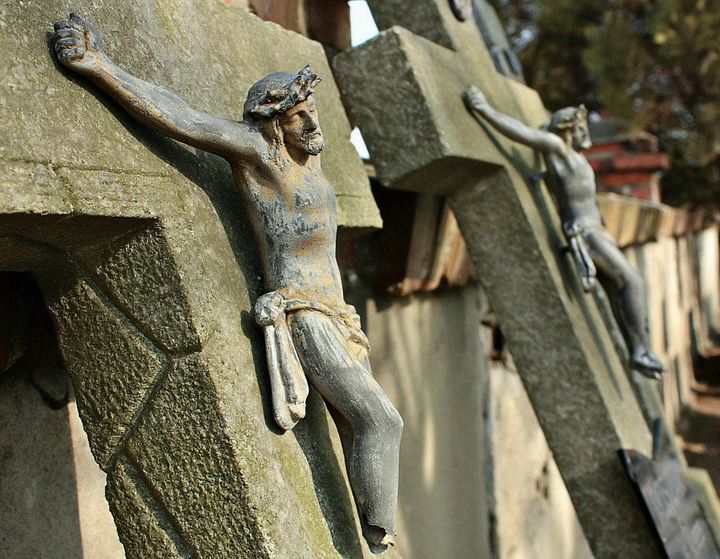
“The mind is its own place, and in itself can make a heaven of hell, a hell of heaven”*…

The Easter ‘Passion of the Christ’ procession in Comayagua, a small town in Honduras
Cults, generally speaking, are a lot like pornography: you know them when you see them. It would be hard to avoid the label on encountering (as I did, carrying out field work last year) 20 people toiling unpaid on a Christian farming compound in rural Wisconsin – people who venerated their leader as the closest thing to God’s representative on Earth. Of course, they argued vehemently that they were not a cult. Ditto for the 2,000-member church I visited outside Nashville, whose parishioners had been convinced by an ostensibly Christian diet programme to sell their houses and move to the ‘one square mile’ of the New Jerusalem promised by their charismatic church leader. Here they could eat – and live – in accordance with God and their leader’s commands. It’s easy enough, as an outsider, to say, instinctively: yes, this is a cult.
Less easy, though, is identifying why. Knee-jerk reactions make for poor sociology, and delineating what, exactly, makes a cult (as opposed to a ‘proper’ religious movement) often comes down to judgment calls based on perceived legitimacy. Prod that perception of legitimacy, however, and you find value judgments based on age, tradition or ‘respectability’ (that nice middle-class couple down the street, say, as opposed to Tom Cruise jumping up and down on a couch). At the same time, the markers of cultism as applied more theoretically – a single charismatic leader, an insular structure, seeming religious ecstasy, a financial burden on members – can also be applied to any number of new or burgeoning religious movements that we don’t call cults.
Often (just as with pornography), what we choose to see as a cult tells us as much about ourselves as about what we’re looking at…
Cults are exploitative, weird groups with strange beliefs and practices, right? So what about regular religions then? “What is a Cult?“
To get a sense of terrain in question, visit Wikipedia’s page “New Religious Movement” and consult their “List of new religious movements.”
For a sense of how time can convert a “new religious movement” into an established faith, consult the “Timeline of religion.”
And for (one) opinion of where all of this might be leading, see “Tomorrow’s Gods: What is the future of religion?”
* Paradise Lost
###
As we ponder piety, we might recall that today is the concluding day of International Clown Week.

Tis the season…

from “Santa and the Ice Cream Bunny”
Your correspondent is headed into the ice and snow of his annual holiday hiatus; regular service will resume early in the new year… But lest readers be at loose ends:
From classics like Santa Claus Conquers the Martians…
… to Christmas Evil, the film John Waters called “the greatest Christmas movie ever made”…
… “13 of the Weirdest Holiday Movies Ever Made.”
###
As we deck the halls, we might recall that it was on this date in 1966 that CBS first aired Dr. Seuss’ How the Grinch Stole Christmas!. Directed by the great Chuck Jones and narrated by Boris Karloff (who also voiced the Grinch), it featured songs with lyrics by Theodor “Dr. Seuss” Geisel himself.

TV Guide, Dec 17-23, 1966 (Chicago edition)
Happy Holidays!!
You must be logged in to post a comment.