Posts Tagged ‘lightning’
“If lightning is the anger of the gods, then the gods are concerned mostly about trees”*…

Mostly, but not entirely. Chloe Aridjis on survivors of lightning strikes…
There are three types of lightning: cloud to cloud, or intercloud, which leaps across gaps of clear air; intracloud, which doesn’t leave the cloud at all; and cloud to ground, the most threatening: a stream, or rather a meeting of two streams, of ionised particles, each following its own determined course, one towards the heavens, the other towards earth, and where they meet the air crackles with heat, creating a sky of forking paths.
To the attendees of the International Lightning Strike Survivor Conference, who have all had encounters with the third kind, the oft-mentioned statistic (nine out of ten survive) offers little consolation. Many of them, given the consequences, would prefer to have been struck dead. Survival provides small solace when your entire existence has been electrically altered.
Just as lightning isn’t a single event but rather a sequence of strokes, so the memory of a lightning strike returns in fierce, dramatic bolts rather than as one clear picture.
…
Distinguished ornithologist ALEX COSTA from Tampa, Florida, the lightning state (three times more strikes than any other in the US), was observing a rare migratory bird when struck, and when he returned to his senses the bird had vanished along with his shoes, binoculars and long-term memory. Indoor landscape painting (he rarely leaves home) has replaced ornithology and, with his good hand, he now paints imaginary woods and meadows. He doesn’t sleep much at night but reads and takes long naps in his armchair by the window….
What is it like to be touched by a lightning bolt? More current-charged recollections: “Notes on the International Lightning Strike Survivor Conference,” at @thedialmag.
* Lao Tzu
###
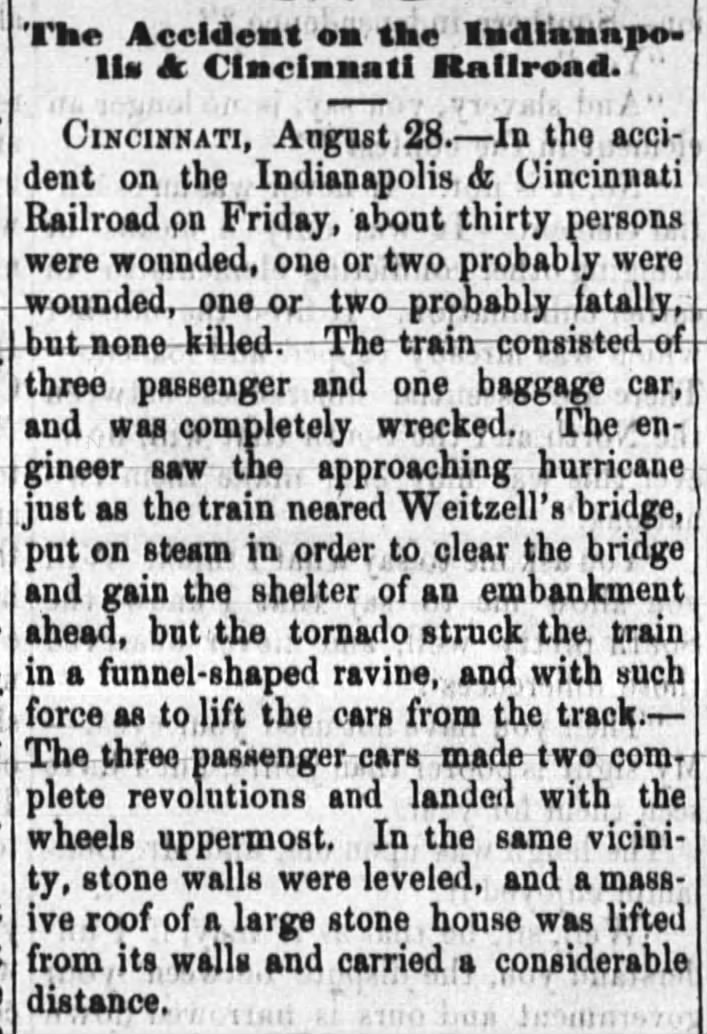
As we take cover, we might remember that it was on this date in 1864 that a train running from Cincinnati to Chicago was derailed by a tornado in Dearborn County, Indiana (about 75 miles southeast of Indianapolis). Three passenger cars were lifted from the tracks and dropped in a ravine, injuring 30 people.
“The city’s full of people who you just see around”*…

An archaeologist’s reconstruction of Dvin, one of the most ancient settlements of the Armenian Highland and an ancient capital of Armenia [source], and modern day New York City [source]
Much of the history of the city—its built forms and its politics, the urban experience, and the characteristic moral ambivalence that cities arouse—can be written as a tension between the visible and the invisible. What and who gets seen? By whom? Who interprets the city’s meaning? What should remain unseen?
Rulers of cities have always had an interest in visibility, both in representing their power and in controlling people by seeing them. The earliest cities emerged out of the symbiosis of religion and political power, and the temple and the citadel gave early urbanism its most visible elements…
Warren Breckman‘s fascinating history of the city as a place to see and be seen: “A Matter of Optics.”
* Terry Pratchett, Men at Arms
###
As we wonder, with Juvenal (and Alan Moore), who watches the watchmen, we might recall that it was on this date in 1752 that Benjamin Franklin and his son tested the relationship between electricity and lightning by flying a kite in a thunder storm. Franklin was attempting a (safer) variation on a set of French investigations about which he’d read. The French had connected lightning rods to a Leyden jar, but one of their experiments electrocuted the investigator. Franklin– who may have been a wastrel, but was no fool– used a kite; the increased height/distance from the strike reduces the risk of electrocution. (But it doesn’t eliminate it: Franklin’s experiment is now illegal in many states.)
In fact, (other) French experiments had successfully demonstrated the electrical properties of lightning a month before; but word had not yet reached Philadelphia.

The Treasury’s Bureau of Engraving and Printing created this vignette (c. 1860), which was used on the $10 National Bank Note from the 1860s to 1890s
“Those who make peaceful revolution impossible will make violent revolution inevitable”*…

It is often observed that the French Revolution was a revolution of scientists. Nourished by airy abstractions and heartfelt cries to Jean-Jacques Rousseau, its leaders sought a society grounded, not in God or tradition, but in what Edmund Burke decried as “the conquering empire of light and reason”. To be sure, if we tallied the professional affiliations of the members of the first National Assembly, we would find it overwhelmingly populated by lawyers. But the revolution’s symbols and motifs were not derived from legal practices and traditions, and it was not as men of law that Maximilien Robespierre and Jean-Paul Marat called for the death of their king and the creation of a democratic republic. Rather, they did so as scientists—middle class intellectuals who saw in government a field ripe for experimentation, innovation, and improvement.
Nowhere was this as clear as their approach to “the will of the people”. Of the many puzzles to which revolutionaries applied themselves as scientists, few seemed so pressing and so intractable. It is obvious what a king’s will looks like, or so we like to think. Kings are individuals, they have bodies, and they can tell us what to do. However they choose to communicate their will — through voice, a gesture, a written pronouncement — it is relatively clear when such acts belong to them. But “the people” enjoy no such obvious body and no evident means of self-expression. What does the will of the people actually look like? And how do we hear their voice if they don’t have a mouth with which to speak? As French revolutionaries enthroned the will of the people, they stepped into uncharted terrain. Democratic revolution, it turned out, required men capable of visualizing the invisible and making appear what escaped our immediate senses. Indeed, it seemed to require the labor of scientific inquiry applied to the people themselves. Like the invisible composition of air, the secret patterns of a magnetic field, or the stratifications of the earth’s soil, democratic politics was governed by a hidden law which the scientist-statesman had to uncover…
Kevin Duong explores how leading French revolutionaries, in need of an image to represent the all important “will of the people”, turned to the thunderbolt — a natural symbol of power and illumination that also signaled the scientific ideals so key to their project: “Flash Mob: Revolution, Lightning, and the People’s Will.”
* John F. Kennedy
###
As we agree with Ursula LeGuin that “You cannot buy the revolution; you cannot make the revolution; you can only be the revolution,” we might send provocative birthday greetings to poet, novelist, literary critic, essayist, inventor, and environmental activist Margaret Eleanor Atwood; she was born on this date in 1939. Currently enjoying wide celebrity via the television adaptations of her novels The Handmaid’s Tale and Alias Grace, her wide body of work has earned her the Arthur C. Clarke Award, Prince of Asturias Award for Literature and the Peace Prize of the German Book Trade; she has been shortlisted for the Booker Prize five times, winning once, and has been a finalist for the Canadian Governor General’s Award several times, winning twice. In addition to her fourteen novels, she has published she has also published fifteen books of poetry, ten non-fiction books, seven children’s books, four collections of stories, three collections of unclassifiable short prose works, three opera libretti, and a graphic novel.
Atwood is also the inventor and developer of the LongPen and associated technologies that facilitate the remote robotic writing of documents, for which she holds several patents.

“Getting struck by lightning is like winning the lottery, except of course, not as lucky”*…

On the coast of Venezuela, in the small fishing village of Ologa, lies a square kilometer that is struck by more lightning than anywhere else on the planet almost every other night of the year. Reuter’s photojournalist Jorge Silva offers an illustrated tour at “Venezuela’s eternal storm.”
* Jarod Kintz
###
As we take cover, we might send highly-charged birthday greetings to Alessandro Giuseppe Antonio Anastasio Volta; he was born on this date in 1745. Volta was a physicist who studied what we now call electrical capacitance; he developed (separate) means to study both electrical potential (V ) and charge (Q ), and discovered that for a given object, they are proportional. This is often called “Volta’s Law”; the unit of electrical potential is universally called the “volt.” For all of this, Volta may be best remembered as the inventor of the first battery (which he called the “voltaic pile“).

“If lightning is the anger of the gods, then the gods are concerned mostly about trees”*…

Lightning strikes around the world– in real time.
* Lao Tzu
###
As we reach for our rods, we might recall that it was on this date in 1957 that the U.S. detonated an atomic weapon on a test range in the Yucca Flats in Nevada-a test of the Air Force’s AIR-2 Genie missile with a nuclear warhead, part of the Plumbbob series, the biggest, longest, and most controversial test series in the continental United States: 29 tests, of which only two failed to detonate. Exactly seven years later– on this date in 1964– the Soviet Union performed a nuclear test in Eastern Kazakh.

You must be logged in to post a comment.