Posts Tagged ‘trucking’
“And miles to go before I sleep”*…

Anna and Kelly Pendergrast on the mechanics of a disorienting life event (that has spawned a mammoth industry)…
In 2022, about 12.6% of the US population (aged 1 year or over) lived in a different house or apartment than they did a year prior. The migration rate within the United States has been steadily declining over recent decades after sitting around 20% from the end of World War II to the 1980s. While people moving within the same county consistently make up the largest share of movers, the percentage of people moving between states has been rising, increasing from 18.8% [that the portion of the opularion that moved] in 2021 to 19.9% in 2022.
Moving house is profoundly disorienting, throwing into disarray the entirety of your material existence, your daily routines, and your relationship to the land and built environment. It’s also one of the most significant organizational challenges people willingly undertake — a moment of intersection with the global logistics infrastructures that move things from one place to another.
Moving house is a very specific, personal pain, but as with all stressful life events (marriage, divorce, death) there’s an entire industry around it. Professional moving companies — previously represented by the American Moving & Storage Association, now a part of the broader American Trucking Association — are dedicated to streamlining all aspects of moving house and extracting money from the weary and frazzled. Moving is a big industry: There were 17,936 companies in the moving services industry in 2024, with over 109,062 employees.
If you’re accustomed to scrappy DIY moves, watching a moving company at work is like glimpsing a more logistically sophisticated world. If the DIY mover is a stevedore, loading lamps and houseplants one by one into a truck or station wagon, professional movers are workers at the containerized port, a model of efficiency as they stack standardized boxes into a standardized truck. The professional move is faster and more streamlined than doing it yourself, but it requires more materials, more coordination, and more infrastructure.
Part of the mover’s arsenal is the specialized box and other assorted paper products. For instance, the Dish Barrel is a double-walled cardboard container designed specifically to move dishware, enabling multiple layers of delicate kitchen items to be stacked while minimizing the risk of crushing. There are different methods for packing a Dish Barrel, both with and without cardboard dividers (which U-Haul calls cell kits). But in all cases the best practice for the Dish Barrel is to use copious sheets of newsprint before packing into a box.
A review of moving YouTube videos like those linked above reveal a curious gender binary: While organizing YouTubers (who teach viewers how to sort, label, and display items in a house) tend to be women, moving YouTubers (who teach viewers how to wrap, pack, and box items to leave a house) are more likely to be men. While the tasks are very similar, the connotations of the work — homemaking and aesthetics on the one hand, lifting and logistics on the other — keep them squarely in gendered categories…
More redolent reportage on relocation: “Moving House,” from @annapendergrast.bsky.social and @kellypendergrast.bsky.social in Scope of Work.
(Image above: source)
* Robert Frost, “Stopping by Woods on a Snowy Evening“
###
As we decamp, we might recall that it was in this date in 1962 that the Seattle World’s Fair (more officially known as “the Century 21 Exposition”) opened. Nearly 10 million people attended the fair during its six-month run; and as planned, the exposition left behind a fairground and numerous public buildings and public works (including the iconic Space Needle and the monorail). Unlike many Fairs of its era, Century 21 made a profit– and, relevantly to the topic above– is credited with revitalizing Seattle’s economic and cultural life and attracting an increased flow of movers to the area.

“The keeping of bees is like the direction of sunbeams”*…
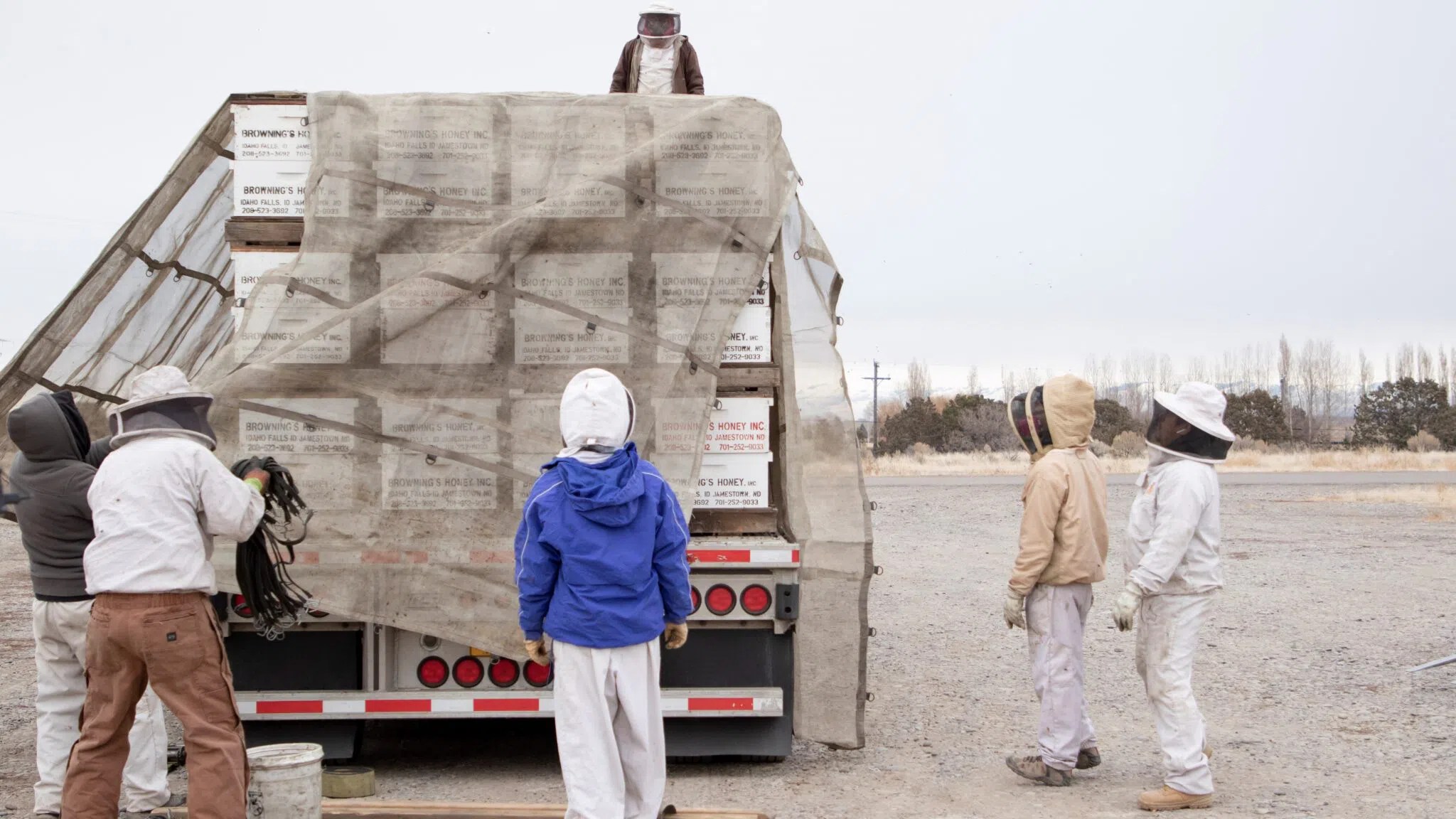
And moving those bees…
About 75% of crops and one-third of the global food supply rely on pollinators such as honeybees, according to Our World in Data. But farmers have to rely on commercially managed honeybees trucked in from other states to help pollinate certain crops, such as almonds, because there aren’t enough wild bees to do the job. And trucking bees hundreds or thousands of miles is not simple…
Honeybees are disappearing due to shrinking habitats and the growing use of pesticides. When there aren’t enough bees to pollinate fields of crops, companies pay beekeepers to transport their colonies of bees for pollination season.
“The great pollination migration” happens every year in February when the almonds bloom in California.
Pollinating the seemingly endless fields of almond trees in California requires 85% to 90% of all honeybees available to pollinate in the U.S… Bees are trucked into California from across the country…
Earl and Merle Warren are brothers, truck drivers and co-owners of Star’s Ferry Transport, based in Burley, Idaho. They started hauling bees for a local beekeeper in 1990 and moved about 50 loads of approximately 22 million bees each last year for companies such as Browning’s Honey Co.
“This is not like a load of steel or lumber. These are live creatures. This is those beekeepers’ livelihoods, so we do everything possible to keep them alive,” Earl Warren said.
Some beekeepers estimate that every time you move a truck of bees, up to 5% of the queens die… Minimizing stress for bees is critical, so beekeepers rely on experienced truck drivers to navigate difficult situations such as warm weather, few opportunities to stop during the day and inspections…
A fascinating link in the modern food chain: “A day in the life of a honeybee trucker,” from Alyssa Sporrer (@SporrerAlyssa).
* Henry David Thoreau
###
As we ponder pollination, we might spare a thought for a scientist whose very field of study was (and is) made possible by bees, Anders (Andreas) Dahl; he died on this date in 1789. A botanist and student of Carl Linnaeus, he is the inspiration for, the namesake of, the dahlia flower.

“Every spirit makes its house, and we can give a shrewd guess from the house to the inhabitant”*…

Where did the very idea of assigning numbers to homes come from? As Deirdre Mask writes in her fascinating new history of street addresses, The Address Book, house numbering is a product of the Enlightenment, and was undertaken originally not to aid citizens but to make it easier to tax and conscript them. “House numbers exist not to help you find your way,” Mask writes, “but rather to help the government find you”…
The familiar American address system of odds and evens running concurrently down opposite sides of the street comes from Philadelphia, where Clement Biddle established it in 1790, according to Anton Tantner’s odd and delightful Address Numbers: Pictures of a Forgotten History. It was also in Philadelphia that the idea of assigning each block its own 100-number range was pioneered, in 1856. Both systems have spread across the world, though other systems still persist: the “horseshoe” method of numbers running sequentially down one side of the street and then back on the other side, so that No. 1 sits across from the highest number on the block; a “distance scheme” in which the number on a house refers to its distance from a given point. There are still plenty of places in the world where addresses are not used. In most towns in Costa Rica, for example, locations are given narratively (“fifty meters west of the town hall,” etc.), since houses have no numbers and, “as in the song of U2,” writes the Costa Rica News, “the streets have no name.”…
Think of your address numbers as your house’s earrings. Your house projects a certain aesthetic to your neighbors, intentionally or unintentionally, a set of visual cues that can be read along lines of class, taste, aspiration, and style. The numbers on your house do more than identify your address for the postman; deployed properly, like the perfect pair of earrings, house numbers accentuate a harmonious visual message in concert with the design around them. Sometimes that message is one of individuality: My house, the numerals say, reflects my own personality, and is unlike any other house you might encounter. Sometimes it’s a message of conformity: My house fits in securely with all my neighbors’.
I recently walked every single street in my ZIP code in the Northern Virginia suburbs, cataloging the house numbers I saw along the way and mapping them, block by block for 1,114 blocks. This absolutely scientific survey yielded significant data about how styles of house numbers propagate across neighborhoods and significant observations about how house numbers “speak” to the passersby they address…
Serif or sans serif?… Dan Kois (@dankois) explores what that can tell us: “How people style their house numbers.”
* Ralph Waldo Emerson
###
As we do a number, we might recall that on this date in 1956 President Dwight D. Eisenhower signed the Federal-Aid Highway Act, landmark legislation that funded a 40,000-mile system of interstate roads that ultimately reached every American city with a population of more than 100,000. Today, almost 90% of the interstate system crosses rural areas, putting most citizens and businesses within driving distance of one another. Although Eisenhower’s rationale was martial (creating a road system on which convoys could travel more easily), the results were largely civilian. From the growth of trucking to the rise of suburbs, the interstate highway system re-shaped American landscapes and lives.


You must be logged in to post a comment.