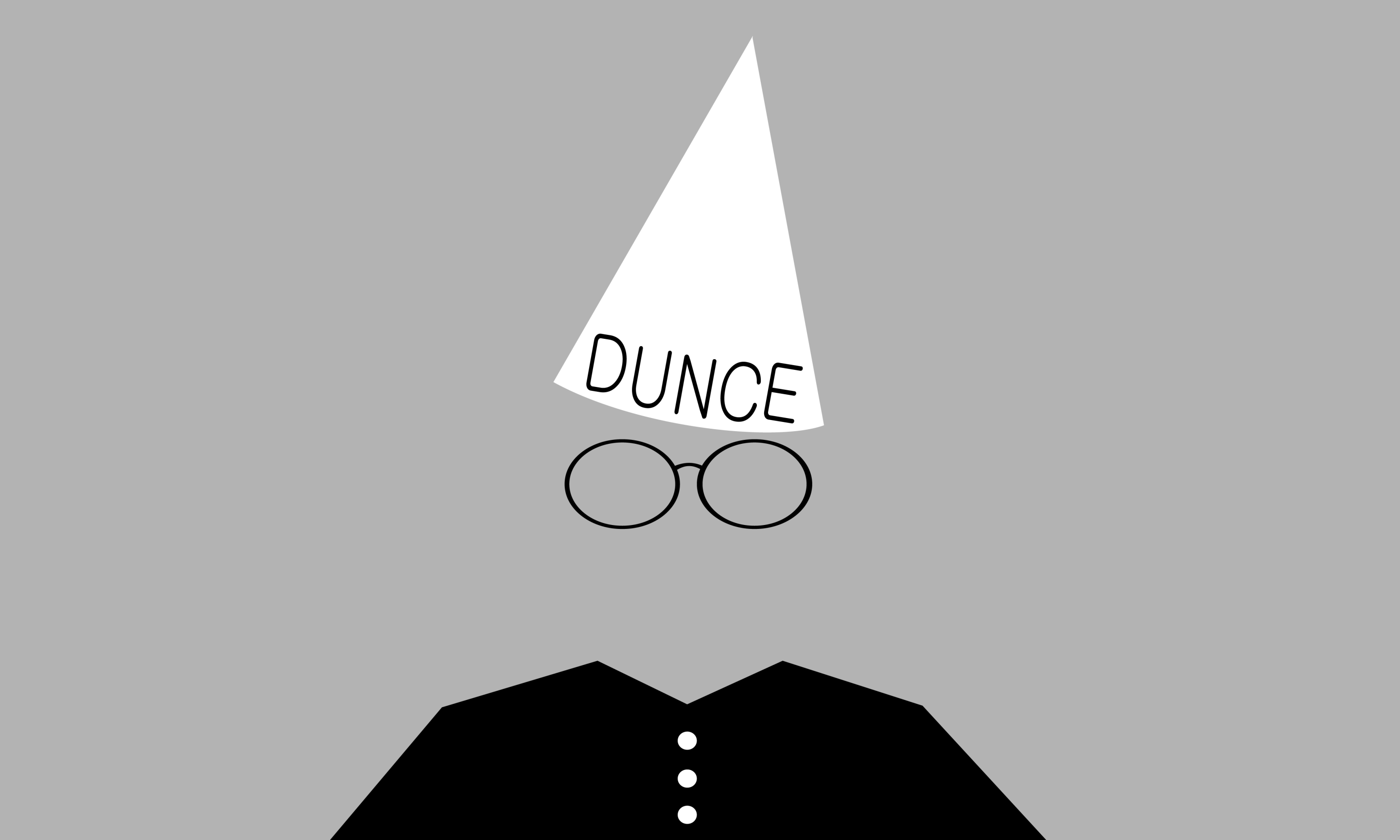
David Krakauer (President of the Sante Fe Institute and Professor of Complex Systems there) argues that it takes intelligence to get things spectacularly wrong…
I have never heard a rock described as stupid. And the same would be true of a river, a hurricane, and even a thermostat. Stupidity seems to be a sophisticated form of behavior despite its ignominious associations.
Human beings can land autonomous rovers on Mars, sequence a genome in hours, and engineer nanometer circuits. And yet conspiracy theories, anti-scientific political movements, and institutional hatred proliferate on a scale that might embarrass the meager success record of a medieval alchemist.
One might say that stupidity implies a capacity for getting things right before it can get them spectacularly wrong. Stupidity is not the opposite of intelligence but its evil twin, the dissimulating Cain to a cerebral Abel. And perhaps surprisingly, the degree of stupidity available to any system scales directly with the intelligence that system possesses—more intelligence begets greater feats of stupidity. It would be a stretch to call a bacterium stupid, and we know that cats and dogs achieve modest feats of it. But human beings, equipped with language, abstraction, technology, institutions, and ideology, can be stupid on a truly civilizational scale. This is not a joke; it is close to a law of nature. A law that might very well be our undoing.
We have thousands of research programs on intelligence, and not all of them are intelligent, including studies of IQ, AI, animal cognition, and collective problem-solving. These take place in celebrated departments and are published in prestigious journals devoted to understanding how minds make hard problems easy. These days we cannot take a step without crashing into another article on intelligence and AI. Researchers from all fields without any knowledge of intelligence research and its history have become self-declared “thought leaders” in natural and artificial intelligence.
Yet stupidity gets almost no attention at all. It is treated as a mere absence, as if once we subtract intelligence what remains is stupidity. It is likened to a form of psychological darkness experienced after you have switched off the lights of deliberation. But this is a mistaken belief. Darkness does not do anything pernicious in the way that stupidity does. Stupidity takes an easy problem and, with great effort and misdirected ingenuity, makes it hard. That effort is the key to grasping stupidity, in that you need sophisticated machinery to be genuinely, consequentially stupid.
Here is how I like to think about this from a scientific perspective. If intelligence means making a problem of difficulty X easier, by deploying tools, using mathematics, and adopting strategies that reduce its cost, then stupidity means making a problem of difficulty X harder. And contrary to expectations, the most reliable way to make an easy problem hard is to bring to bear an impressive apparatus of complicated theories, elaborate beliefs, and sophisticated algorithms that sound tremendously convincing but perform worse than doing nothing. A person who does not know the answer to a question is merely ignorant. A person who constructs an ingenious hundred-page argument for the wrong answer is stupid. As great writers, artists, and philosophers throughout time have understood, such constructions require intelligence of a high order…
[Krakauer explores a variety of types of human stupidity, then turns to AI and draws his conclusion…]
… Artificial intelligence is by design the most powerful cognitive artifact ever created. It is engineered to minimize user effort by performing tasks that humans would otherwise find time consuming or impossible. The problem of course is that the better the tool gets the less the user needs to think for themselves. And in a vicious spiral, the less the user thinks the more dependent they become on their tools. That is until the tool disappears and the whole system collapses.
If intelligence is a necessary precondition for stupidity, and intelligence and stupidity scale together such that it takes real intelligence to be spectacularly stupid, then super-intelligence will be the opening act to an era of super-stupidity.
AI hallucination might be the first evidence of this dynamic. Large language models produce fluent, confident, detailed text that is, with some regularity, factually wrong. And this is not a simple bug but a structural feature of systems that optimize for appeal and plausibility rather than truth. And the danger is not that the AI will be wrong, after all, humans are wrong all the time, but knowing this, humans have invented means to detect and correct errors. We call this the scientific method.
The danger is that an AI will be wrong in ways humans can no longer detect because the very capacities that would catch the error have been outsourced to the machine or exceed the capacities of human minds. We face the prospect of a stupidity so sophisticated that it becomes indistinguishable, to its beneficiaries, from intelligence. This is the parable of Douglas Adams’ The Hitchhiker’s Guide to the Galaxy, where the answer to the ultimate question, the meaning of life, the universe, and everything, is 42.
I would like to make a modest proposal and suggest that we need a science of stupidity as rigorous as our emerging sciences of intelligence. This will not require billions of dollars of investment. It would involve inquiries into the mechanisms by which intelligent systems produce stupid outcomes. It would include studying the evolutionary dynamics that maintain stupidity despite its selective costs. It would promote the development of design principles that distinguish tools which enhance cognition from tools which replace it. And it would include surveying the institutional conditions under which collective intelligence degrades into collective stupidity.
Stupidity is not what remains when intelligence is subtracted, it is an active mechanism with its own logic, its own dynamics, and a capacity for unbounded growth parasitic on ingenuity. In a world obsessed with ever more powerful cognitive technologies, understanding stupidity is not merely an academic exercise, it might prove to be the most intelligent thing we do…
Apposite: “How we meet the future” (“If we couldn’t make generalisations, we would be paralysed by the world’s complexity. Does that ever excuse stereotyping?”)
* Albert Einstein
###
As we investigate imbecility, we might recall that it was on this date in 2008 that the Trump International Hotel and Tower in Chicago “topped out“; construction was completed over the next few months. Donald Trump had announced in 2001 that the skyscraper would become the tallest building in the world, but after the September 11 attacks that same year, the architects scaled back the building’s plans, and its design underwent several revisions. When opened in 2009, it became the second-tallest building in the U.S. It surpassed the city’s John Hancock Center as the building with the highest residence (apartment or condo) in the world and briefly held that title until the completion of the Burj Khalifa several months later. The property has been beset by problems from its opening; they continueto thisday.
The sharing of experimental results and the underlying data is critical to the advance of science. Indeed, when I had the chance to do a scenario planning exercise with a collection of the leading research university librarians in the U.S. a couple of decades ago, the biggest threat/fear they surfaced was the concern that the free and open exchange of ideas and data, as manifest formally in scientific publication and informally in the collegial cooperation among scientists, would be occluded by an increasing proprietary embrace of knowledge.
73% of geneticists surveyed in an article in the 23/30 January 2002 issue of the Journal of the American Medical Association agreed that although keeping data private may help the individual researcher, data hoarding is detrimental to the progress of science Still, sadly, that threathasgrown since the turn of the millennium.
By way of current (and dramatic) example: as Celina Zhao reports, more than half of AI “unicorns” have never published a paper or preprint…
Today’s biggest artificial intelligence (AI) startups make no shortage of bold promises. Their technologies, some boast, will revolutionize software development, drug discovery, and scientific research.
Yet a new preprint posted on 16 July on bioRxiv suggests many of these firms barely participate in one of science’s most fundamental practices: publicly documenting discoveries in scientific literature so other researchers can evaluate and build on them. More than half of AI unicorns—private companies valued at more than $1 billion—have never played a leading role in publishing a scientific paper or preprint, according to the new analysis. Collectively, they accounted for just one in every 1000 AI papers published in 2025.
“For a field that is supposedly reshaping science and is so advanced in terms of scientific potential, not having any scientific documentation seems like a very weird paradox,” says paper co-author John Ioannidis, a metascientist at Stanford University [see here]. “How can you judge that what they say is real, validated, and reproducible?” The scarcity of publications, others say, also makes it harder to assess AI’s social impacts, including energy use and safety.
But University of Alberta AI ethicist Mohamed Abdalla says the findings reflect the incentives facing commercial AI developers, rather than solely a failure to uphold scientific norms. “It’s not the company’s job to advance science, right?” he says. “The company’s job is to advance money.”
Ioannidis has long studied how unicorns, particularly in biotech, engage with the scientific literature. (In 2015, he was the first to publicly scrutinize the lack of peer-reviewed studies produced by Theranos, the blood testing startup that proved to be based on fraudulent data.) He wondered whether AI unicorns would show similar patterns.
To find out, he and his team first identified all 317 unicorn AI companies that have existed from 1998 to 2025. Then, they searched for publications affiliated with these startups—including journal articles, conference papers, reviews, and preprints. They selected those where a company researcher played a leading role as a first or last author, indicating the startup had made a substantial contribution to the work. The final data set included 2077 final publications, comprising 1389 peer-reviewed papers and 688 preprints.
More than half of the startups had never produced a single qualifying paper, the analysis revealed. Scientific influence proved even more concentrated, with the top 5% of firms accounting for greater than 90% of all citations. OpenAI alone was responsible for nearly 40% of all citations in the data set, followed by the Chinese computer vision company Megvii and the platform Hugging Face. And even at the most prolific companies, much of the output came from the same small group of repeat authors. For example, despite OpenAI employing roughly 4500 people, only eight researchers had authored five or more qualifying papers.
The findings are unsurprising to some AI researchers given how the industry is structured. For example, unlike the pharmaceutical industry, where published discoveries can be protected by patents, AI companies have learned they often gain little from publicly disclosing technical advances, says Nur Ahmed, an AI researcher at the University of Arkansas. Google’s landmark 2017 paper on the transformer—the architecture that underpins today’s large language models—has become a classic cautionary example, Abdalla adds. Although Google patented aspects of the technology, “I don’t think anybody’s paying Google for that,” he says.
Startups also operate on much faster timelines than academia, where peer review can lumber on for months or even years. That’s why many AI companies have embraced what Avijit Ghosh, an AI policy researcher at Hugging Face, calls the “blogification” of research: announcing new models and releasing code or data sets through blog posts and technical reports rather than scientific journals. The new analysis didn’t track those outputs, he points out.
For Ghosh, the debate shouldn’t center on publishing in journals versus blogs. What matters is whether companies are releasing enough code, data sets, or model weights (the numbers that determine how a model interprets and responds to a prompt) for others to independently verify and build on their work, he says.
The preprint also found that firms based in China consistently published more papers than their counterparts based in the United States. Whereas leading U.S. frontier labs have increasingly kept the details of their most capable models secret or “closed sourced,” leading Chinese companies have embraced “open-source” models. Moonshot AI, one of the Chinese startups included in the study, recently unveiled Kimi K3—one of the strongest open models to date—and publicly released its model weights through Hugging Face today.
But whether models are open or closed, the rapid pace toward increasingly powerful generalist AI worries Emma Pierson, a computer scientist at the University of California, Berkeley. She argues AI research—whether published freely or kept secret—risks accelerating models that pose serious societal and safety concerns, including supercharging cyberattacks. “If we were racing forward on cancer-curing AI, I would be like, ’Fantastic, full steam ahead,’” she says. “But that’s not what we’re racing toward, right?”…
By way of example? In order to have a broader footprint in AI for (default proprietary) scientific discovery, Google moves away from a successful AI effort (that did publish): “Google DeepMind dismantles Nobel-winning AlphaFold team in strategy shift” (gift article from the FT). Onewonders: when these LLMs run out of published papers on which to train, where (and how) will they source the knowledge they need to stay useful?
* Neil deGrasse Tyson
###
As we share and share alike, we might recall that it was on this date in 1887 that Chester A. Hodge of Beloit, Wisconsin received patent No. 367,398 for ‘spur rowel’ barbed wire (consisting of spur shaped wheels with 8 or 10 points mounted between 2 wires). It was one of many patents for barbed wire (e.g., here), which spread across the American West rapidly (thanks, in no small measure to the guy featured in the almanac entry here)– and (by protecting farmers from foraging free-ranging cattle) paved the way for the expansion of wheat (and other kinds of) farming… even as it spelled the doom of a commons– the open range.
Two figures related to the art of astronomy from a manuscript of the Ars notoria (NLI Ms. Yah. Var. 34), ca. 1550–1600. Each contains subordinate figures to be contemplated — while reciting accompanying prayers (orations) — in a prescribed sequence over time and with respect to the cardinal directions — Source.
As Anne Lawrence-Mathers explains, centuries before Neo instantly mastered Kung Fu in The Matrix, and AI emerged promising quick command of any subject to any of us, medieval scholars found a shortcut to years of difficult study: a magical manuscript that promised to fast-track advanced learning. Anne Lawrence-Mathers investigates the Ars notoria, its supposed powers, and the demonic influence it had upon some users…
Mastering the full range of subjects taught in medieval universities normally required many years of hard and expensive study. From the thirteenth century on, however, an anonymous work known as the Ars notoria promised, through diagrams, incantations, and arcane rituals, to rapidly transmit to scholars the total knowledge of anything they might need. Condemned by church authorities, the fifty-six extant manuscripts nevertheless testify to the seductiveness of that offer.
Its complex diagrams were at the center of its appeal. Unlike diagrams in other magical texts, those in Ars notoria do not illustrate what the text is seeking to communicate. Nor do they act as models to be replicated in three-dimensional form as pieces of magical equipment. Instead, they supposedly work almost in the same way as religious icons. That is, faithful possession and use of them can offer direct contact with powerful and benign supernatural forces — and ultimately even with God. The diagrams themselves are the route to magic and consist of arrangements of symbolic and geometric forms, patterns, and symbols, interspersed with “words”, which are frequently unintelligible combinations of letters.3 Practitioners who opened their minds to receive and imprint these labyrinthine images, while reciting complex verbal formulae and strings of mysterious, almost unpronounceable words and names, are engaging in a significant act of trust.
Several factors made the Ars notoria fundamentally different from other magical texts. First, this is not a text in conflict with the church. In fact, the rituals framing and shaping usage of the images are presented as extremely pious, and the texts to be recited are identified as prayers. The alien words, names, and characters are explained as coming from ancient languages such as Greek, Hebrew, and “Chaldean”, and are claimed to preserve both the names of angels and words used to communicate with them. Second, the advantages offered are relatively virtuous: contact with spiritual beings and full knowledge of the subjects taught in medieval universities. Such claims cut little ice with thirteenth-century theologians, however, who saw clear links to things condemned as superstitious and demonic by St Augustine, despite the text’s assertion that it contains wisdom revealed to King Solomon.
St Thomas Aquinas was worried enough by the Ars notoria to name and condemn it specifically in his Summa theologiae — one of the most authoritative summaries of Christian teaching. He dealt with the very serious issue of superstition in Book Two, Part 2 — Question 96 is effectively devoted to the Ars notoria. Aquinas’ conclusion is wholly negative: the “art” is both “unlawful and futile”. It is futile because it cannot deliver what it promises. Still more seriously, its “signs” are neither understood by humans (like ordinary words and letters) nor sent by God (as sacraments are), and thus are precisely the type of thing that lures humans into contact and compact with demons.
That may seem a conclusive case for the rejection of the Ars notoria, especially as Aquinas’ objections were echoed by other major theologians. However, the number of surviving medieval copies of the work, and the fact that it was copied and owned in religious institutions until the end of the medieval period, show that the church ultimately had neither the interest nor ability to stamp it out. Moreover, it was translated in the early modern period and also went into print, demonstrating an ongoing — and more widespread — interest…
[Professor Lawrence-Mathers explains how the Ars notoria was used…]
… For some users, the rituals were so powerful that they seemed demonic. One of these was Brother John, an early fourteenth-century monk of the abbey of Morigny, near Étampes. John’s account of his introduction to the text, his powerful attraction to it, and the terrifying experiences he underwent while using it, was given in several chapters of John’s own, visionary work, the early fourteenth century Liber florum celestis doctrine.6
The great attraction of the Ars notoria for John was its promise of quick access to advanced scholarly knowledge. He recounts his continuing wish to study, and how he was lent a copy of a book of necromancy by “a certain cleric”. He copied much of it and wanted more. This led to an encounter with a “medical expert” from Lombardy, who informed John that what he needed was the Ars notoria, and that a copy of it was to be found within the walls of the school (at Orléans) where John had been sent. These details provide important evidence of the liminal status of works of ritual magic. They were recognised as dangerous, and were far from being officially approved, and yet were well known, owned and recommended by educated individuals, including monks and clerics.
For John, the Ars notoria was dangerous not in some abstract way, but very directly. He confesses that it struck him at first as beautiful and holy, and seemed to offer miraculous gifts rather than demonic temptations. It became apparent, however, that the book was utterly deceptive, a work of the Devil, a “sick pleasure” that was actually fatally poisonous to the soul, not only to the body…
As we do the work, we might recall that it was on this date in 1965 that Frank Herbert’s Dune was published.
Herbert published a three-part serial Dune World in the monthly Analog, from December 1963 to February 1964. The serial was accompanied by several illustrations that were not published again. After an interval of a year, he published the much slower-paced five-part The Prophet of Dune in the January–May 1965 issues. The first serial became “Book One: Dune” in the final published Dune novel, and the second serial was divided into “Book Two: Muad’dib” and “Book Three: The Prophet”. The serialized version was expanded, reworked, and submitted to more than twenty publishers, each of whom rejected it. The novel, Dune, was finally accepted and published in August 1965 by Chilton Books, a printing house better known for publishing auto repair manuals. Sterling Lanier, an editor at Chilton, had seen Herbert’s manuscript and had urged his company to take a risk in publishing the book. However, the first printing, priced at $5.95 (equivalent to $60.79 in 2025), did not sell well and was poorly received by critics as being atypical of science fiction at the time. Chilton considered the publication of Dune a write-off and Lanier was fired. Over the course of time, the book gained critical acclaim, and its popularity spread by word-of-mouth to allow Herbert to start working full time on developing the sequels to Dune, elements of which were already written alongside Dune.
Herbert died in 1986; his son Brian Herbert and author Kevin J. Anderson continued the series in over a dozen additional novels since 1999. Among them was Dune: The Butlerian Jihad, a prequel which chronicles the fictional Butlerian Jihad, a crusade by the last free humans in the universe against the thinking machines, a violent and dominating force led by the sentient computer Omnius.
Times have changed. As the New York Times reports (in a piece apposite to Tuesday’s post)…
When Google prepared to go public in 2004, Larry Page, a co-founder of the company, wrote a letter to shareholders describing the internet firm’s responsibility to the world.
“We believe a well-functioning society should have abundant, free and unbiased access to high-quality information,” Mr. Page said.
Google fulfilled that responsibility by acting as a gateway to the internet. It answered people’s search queries with lists of hyperlinks, pushing users out to what is known as the “open web” — the millions of websites run by merchants, publishers, universities and others — for more information. In the ensuing decades, Google became one of the planet’s richest and most powerful companies by directing people to the vastness of the open web.
Now in the age of artificial intelligence, Google appears to be shrinking back from the open web — and may be imperiling it.
Since last year, the Silicon Valley giant has revamped its search with A.I. It introduced AI Mode, which replaces search results of hyperlinks with conversational responses written by Gemini, its A.I. chatbot. Most recently, Google changed its iconic search box for the first time in 25 years so that people could add photos and videos to their queries and assign A.I. “agents” to run searches for them.
The effect of these moves is becoming clear: People are spending more time with Google than ever…
… and spending less time with the sites that supply the information Google’s AI returns. Stephen Follows unpacks one web site’s experience– a cautionary tale for the open web and a reminder that, if we kill the sites generating the answers on which we depend, they won’t be there for anyone (directly or via AI) to find…
If you work in or around the film industry, there is a decent chance you have used the work of The Numbers this month, whether you realise it or not.
Its hand-researched data is the highest quality, tracking box office grosses, budgets, home video and streaming across more than 78,000 films and 236,000 people. It gets north of eight million visitors a year, and is treated as THE definitive authority by journalists, academics, filmmakers, prediction markets, and even Guinness World Records.
And it was this GOAT status which caused the catastrophic events of March this year.
The site was down for over a week, without explanation. A week later, it resurfaced at a fraction of its former size. Gone were the historical charts, the individual movie pages, and even the much-loved Report Builder.
With only a generic “we’re rebuilding, please bear with us” message to go on, the internet responded as it always does – with confusion, anger, and conspiracy theories. One Reddit theory even suggested it was a deliberate rug pull designed to cripple the free site to push people towards paid products.
Three months on, I spoke at length with Bruce Nash, founder and CEO of The Numbers, about what happened. He describes quite an unpleasant and eventful experience:
We got a lot of angry emails from people who are like, ‘Where’s this page that you used to have and you don’t have anymore?’
Within his tale are a number of things that should worry anyone who runs, relies on, or simply appreciates the internet…
[Follows recounts the history of The Numbers: its launch on Geocities, its growth, the onslaught of robots, the attack of hackers, and the coming of the LLMs and their relentless scraping…
… How bad could [AI bot scraping] be? Pretty bad, tbh. Enough that site owners such as Bruce have to question the value of something that will take so much time and money to build and defend.
Cloudflare, which protects a huge share of the world’s websites, publishes data on how many pages each AI platform crawls for every one visitor it sends back to the websites it crawled.
Google crawls about five pages for every visitor it sends you. OpenAI crawls over 1,000. Anthropic crawls over 38,000 pages for every single visitor it refers.
Note that the scale is logarithmic, i.e. each step along the bottom is ten times bigger than the last, because otherwise the differences are quite literally too large for me to include on one chart.
For the history of the internet to date, the principle of the open web was that, in return for letting the search engine robots read your site, they would send you readers. But now, that trade no longer applies. The number of robots has exploded, and they no longer send anyone back.
When this firehose is aimed at a small site, it can inflate the bandwidth bill and possibly even take down an entire site…
[Follows looks at other sites, including Wikipedia, in similar straights, and at attempts to protect these sites…]
… Whether any of this works depends on whether the AI companies play along rather than route around it. But as Bruce put it to me, somebody has to try.
Let’s look beyond the specifics for a moment and consider what happened here.
A beloved, useful, free website, run carefully by a competent, honest person for nearly thirty years, was crushed between two features of the new AI economy.
Unsustainable machine traffic hammered it from above, and in all likelihood a financially motivated intruder, operating in a world where breaking into websites has never been easier, took it down.
Bruce’s business and livelihood survived only because the website was not the whole business.
Others have not been so fortunate. Just last week, ZEGO, a German textile firm that had been in business for 37 years, filed for insolvency after a single cyberattack in March shut down its production for six weeks. Unlike The Numbers, they had no other business to fall back on.
The web is full of independent archives, hobby databases, local news sites, forums, reference works. Decades of accumulated human effort, running on old code, maintained by small teams or single individuals, quietly holding up far more of our shared knowledge than anyone acknowledges.
The Numbers is coming back, better built than before. I would encourage you to keep using it, keep supporting it, and, if you are one of the many people who emailed Bruce in fury about a missing page, perhaps send a kinder one now you know why it was missing…
As we conserve our culture, we might spare a thought for Vladimir Zworykin; he died on this date in 1982. An engineer and inventor, he is considered “the father of television” (or at least one of them). At the dawn of radio broadcasting, Zworykin began developing a system for transmitting sound and pictures. Other inventors were using a motorized, mechanical scanning system with rotating disks capable of a picture about one inch square– bulky, heavy, and impractical for home use. Zworykin, at Westinghouse, instead developed an electronic scanning television system using cathode-ray tubes; his innovations– among them, the iconoscope (the forerunner of the television camera) and the kinescope (which allowed the transfer of video to film)– laid the technical foundation for television as we came to know it… and contributed to the development of the electron microscope.
The estimable Tim O’Reilly reminds us to think deeply about how AI could and should turn out. He suggests that Jeff Ding‘s diffusion theory of the role of technology in great-power competition also applies to AI adoption– and that it suggests that companies obsessed with the frontier might be optimizing for the wrong thing…
In the 1980s, Japan led the world in semiconductors, consumer electronics, and computer hardware, the industries everyone assumed would decide the next phase of economic power. Japan won them and still did not overtake the United States in the information revolution that followed. Jeff Ding, a political scientist at George Washington University, opens his book Technology and the Rise of Great Powers with the history of the first and second industrial revolutions and the third, the information revolution. The explanation he gives for who wins and who loses applies to companies as well as it does to nations, and very much to the current trajectory of AI.
Ding contrasts two theories of how technological revolutions reshape economic power. The conventional one he calls the leading sector model, or LS theory. It goes like this: New technologies create fast-growing new industries like steel and railroads and automobiles and semiconductors, and the country that dominates invention in those sectors captures the monopoly profits and the upstream and downstream economic linkages that come with them. As the story goes, if you win the leading sector, you win the era. Britain won in the first industrial revolution through its mastery of steam power, and then was surpassed by the US in the second through its leadership in electrification, the internal combustion engine, and mass manufacturing. The US kept its lead over Japan in the information systems revolution not by competing in the “leading sector” of electronic hardware but by diffusing “up the stack” via software that took the power of computing into every sector of the economy. (OK, that last bit is my explanation of what happened rather than Ding’s, but it’s consistent with his theory.)
Leading Sector theory is pretty clearly the working hypothesis of today’s AI industry and the national strategy that is forming around that industry. The company and the country with the biggest and best models wins. Everyone else is an also-ran.
Ding offers another explanation, which he calls diffusion theory. He points out that general-purpose technologies, foundational ones like the steam engine, electricity, and the computer, don’t just create massive profits and productivity gains in a single industry but instead spread across the whole economy. National economic leadership comes not from inventing the new sector but from diffusing the general-purpose technology more quickly and more broadly than your rivals. This happens over decades. The win goes to whoever most successfully embeds the technology into a wide range of ordinary productive work. This is how the US kept its lead over Japan rather than being surpassed by it.
This is obviously aligned with the thinking of Arvind Narayanan and Sayash Kapoor in “AI as Normal Technology,” which Ding cites in his book.
A big part of what enables diffusion is what Ding calls skill infrastructure, the education and training systems that widen the pool of people who can actually work with the technology. When the priority is widespread adoption rather than invention, he argues, the institutions that matter are the ones that build engineering skill at scale, standardize good practice, and tie research to industry. He writes:
GPT diffusion theory highlights the importance of GPT [General Purpose Technology] skill infrastructure. Education and training systems that widen the pool of engineering skills and knowledge linked to a GPT. When widespread adoption of GPTs is the priority, it is ordinary engineers, not heroic inventors, who matter.
Music to my ears, as it should be to yours: “It is ordinary engineers, not heroic inventors, who matter.”
That is not how the current AI narrative goes. Everyone is fixated on the labs, the frontier models, and the most famous researchers. And that fixation shapes enterprise strategy. Inside many companies AI strategy is a procurement decision: Which model and which vendor and which flagship tool should we choose? Or it’s a moonshot to stand up a lab and build an impressive demo and hire your own famous developer. Both approaches treat AI as a sector to be won. Ding’s argument is that the breakthrough sector itself is not where the long-term value for national power lives. And I believe that the same applies to corporate success. The value is in how widely and how well the technology gets embedded into the work of the people you already employ. The company that puts AI to work in finance and support and legal and sales and operations, across every unglamorous process, as well as in product and engineering, outperforms its competitors and drives its industry forward.
The reason diffusion takes a long time is that it is an organizational problem and not a technical one…
[Tim elaborates, and specifies the requirements for successful management of what is an “enterprise transformation problem”; he then unpacks the geopolitics of AI. He concludes…]
… Sovereign AI is not just a matter of national power. It is a predictable consequence of diffusion. A technology that diffuses widely will be adapted by different societies, firms, and institutions to suit their own needs, values, and constraints. Sovereign AI is AI designed for diffusion, not just raw increases in capability.
This is one reason the arms-race framing is unhelpful. It encourages us to treat AI as if it were a weapons system or a scarce strategic asset. But if AI is closer to electrification, computing, or the written word, the important thing is how the technology is embedded into the ordinary life of economies and institutions, and whether that embedding happens in ways that increase agency broadly rather than concentrating it in a few hyperpowerful companies.
There are a few additional lessons we can take from the history of electrification. While motors became decentralized, factories stopped generating their own power and bought it from a centralized grid. The unit-drive revolution decentralized application, not generation. This limitation, which we are now working to overcome to some extent with decentralized solar generation, is perhaps ironically showing up most strongly in the strain that AI data centers are placing on the grid. Let’s learn from that misstep. You can diffuse AI into every workflow via API calls to a big centralized model, or it can be diffused by a network of smaller models that turbocharge every part of the economy.
We should design for a future of multiple AIs, not a single universal system. Different countries will want systems shaped by different legal regimes, languages, histories, and cultural assumptions. So will companies. So will professions and communities of practice. The instinct of some frontier labs is to imagine that the right answer is to homogenize the technology, purge it of bias, and offer a single sanitized intelligence layer for the world. But AI is a social and cultural technology. The differences are not a defect to be smoothed away.
We do need to think about standards and interoperability. The historical analogy that comes to mind is railroad gauge. When real world systems are built to incompatible standards, the result is not healthy diversity but decades of friction, kludges, and retrofitting. The same may prove true for AI. If we force the future into a choice between one universal model and a patchwork of disconnected sovereign systems, we will get the worst of both worlds. We need a layer between uniformity and fragmentation, which can come from standardized protocols that allow different models, tools, and institutions to interoperate without requiring them to become identical.
This is also why open source matters, but only if it is properly understood. Open source is not just about licenses. My earliest introduction to the shared development of software that now goes by that name came from the research community that grew up around Bell Labs’ Unix operating system despite AT&T’s proprietary (albeit permissive) licensing. Because of that experience, I became convinced that it was the modular, protocol-centric architecture of Unix that was a key driver of collaborative, internet-enabled software development.
Open source AI depends on far more than open models. It depends on the architecture of participation built into the systems above and around them: the protocols, servers, interfaces, and shared technical conventions that let many different actors build on common foundations. The Open Source AI Gap Map shows just how rich that open source AI ecosystem is becoming. But open source can also coexist with proprietary, de facto standards like the OpenAI and Anthropic APIs. Like the electric grid we are now beginning to rebuild, the AI future will be a mix of centralized and decentralized systems. Cooperation and competition can coexist. Different actors can build different systems, for different purposes, under different forms of governance, while still participating in a shared technical and economic order.
This is how the future can belong not just to the inventors of AI but to the people who make it usable, adaptable, interoperable, and worth adopting.
As we amplify access, we might we might spare a thought for someone who launched more than one central technology into braod diffusion: the Serbian-American electrical engineer and inventor Nikola Tesla; he died on this date in 1943. Tesla is probably best remembered for his rivalry with Thomas Edison: Tesla invented and patented the first AC motor and generator (c.f.: Niagara Falls); Edison promoted DC power… and went to great lengths to discredit Tesla and his approach. In the end, of course, Tesla was right.
Tesla patented over 300 inventions worldwide, though he kept many of his creations out of the patent system to protect their confidentiality. His work ranged widely, from technology critical to the development of radio to the first remote control. At the turn of the century, Tesla designed and began planning a “worldwide wireless communications system” that was backed by J.P. Morgan… until Morgan lost confidence and pulled out. “Cyberspace,” as described by the likes of William Gibson and Neal Stephenson, is largely prefigured in Tesla’s plan. On Tesla’s 75th birthday in 1931, Time put him on its cover, captioned “All the world’s his power house.” He received congratulatory letters from Albert Einstein and more than 70 other pioneers in science and engineering. But Tesla’s talent ran far, far ahead of his luck. He died penniless in Room 3327 of the New Yorker Hotel.







You must be logged in to post a comment.