“It’s easy to meet expenses – everywhere we go, there they are.”*…

… And those expenses seem to keep rising. Ben Brubaker weighs in on one ever-more-timely culprit…
Imagine a town with two widget merchants. Customers prefer cheaper widgets, so the merchants must compete to set the lowest price. Unhappy with their meager profits, they meet one night in a smoke-filled tavern to discuss a secret plan: If they raise prices together instead of competing, they can both make more money. But that kind of intentional price-fixing, called collusion, has long been illegal. The widget merchants decide not to risk it, and everyone else gets to enjoy cheap widgets.
For well over a century, U.S. law has followed this basic template: Ban those backroom deals, and fair prices should be maintained. These days, it’s not so simple. Across broad swaths of the economy, sellers increasingly rely on computer programs called learning algorithms, which repeatedly adjust prices in response to new data about the state of the market. These are often much simpler than the “deep learning” algorithms that power modern artificial intelligence, but they can still be prone to unexpected behavior.
So how can regulators ensure that algorithms set fair prices? Their traditional approach won’t work, as it relies on finding explicit collusion. “The algorithms definitely are not having drinks with each other,” said Aaron Roth, a computer scientist at the University of Pennsylvania.
Yet a widely cited 2019 paper showed that algorithms could learn to collude tacitly, even when they weren’t programmed to do so. A team of researchers pitted two copies of a simple learning algorithm against each other in a simulated market, then let them explore different strategies for increasing their profits. Over time, each algorithm learned through trial and error to retaliate when the other cut prices — dropping its own price by some huge, disproportionate amount. The end result was high prices, backed up by mutual threat of a price war.
Implicit threats like this also underpin many cases of human collusion. So if you want to guarantee fair prices, why not just require sellers to use algorithms that are inherently incapable of expressing threats?
In a recent paper, Roth and four other computer scientists showed why this may not be enough. They proved that even seemingly benign algorithms that optimize for their own profit can sometimes yield bad outcomes for buyers. “You can still get high prices in ways that kind of look reasonable from the outside,” said Natalie Collina, a graduate student working with Roth who co-authored the new study…
Read on for more on recent findings that reveal that even simple pricing algorithms can make things more expensive: “The Game Theory of How Algorithms Can Drive Up Prices,” from @benbenbrubaker.bsky.social in @quantamagazine.bsky.social.
See also the charmingly-understatedly-titled “AI-Driven Personalized Pricing May Not Help Consumers.“
* anonymous
###
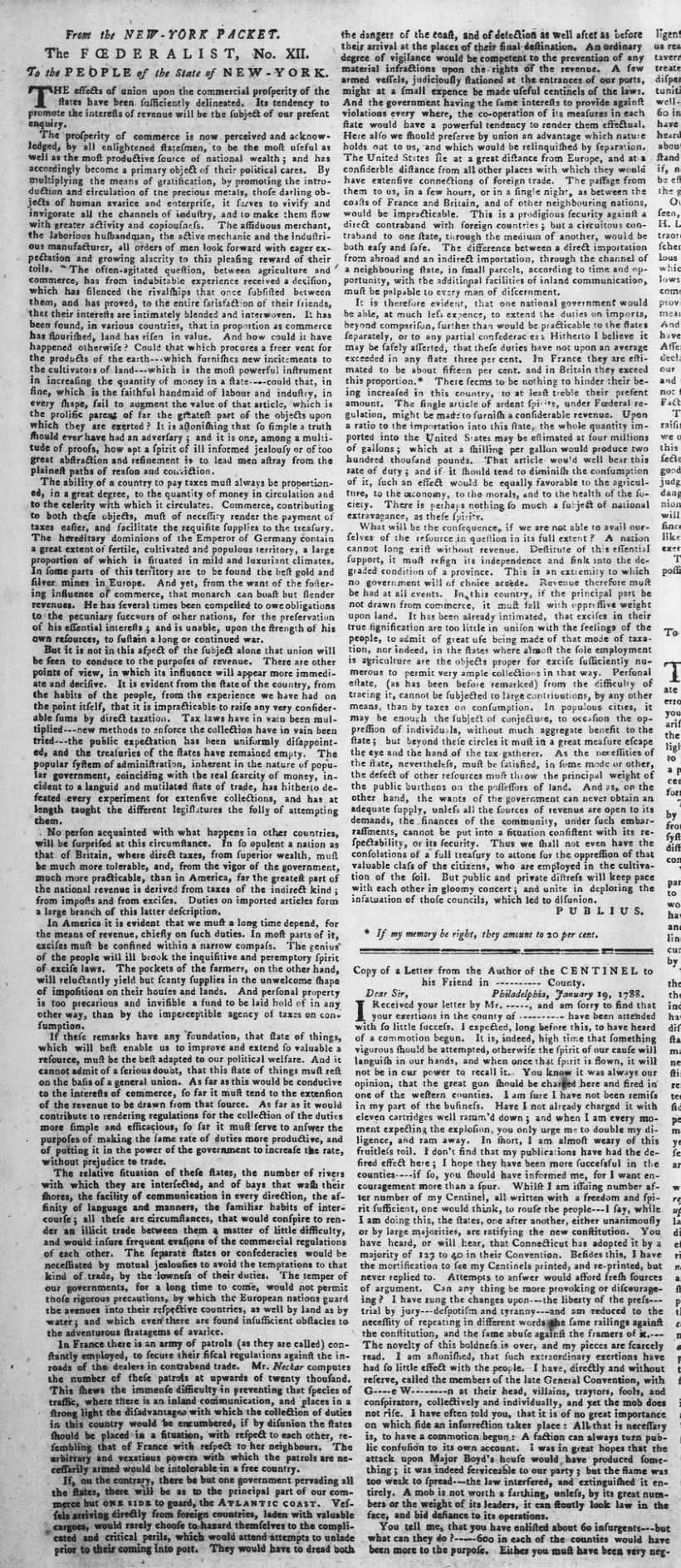
As we muse on malign mechanisms, we might recall that it was on this date in 1787 that the first in a series of eighty-five essays by “Publius,” the shared pen name of Alexander Hamilton, James Madison, and John Jay, appeared in the Independent Journal, a New York newspaper. Known collectively as The Federalist Papers, they were an effort to urge New Yorkers to support ratification of the Constitution approved by the Constitutional Convention on September 17, 1787. While aimed at New Yorkers, the essays were reprinted in newspapers (and pamphlets) across the fledgling nation.
In Federalist Paper #12, Alexander Hamilton (later the first Secretary of the Treasury) articulated an argument for the economic advantages of a united government under the proposed Constitution– and sketched the outline of the financial and commercial regime we’ve built since.

Your correspondent is heading into a series of meeting sufficiently intense that (R)D will be on brief hiatus. Regular service should resume on October 30.
You must be logged in to post a comment.