Archive for September 2013
Never going to happen…
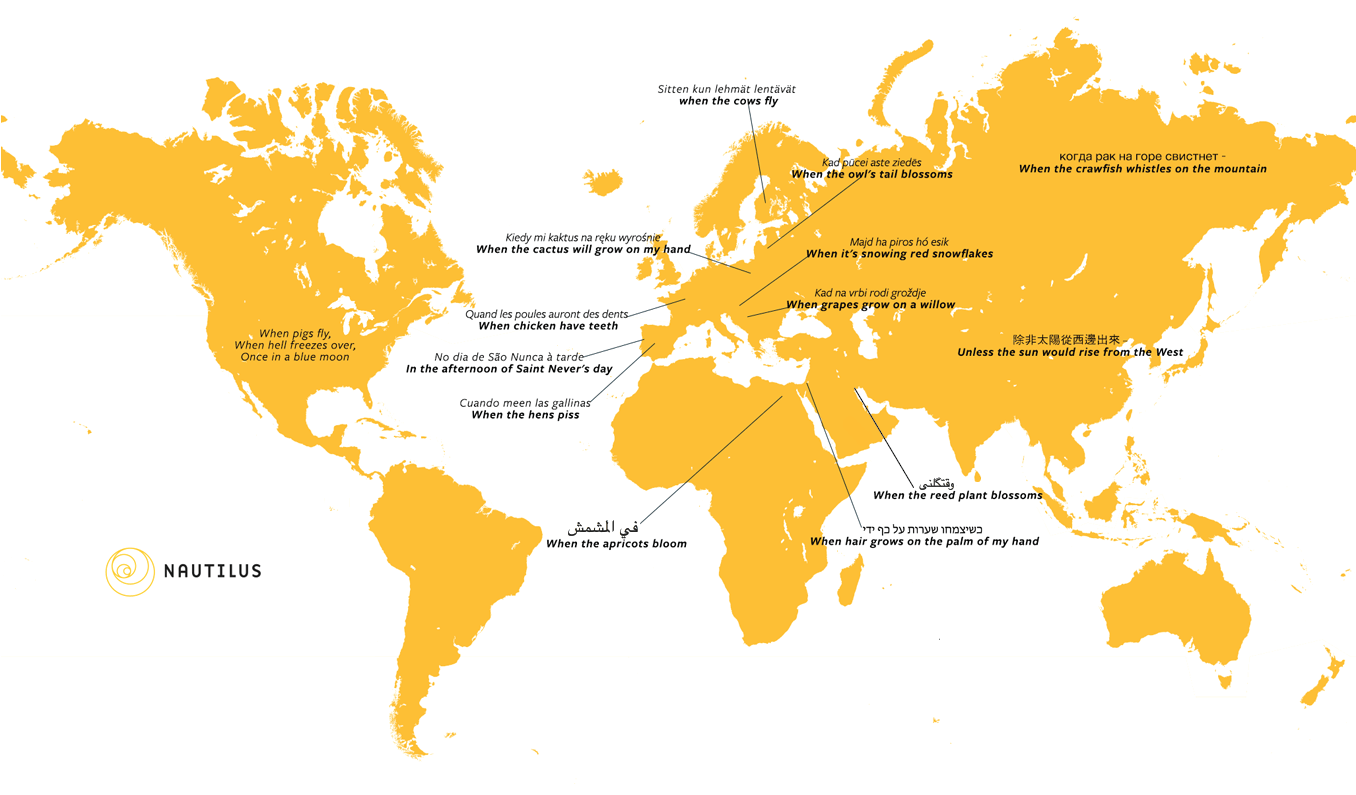
One might express the exceedingly low probability that one might agree (that, say, Adam Sandler is the artistic and comedic rival of Buster Keaton) in a variety of ways. Here in the U.S., it might be “when pigs fly” or “when Hell freezes over”. Now, thanks to the good folks at Nautilus, one can answer with the appropriately idiomatic expression of improbability all over the world. Just click the image above…
###
As we substitute hyperbole for hyperventilation, we might recall that it was on this date in 2008 that Lehman Brothers filed for bankruptcy, setting off the worst financial crisis since the nineteen-thirties, a seven-hundred-billion-dollar bank bailout, and a painful recession. On this dark anniversary, John Cassidy asks, “What Has Changed Since Lehman Failed?” James Kwak answers, “5 Years Later, We’ve Learned Nothing From The Financial Crisis. And for a really deep dive, leap in here.

Then-Secretary of the Treasury, Henry Paulson
The Passing of the Passion Pit (Part 2)…

Long-time readers will recall Carl Weese’s photographic homage to “soft-tops,” as drive-in movie theaters are known in the trade. Now, following figuratively in his footsteps, Craig Deman’s “The Drive-in Project,” a record of pleasures past across the country.

See the full portfolio here. And dive more deeply into the melancholy via this photo tour of abandoned amusement parks around the world.
###
As we reach for the speaker, we might recall that it was on this date in 1982 that Grace, Princess of Monaco (née Grace Kelly) died when she suffered a stroke, then lost control of her automobile and crashed. She had retired in 1956 from a six-year career as an actress, capped by a Academy Award for her performance in The Country Girl, to marry Prince Ranier.

Grace Kelly in “High Society” (1956)
One is the loneliest number…

Ben Marcin is fascinated by homes that stand alone. Consider his photo series “Last House Standing“…
One of the architectural quirks of certain cities on the eastern seaboard of the U.S. is the solo row house. Standing alone, in some of the worst neighborhoods, these nineteenth century structures were once attached to similar row houses that made up entire city blocks. Time and major demographic changes have resulted in the decay and demolition of many such blocks of row houses. Occasionally, one house is spared – literally cut off from its neighbors and left to the elements with whatever time it has left.
My interest in these solitary buildings is not only in their ghostly beauty but in their odd placement in the urban landscape. Often three stories high, they were clearly not designed to stand alone like this. Many details that might not be noticed in a homogenous row of twenty attached row houses become apparent when everything else has been torn down. And then there’s the lingering question of why a single row house was allowed to remain upright. Still retaining traces of its former glory, the last house standing is often still occupied.
But Marcin’s interest doesn’t stop there. See also “A House Apart” and “Off the Grid.”
###
As we pose apart, we might send revelatory birthday greetings to Sherwood Anderson; he was born on this date in 1876. A novelist and short story writer, he’s best-known for the short story sequence Winesburg, Ohio, which launched his career and for the novel Dark Laughter, his only bestseller. But his biggest influence was probably his formative influence on the next generation of American writers– William Faulkner, Ernest Hemingway, John Steinbeck, and Thomas Wolfe, among others– who cited Anderson as an important inspiration and model. (Indeed, Anderson was instrumental in gaining publication for Faulkner and Hemingway.)

Art that wants to be free…

Alexander the Great in the Air; Unknown; Regensburg, Bavaria, Germany, Europe; about 1400 – 1410 with addition in 1487; Tempera colors, gold, silver paint, and ink on parchment
Early this month, The Getty Museum announced the launch of their Open Content Program, which makes over 4500 images from their collection (including the three examples here) available under an open license– meaning that anyone can share the images freely and without restriction.

Among The Tree Tops Calaveras Grove; Carleton Watkins, American, 1829 – 1916; California, United States, North America; negative about 1878; print 1880 – 1890; Albumen silver print

A Crocodile [as then imagined from reports]; Unknown; England, Europe; about 1250 – 1260; Pen-and-ink drawings tinted with body color and translucent washes on parchment
Visit the Getty’s site to begin exploring. [via Public Domain Review]
###
As we share and share alike, we might send acerbic birthday greetings to journalist, essayist, magazine editor, satirist, and critic Henry Louis “H. L.” Mencken; he was born on this date in 1880. Mencken is the author of the philological work The American Language, and is remembered for his journalism (e.g., his coverage of the Scopes Trial) and for his cultural criticism (and editorship of American Mercury– published by Alfred Knopf, also born on this date, but 12 years after Mencken ) in which he championed such writers as D.H. Lawrence, Ford Madox Ford, and Sherwood Anderson. But “H.L.” is probably most famous for the profusion of pointed one-liners and adages that leavened his work…
The difference between a moral man and a man of honor is that the latter regrets a discreditable act, even when it has worked and he has not been caught.
Civilization, in fact, grows more and more maudlin and hysterical; especially under democracy it tends to degenerate into a mere combat of crazes; the whole aim of practical politics is to keep the populace alarmed (and hence clamorous to be led to safety) by an endless series of hobgoblins, most of them imaginary.
I believe in only one thing and that thing is human liberty. If ever a man is to achieve anything like dignity, it can happen only if superior men are given absolute freedom to think what they want to think and say what they want to say. I am against any man and any organization which seeks to limit or deny that freedom. . . [and] the superior man can be sure of freedom only if it is given to all men.
Democracy is the theory that the common people know what they want, and deserve to get it good and hard.
Truth would quickly cease to be stranger than fiction, once we got as used to it.

1932 portrait by Carl Van Vechten
What goes around…

The bicycle revolutionized late Victorian and Edwardian society. Between the 1880s and the 1910s, it grew from an expensive fad for the upper classes, to a popular sport, to a marker of freedom for women, and finally, to an affordable mode of transportation for the middle and working classes. The more daring took the riding of the bicycle even further to amazing acrobatic feats atop two pneumatic tyres!
Fancy Cycling, published in 1901, chronicles some of the daring tricks that could be executed on a bicycle…
From the ever-edifying Edwardian Promenade; the photo above is © Shire Publications/Old House, which has just re-released Fancy Cycling.
###
As we fixate on fixies, we might recall that it was on this date in 1883 that James Goold Cutler patented the mail chute. An architect (and later, Mayor of Rochester, NY), Cutler developed the system to allow employees or residents in multi-story buildings– which, with the advent of Otis’ “safe” elevators, were going up in huge numbers– to use a slot on their floor to mail letters which then dropped through a thin shaft to a collection box in the lobby. Largely extinct now (they had an unfortunate habit of jamming, and then of course, there came email), they were once a standard feature of high-rises.

A Cutler mail chute, still in service as of 2010, in the lobby of the Idaho Building in downtown Boise.

You must be logged in to post a comment.