Posts Tagged ‘worms’
“My heart & soul care for worms”*…
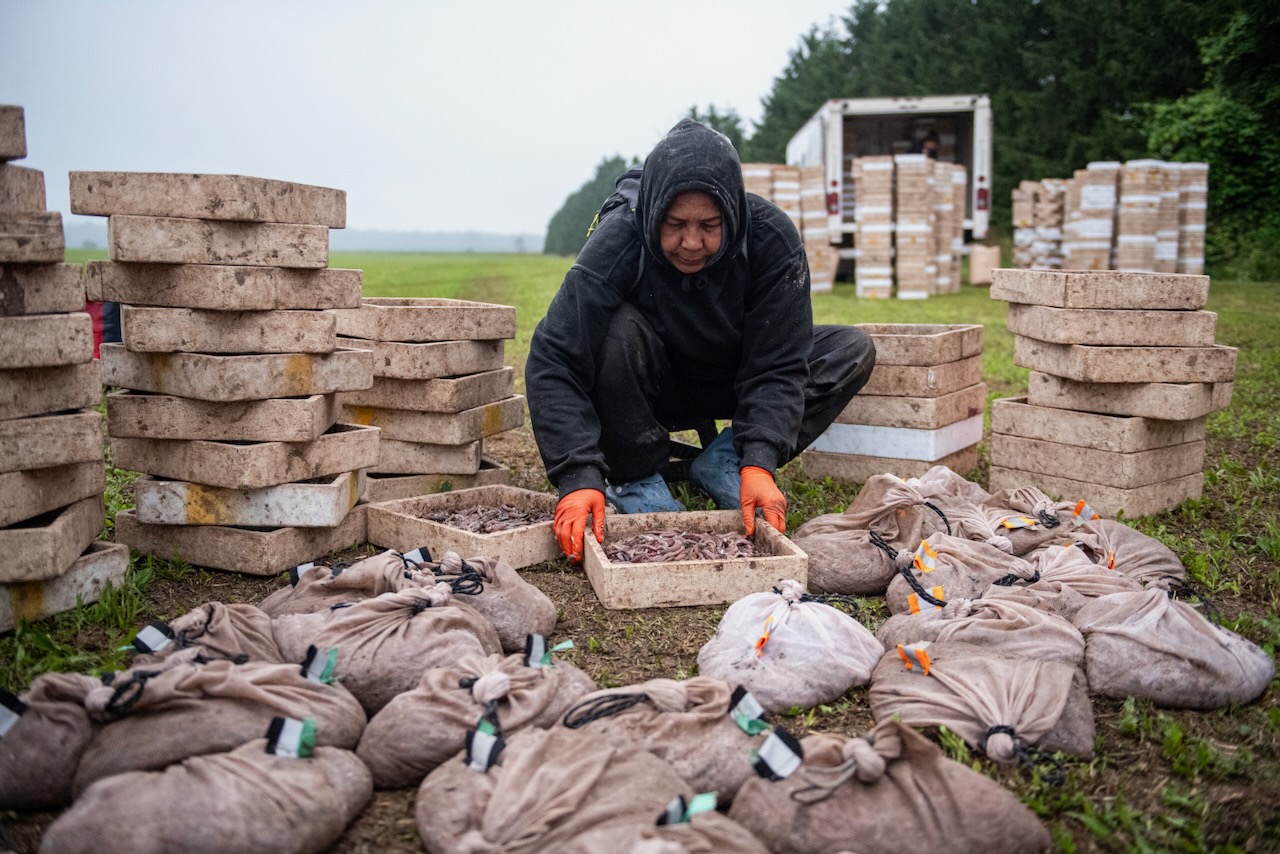
Last summer we visited the family in the Florida panhandle that has been harvesting worms to sell as bait for generations. Today, Inori Roy takes us to southern Ontario, where worming is an industry. Nearly all bait worms sold in North America are hand-plucked from farmland in this part of Canada. But are we witnessing the final wiggles of a once thriving business?…
To successfully catch a Canadian nightcrawler, you have to approach it a little like you’re a cat. The worm—fat, pink, undomesticable, and anywhere between five and 10 inches long—has made its way two-thirds out of its burrow, taking in moisture from the cool night air and exploring the surface of the soil for food. If it senses your approach, it will hurtle back into its hole with startling, uncharacteristic speed. So, crouched in the dirt, you must reach for it with a quiet, swift confidence. With the pads of your thumb and forefinger, you grasp the worm’s body right above where it disappears into the burrow hole. Gently, firmly, careful not to squish or tear it, you pull.
It’s just past 10 p.m. on a cool, overcast night in early July, and I’m standing in the middle of a field in the heart of southern Ontario farm country—West Perth, population 9,000. Dozens of workers quietly emerge from the three vans that have driven onto the field. In the dim light spilling out of the vehicle interiors, they layer raincoats over hoodies, bracing for the damp and the chill. Then, they accessorize: LED headlamps strapped to their foreheads, two bags of finely ground sawdust at their hips to keep their gloves or hands dry, and large, empty tin cans hooked at their waists. If it’s a good night, they will each harvest thousands, perhaps even 10,000, worms by dawn.
If you’re in the market for fishing bait anywhere in North America, and now even in parts of western Europe, odds are you’re buying a Canadian nightcrawler plucked from this stretch of land between Toronto and Windsor. These wild Canadian worms, who live so far beneath the surface of the soil that breeding or farming them is impractical, are hand-picked by a small army of workers, almost all immigrants from Southeast Asia, including generations of Vietnamese refugees and, more recently, temporary foreign workers from Thailand and Laos. It’s a niche sector of the western economy that’s exclusively sourced from this small corner of the province, and run primarily by family businesses passed from one generation to the next. In a given year, the more than $200 million industry sells between 500 and 700 million worms. But with changing demand, immigration labour policies, and the climate crisis, it’s also at an existential crossroads…
Fascinating: “The Worm Hunters of Southern Ontario,” from @royinori.bsky.social in @thelocal.to.
* Charles Darwin, in an 1880 letter See also here and the earlier (R)D linked above.
###
As we wriggle, we might recall that it was at about 2:30 p.m. on this date in 2004, in the village of Knighton in Shropshire (in the West Midlands of the UK), that worms were temporarily unnecessary: it rained fish.
See also: “Ten Times It Rained Animals (Yes, Animals)” (and here).

“It may be doubted that there are many other animals which have played so important a part in the history of the world as have these lowly organized creatures”*…

Michael Adno on the third generation of a Florida family that coaxes earthworms from the forest floor…
A hint of blue on the horizon meant morning was coming. And as they have for the past fifty-four years, Audrey and Gary Revell stepped out their screen door, walked down a ramp, and climbed into their pickup truck. Passing a cup of coffee back and forth, they headed south into Tate’s Hell—one corner of a vast wilderness in Florida’s panhandle where the Apalachicola National Forest runs into the Gulf of Mexico. Soon, they turned off the road and onto a two-track that stretched into a silhouette of pine trees. Their brake lights disappeared into the forest, and after about thirty minutes, they parked the truck along the road just as daylight spilled through the trees. Gary took one last sip of coffee, grabbed a wooden stake and a heavy steel file, and walked off into the woods. Audrey slipped on a disposable glove, grabbed a bucket, and followed. Gary drove the wooden stake, known as a “stob,” into the ground and began grinding it with the steel file [each pass of which is a “roop”]. A guttural noise followed as the ground hummed. Pine needles shook, and the soil shivered. Soon, the ground glowed with pink earthworms. Audrey collected them one by one to sell as live bait to fishermen. What drew the worms to the surface seemed like sorcery. For decades, nobody could say exactly why they came up, even the Revells who’d become synonymous with the tradition here. They call it worm grunting.
Audrey and Gary Revell took to each other in high school. In 1970 when Gary graduated, he asked Audrey to be his wife, and they married at his grandfather’s place down in Panacea, about thirty miles south of Tallahassee. For his entire life, he’d lived on an acre six miles west of Sopchoppy, Florida, in an area known as Sanborn. The place is set deep in the heart of the Apalachicola National Forest, a vast expanse of flatwoods and swamp that covers over half a million acres struck through with rivers. It’s where he and his siblings grew up in an old church building, where his great-grandfather had settled after finding his way up Syfrett Creek into the wilderness. It’s where Audrey and Gary settled after their wedding. “I was only sixteen, so I feel like I grew up here,” Audrey told me. Soon after, they started looking for ways to make ends meet, and Gary suggested, “We might ought to look into that worm thing.”
His family was already deep into worm grunting. Three generations preceded him, and by 1970, his uncles Nolan, Clarence, and Willie weren’t only harvesting the worms to sell as bait but were working as brokers with their own shops that distributed the critters throughout the South. It didn’t hurt that Audrey fell in love with it immediately. The work was seasonal, busiest in spring. During other parts of the year, their family trapped for a living, dug oysters, logged, raised livestock, and set the table with what they grew in their yard or caught in the water or in the forest. “That’s how we learned the woods,” Gary said. “We went in every creek, water hole, pig trail. You name it.”
By the 1970s, the cottage industry had reached its peak. Then Charles Kurault arrived in 1972 to film a segment for his eponymous CBS show, On the Road with Charles Kurault. The attention led the Internal Revenue Service and the U.S. Department of Agriculture to start regulating the harvest of worms, investigating unreported income, and implementing permit requirements. Back then, the sound produced by grunters in the first hours of daylight was as common as birdsong in this forest, and hundreds of thousands of worms were carried out in cans. Folks who once turned to grunting to make ends meet seasonally were soon in the woods year-round during that decade, competing to summon the bait to the surface and sell to brokers among the counties set between the capital city and the Apalachicola River. Millions of worms left those counties bound for fishing hooks across America. Money followed the pink fever, but as with any rush, the demand eventually dimmed as commercial worm farms caught on and soft, plastic lures became popular.
By that point, Audrey and Gary had decided to shape their own outfit. His uncles had told them, You ought to just think about keeping all that money to yourself. The couple had grown tired of depending on others for work. So, they set up their own shop full time, cultivated clients as far away as Savannah, and delivered bait all over the South, driving it themselves, or sending it north in sixteen-ounce, baby blue containers via Greyhound buses. “All the money was coming our way, what little we made,” said Gary. “We struggled with it for a long time, because when you get off the grid like that and try to do it for yourself and you’re young, it’s hard.”
I wanted to know what spending their life in the woods hunting for worms meant, but I also wanted to know where this mysterious, artful tradition came from. In the UK, there are a handful of worm-charming competitions and festivals in Devon, Cornwall, and Willaston that began in the 1980s and another in Canada that started in 2012. I’d heard of similar events in east Texas, of people using pitchforks and spades as well as burying one stick in the ground and rubbing it with another to coax worms up to the surface. Later, I even found a newspaper clipping from 1970 reporting on the first International Worm Fiddling Championship, in Florida. I searched for a deep well of literature on the practice but found nothing. Certainly, worm grunting predated the Revells. But why did rubbing a stick stuck in the ground with a metal file conjure earthworms? The only way to understand was to follow the Revells into the woods…
A fascinating profile: “The Worm Charmers,” from @michaeladno in @oxfordamerican.
(In his childhood in a different part of Florida, your correspondent employed a variation on the techniques described and can testify that they do, in fact, work.)
* Charles Darwin, The Formation of Vegetable Mould through the Action of Worms
###
As we grunt, we might recall that it was on this date in 1939, at Hyde Park, that President Franklin D. Roosevelt hosted a luncheon for King George VI and Queen Elizabeth of England. Despite his mother’s horror, FDR wanted to show the King and Queen an old-fashioned, American style picnic– featuring hot dogs. In the U.S. to raise support U.S. for Britain’s cause in World War II, the royal couple at least appeared to enjoy the meal.


You must be logged in to post a comment.