Posts Tagged ‘rain of fish’
“My heart & soul care for worms”*…
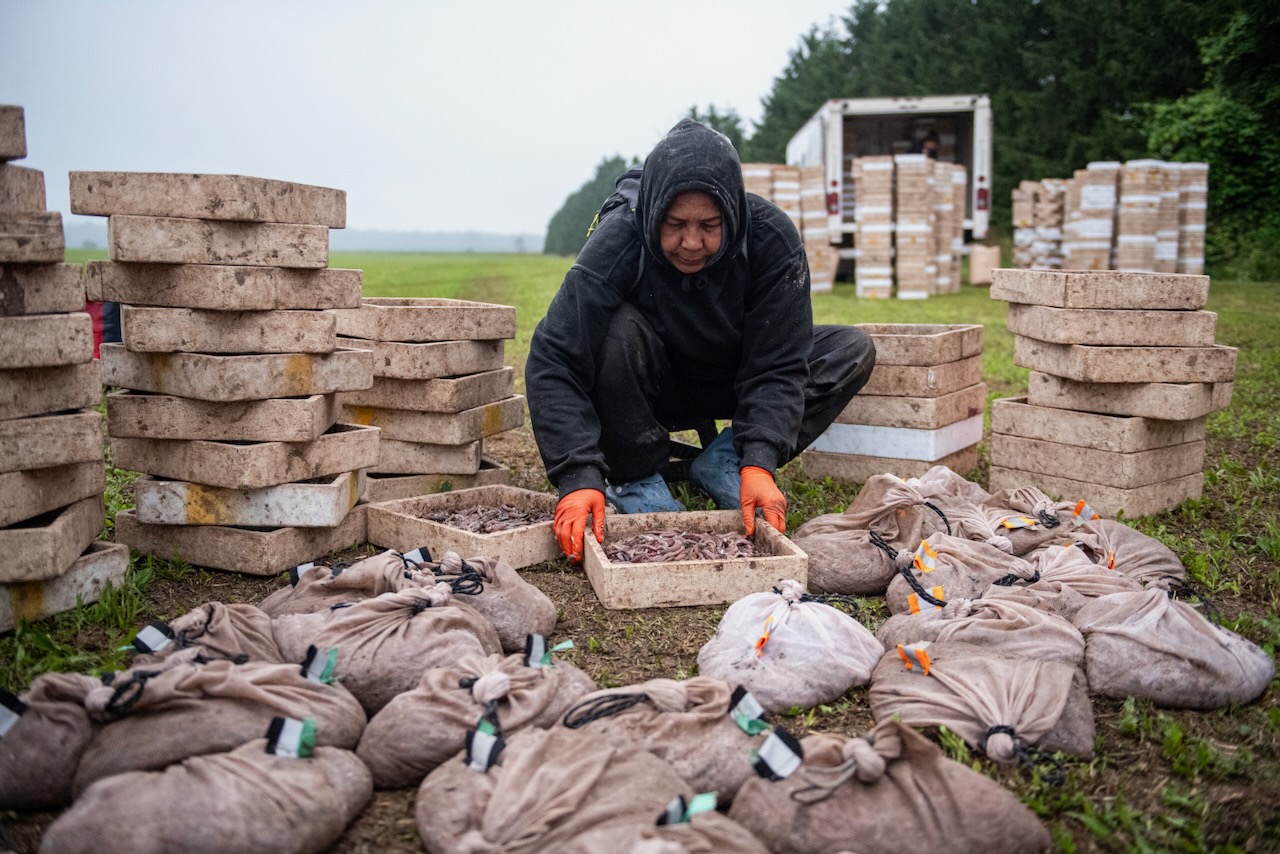
Last summer we visited the family in the Florida panhandle that has been harvesting worms to sell as bait for generations. Today, Inori Roy takes us to southern Ontario, where worming is an industry. Nearly all bait worms sold in North America are hand-plucked from farmland in this part of Canada. But are we witnessing the final wiggles of a once thriving business?…
To successfully catch a Canadian nightcrawler, you have to approach it a little like you’re a cat. The worm—fat, pink, undomesticable, and anywhere between five and 10 inches long—has made its way two-thirds out of its burrow, taking in moisture from the cool night air and exploring the surface of the soil for food. If it senses your approach, it will hurtle back into its hole with startling, uncharacteristic speed. So, crouched in the dirt, you must reach for it with a quiet, swift confidence. With the pads of your thumb and forefinger, you grasp the worm’s body right above where it disappears into the burrow hole. Gently, firmly, careful not to squish or tear it, you pull.
It’s just past 10 p.m. on a cool, overcast night in early July, and I’m standing in the middle of a field in the heart of southern Ontario farm country—West Perth, population 9,000. Dozens of workers quietly emerge from the three vans that have driven onto the field. In the dim light spilling out of the vehicle interiors, they layer raincoats over hoodies, bracing for the damp and the chill. Then, they accessorize: LED headlamps strapped to their foreheads, two bags of finely ground sawdust at their hips to keep their gloves or hands dry, and large, empty tin cans hooked at their waists. If it’s a good night, they will each harvest thousands, perhaps even 10,000, worms by dawn.
If you’re in the market for fishing bait anywhere in North America, and now even in parts of western Europe, odds are you’re buying a Canadian nightcrawler plucked from this stretch of land between Toronto and Windsor. These wild Canadian worms, who live so far beneath the surface of the soil that breeding or farming them is impractical, are hand-picked by a small army of workers, almost all immigrants from Southeast Asia, including generations of Vietnamese refugees and, more recently, temporary foreign workers from Thailand and Laos. It’s a niche sector of the western economy that’s exclusively sourced from this small corner of the province, and run primarily by family businesses passed from one generation to the next. In a given year, the more than $200 million industry sells between 500 and 700 million worms. But with changing demand, immigration labour policies, and the climate crisis, it’s also at an existential crossroads…
Fascinating: “The Worm Hunters of Southern Ontario,” from @royinori.bsky.social in @thelocal.to.
* Charles Darwin, in an 1880 letter See also here and the earlier (R)D linked above.
###
As we wriggle, we might recall that it was at about 2:30 p.m. on this date in 2004, in the village of Knighton in Shropshire (in the West Midlands of the UK), that worms were temporarily unnecessary: it rained fish.
See also: “Ten Times It Rained Animals (Yes, Animals)” (and here).

You must be logged in to post a comment.