Posts Tagged ‘timeline’
“Time is a game played beautifully by children”*…

Readers will recall our earlier adventures in space and scale (e.g., here). Now, from Wait But Why, a trip through time. Starting with the near-in (above), Tim Urban has created a series timelines, each of which nests into the next…
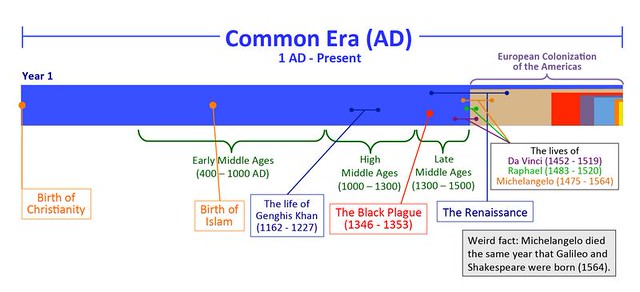
Until one has “traveled” all the way to the entirety of time.

See them all (and larger) at “Putting Time in Perspective.” (G-rated version here)
* Heraclitus, Fragments
###
As we check our watches, we might send culturally-relevant birthday greetings to James Mooney; he was born on this date in 1861. A pioneering ethnographer, he started working in 1885 with the Bureau of American Ethnology in Washington, D.C. He compiled a list of tribes and their members which contained 3,000 names, but quit after the US Army’s 1890 massacre of Lakota people at Wounded Knee, South Dakota.
Mooney did extensive work with the Cherokee and Kiowa tribes. His most notable works were his ethnographic studies of the Ghost Dance after Sitting Bull’s death in 1890, a widespread 19th-century religious movement among various Native American culture groups, and his deciphering of the Kiowa calendar.

“They always say time changes things, but you actually have to change them yourself”*…

From Lapham’s Quaterly, a timeline of time-keeping…
* Andy Warhol
###
As we adjust our dials, we might send transcendental birthday greetings to Albert Hofmann; he was born on this date in 1906. As a young chemist at Sandoz in Switzerland, Hofmann was searching for a respiratory and circulatory stimulant when he fabricated lysergic acid diethylamide (LSD); handling it, he absorbed a bit through his fingertips and realized that the compound had psychoactive effects. Three days later, on April 19, 1943– a day now known as “Bicycle Day”– Hofmann intentionally ingested 250 micrograms of LSD then rode home on a bike, a journey that became, pun intended, the first intentional acid trip. Hofmann was also the first person to isolate, synthesize, and name the principal psychedelic mushroom compounds psilocybin and psilocin.
He died in 2008, at the age of 102.

“It’s such a fine line between stupid, and uh…”*

From the folks at Concert Hotels, “100 Years of Rock in Less Than a Minute.” Rock’s family tree– from 1900 to 2000– unspools (as excerpted above); and each box, when clicked, plays an example of the genre. Educational fun for all!
* David St. Hubbins (Michael McKean) in This is Spinal Tap… which is fast approaching– in March– the 30th anniversary of its release
###
As we turn it up to 11, we might recall that this date in 1959 was “the day the music died”: the day that a plane crash near Clear Lake, Iowa killed Buddy Holly, Ritchie Valens, J.P. Richardson (aka, The Big Bopper), and pilot Roger Peterson.
If Beethoven had been killed in a plane crash at the age of 22, it would have changed the history of music… and of aviation.
– Tom Stoppard

Every picture tells a story…
… and some tell more complicated stories than others…

This [1897] chart, digitized by the Library of Congress, depicts major battles, troop losses, skirmishes, and other events in the American Civil War. (Click on the image to arrive at a zoomable version, or visit the LOC’s website.)
The “Scaife Synoptical Method,” advertised at the top of the timeline, aimed to fit as much information as possible into a single chart. Information on Arthur Hodgkin Scaife is scant, but the Comparative Synoptical Chart Company, apparently based in Toronto, also published his “Synoptical Charts” of the “Cuban Question,” English history, and the life of William Gladstone…
Read the whole story at Vault.
###
As we concentrate on consolidation, we might recall that it was on this date in 1863 that Union Generals Alexander M. McCook and Thomas Crittenden were relieved of their commands and ordered to Indianapolis, Indiana, to face a court of inquiry following the Federal defeat at the battle of Chickamauga in Georgia (c.f., the chart above). As History. com explains…
Eight days before, the Union Army of the Cumberland, commanded by General William Rosecrans, had retreated from the Chickamauga battlefield in disarray. On the battle’s second day, Rosecrans mistakenly ordered a division to move into a gap in the Federal line that did not exist, creating a real gap through which the Confederates charged, thus splitting the Union army. One wing collapsed, and a frantic retreat back to Chattanooga,Tennessee, ensued. The other wing, led by General George Thomas, remained on the battlefield and held its position until it was nearly overrun by Confederates.
The search for scapegoats began immediately, and fingers soon pointed to McCook and Crittenden. Their corps had been part of the collapsed flank, so Rosecrans removed them from command. Crittenden’s removal stirred anger in his native Kentucky, and the state legislature sent a letter to President Abraham Lincoln demanding a reexamination of the firing. In February 1864, a military court cleared McCook and Crittenden, but their careers as field commanders were over. By quickly removing McCook and Crittenden, Rosecrans had been trying to save his own job. Within weeks after firing the generals, Rosecrans was himself replaced by Thomas.

lithograph by Kurz and Allison, 1890
A matter of perspective…

Visit Here Is Today and, in a few brief clicks, put everything (and I do mean everything) into perspective…
###
As we realize that we’re late for the Mad Hatter’s tea party, we might recall that it was on this date in 1961, before a joint session of Congress, that President John F. Kennedy introduced the NASA Apollo Program, vowing to land an American astronaut safely on the moon before the end of the decade. The mission was accomplished on July 20, 1969, when Apollo 11’s Neil Armstrong left the Lunar Module and set foot on the surface of the Moon.

You must be logged in to post a comment.