Posts Tagged ‘Renaissance’
“Only connect”*…

These days everybody knows about the ampersand. It’s one of typography’s most unique and interesting characters.
Its rise to hipster fame has catapulted the ampersand from the sketchbooks of type designers onto just about every printable surface you can imagine, the variations of which seem endless. From traditional representations all the way to hyper-stylised forms that bear little resemblance to the original mark.
The varied nature of its form allows type designers a little creative freedom, and is often seen as an opportunity to inject some extra personality into a typeface. Officially classified as punctuation by todays unicode, it was in fact, once the 27th letter in the English alphabet existing as the graphical representation of the word ‘and’…
Fascinating: “The History of the Ampersand.” For a celebration of this marvelous mark, see “And Further…”
* E.M. Forster
###
As we ponder plurality, we might send learned birthday greetings to Desiderius Erasmus Roterodamus, better known simply as Erasmus; he was born on this date in 1466 (though some sources place his birth two days later). A Catholic priest, social critic, teacher, translator, and theologian, probably best remembered for his book In Praise of Folly, he was the greatest scholar of the northern Renaissance, the first editor of the New Testament (“Do unto others…”), and an important figure in patristics and classical literature. Among fellow scholars and philosophers he was– and is– known as the “Prince of the Humanists.”

“The karma of humans is AI”*…

The black box… penetrable?
Already, mathematical models are being used to help determine who makes parole, who’s approved for a loan, and who gets hired for a job. If you could get access to these mathematical models, it would be possible to understand their reasoning. But banks, the military, employers, and others are now turning their attention to more complex machine-learning approaches that could make automated decision-making altogether inscrutable. Deep learning, the most common of these approaches, represents a fundamentally different way to program computers. “It is a problem that is already relevant, and it’s going to be much more relevant in the future,” says Tommi Jaakkola, a professor at MIT who works on applications of machine learning. “Whether it’s an investment decision, a medical decision, or maybe a military decision, you don’t want to just rely on a ‘black box’ method.”
There’s already an argument that being able to interrogate an AI system about how it reached its conclusions is a fundamental legal right. Starting in the summer of 2018, the European Union may require that companies be able to give users an explanation for decisions that automated systems reach. This might be impossible, even for systems that seem relatively simple on the surface, such as the apps and websites that use deep learning to serve ads or recommend songs. The computers that run those services have programmed themselves, and they have done it in ways we cannot understand. Even the engineers who build these apps cannot fully explain their behavior…
No one really knows how the most advanced algorithms do what they do. That could be a problem: “The Dark Secret at the Heart of AI.”
* Raghu Venkatesh
###
As we get to know our new overlords, we might spare a thought for the painter, sculptor, architect, musician, mathematician, engineer, inventor, physicist, chemist, anatomist, botanist, geologist, cartographer, and writer– the archetypical Renaissance Man– Leonardo da Vinci. Quite possibly the greatest genius of the last Millennium, he died on this date in 1519.

Self-portrait in red chalk, circa 1512-15
“Sameness is the mother of disgust”*…

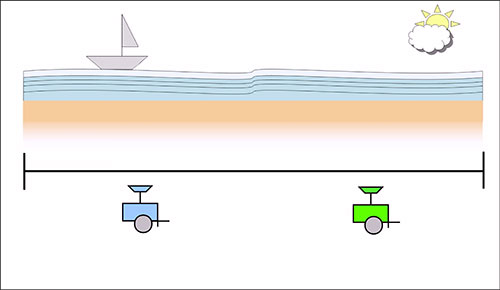
Let’s imagine we’re on a beach that’s a mile long, and on that beach there are a couple of ice cream carts…
Let’s also imagine that the ice cream sold at each cart is identical in quality and cost, so the only reason customers choose one cart over the other is when one cart is closer. Given all of that, the best location of the carts is with each cart halfway between the middle of the beach and one of the ends. In this arrangement each cart gets 50% of the customers, and no one has to walk more than 1/4 mile to get some ice cream.
But what if one of the ice cream vendors decides to move their cart a bit closer to the middle of the beach…
They are now the ice cream cart of choice for a bigger segment of the beach, and will get more business. The other ice cream cart has no choice but to retaliate…
Now once again they each serve the same percentage of the beach-going public. Since any further movement by either cart would mean a loss of business for that cart, they end up permanently side by side, in the middle of the beach, even though this is a less optimal location for their customers.
That is a simple example of something called Hotelling’s law; the tendency of competing products to end up as similar as possible…


“Producers of products and services tend to make their products and services as similar as possible to those of their competitors.” From The Laws of the Universe, the story of Hotelling’s Law.
* Petrarch
###
As we nose around for niches, we might send ambitious birthday greetings to Count Giovanni Pico della Mirandola; he was born on this date in 1463. An Italian philosopher, he undertook, in 1486, at the age of 23, to defend 900 theses on religion, philosophy, natural philosophy and magic against all comers, in the process of which he wrote his famous Oration on the Dignity of Man, which has been called the “Manifesto of the Renaissance”; a revitalization of Neo-Platonism, it was a seminal text of Renaissance humanism and of what has been called the “Hermetic Reformation.”

Pico’s portrait, from the Uffizi Gallery in Florence
“When we women offer our experience as our truth, as human truth, all the maps change”*…

Louise E. Jefferson, “Americans of Negro Lineage,” Friendship Press, 1946. (Used by permission of the National Council of Churches of Christ in the USA. All rights reserved worldwide, 2016.) Larger version here.
Women have been making maps for centuries. They have developed and applied new technologies, data collection techniques, and visual presentations to their maps as they charted new terrain, illustrated historical narratives, and pushed political and social agendas. In the 20th century, women mapmakers continued this work in larger numbers than ever—and no short post can account sufficiently for all of their contributions over a century that saw technological and social revolutions, one after another.
Examining just a small sample of the many compelling maps made by North American women in the 20th century, a theme emerges: aesthetic mastery.
In the days before the women’s liberation movement (except for a brief moment during World War II), most women didn’t have access to technical training in cartography. “Civil engineering, where topographic drafting was taught, was not a ‘girls’ subject,” writes Judith Tyner, a professor emerita of geography at California State University, Long Beach, in a presentation given at mapping conference earlier this year. But this didn’t stop women from participating in cartography. It simply meant that many who did started with a background in the arts…
More of the story– and several beautiful examples– at “How 20th-Century Women Put the ‘Art’ in Cartography,” the third installment in a series on women and maps; see also Part 1 and Part 2.
* Ursula Le Guin
###
As we contemplate cartography, we might spare a thought for Francesco Petrarca– Petrarch: on this date in 1341, he became the first poet laureate since antiquity, crowned by Roman Senatori Giordano Orsini and Orso dell’Anguillara on the holy grounds of Rome’s Capitol. Considered by many to have been “the Father of Humanism,” and reputed to have coined the term “Renaissance,” Petrarch was famous for his paeans to his idealized lover “Laura” (modeled, many scholars believe, on the wife of Hugues de Sade, Laura de Noves, whom he met in Avignon in 1327, and who died in 1348). But Petrarch’s more fundamental and lasting contribution to culture came via Pietro Bembo, who created the model for the modern Italian language in the 16th century based largely on the works of Petrarch (and to a lesser degree, those of Dante and Petrarch’s frequent correspondent, Boccaccio).

“Plans are of little importance, but planning is essential”*…

In 2014, in a forest at the location above, Scottish artist Katie Paterson launched Future Library…
… a public art project that begins with a thousand trees planted in the Norwegian forest of Normarka. After a century of growth, these trees will be cut down, pulped, and turned into a collection of books to be housed at the New Public Deichmanske Library in Oslo, which is scheduled to open in 2019.
During each year of the forest’s growth, one writer will contribute a text to be published in the anthology. The writing will be unseen by the public until the book collection is created in 2114. So far, two prominent writers have announced their involvement: Canadian author Margaret Atwood and British novelist David Mitchell. Both authors have either won or been shortlisted for the Booker Prize on numerous occasions…
Read more at “How to Harvest a Library in Just 100 Years.”
* Winston Churchill
###
As we take the very long view, we might send a celebratory sonnet to Francesco Petrarca– Petrarch; he was born on this date in 1304. Considered by many to have been “the Father of Humanism,” and reputed to have coined the term “Renaissance,” Petrarch was famous for his paeans to his idealized lover “Laura” (modeled, many scholars believe, on the wife of Hugues de Sade, Laura de Noves, whom he met in Avignon in 1327, and who died in 1348). But Petrarch’s more fundamental and lasting contribution to culture came via Pietro Bembo who created the model for the modern Italian language in the 16th century based largely on the works of Petrarch (and to a lesser degree, those of Dante and Boccaccio).
You must be logged in to post a comment.