Posts Tagged ‘Opinion polling’
“In America, everyone is entitled to an opinion, and it is certainly useful to have a few when a pollster shows up”*…

In the last couple of decades, opinion polling in the U.S. has exploded; the number of national pollsters has more than doubled. Over the same period, American lifestyles have changed in ways that have challenged pollsters– and led them to innovate in a quest for accuracy. Indeed, after the embarrassment of the election of 2016, 61% of national pollsters have changed their methods…
The pollsters at The Pew Research Center— arguably the best of bunch– have polled the pollsters…
The 2016 and 2020 presidential elections left many Americans wondering whether polling was broken and what, if anything, pollsters might do about it. A new Pew Research Center study finds that most national pollsters have changed their approach since 2016, and in some cases dramatically. Most (61%) of the pollsters who conducted and publicly released national surveys in both 2016 and 2022 used methods in 2022 that differed from what they used in 2016. The study also finds the use of multiple methods increasing. Last year 17% of national pollsters used at least three different methods to sample or interview people (sometimes in the same survey), up from 2% in 2016.
This study captures what changes were made and approximately when. While it does not capture why the changes were made, public commentary by pollsters suggests a mix of factors – with some adjusting their methods in response to the profession’s recent election-related errors and others reacting to separate industry trends. The cost and feasibility of various methods are likely to have influenced decisions.
This study represents a new effort to measure the nature and degree of change in how national public polls are conducted. Rather than leaning on anecdotal accounts, the study tracked the methods used by 78 organizations that sponsor national polls and publicly release the results. The organizations analyzed represent or collaborated with nearly all the country’s best-known national pollsters. In this study, “national poll” refers to a survey reporting on the views of U.S. adults, registered voters or likely voters. It is not restricted to election vote choice (or “horserace”) polling, as the public opinion field is much broader. The analysis stretches back to 2000, making it possible to distinguish between trends emerging before 2016 (e.g., migration to online methods) and those emerging more recently (e.g., reaching respondents by text message)…
Fascinating– and important: “How Public Polling Has Changed in the 21st Century,” from @pewresearch (via friend PH).
* Neil Postman, Amusing Ourselves to Death
###
As we consider our answers, we might recall that it was on this date in 2016 that Pew Research Center published the results of a poll on voter satisfaction with U.S. Presidential candidates:
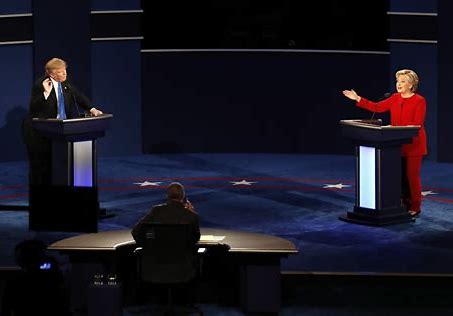
Voter satisfaction with the choice of presidential candidates, already at a two-decade low, has declined even further. A new survey finds that just a third of registered voters say they are very or fairly satisfied with the choices, while 63% say they are not too or not at all satisfied. That represents a 7-percentage-point drop since June in the share of voters expressing satisfaction with their candidate choices…
Already-low voter satisfaction with choice of candidates falls even further

“It’s the end of the world as we know it / And I feel fine”*…

From the Department of Polarization…
While the percentage of Americans who are satisfied with the direction of the United States is only around 17 percent — up from 11 percent in the pits of the pandemic but still down from 41 percent two years ago — respondents are telling pollsters that nevertheless they’re personally doing just great. Fully 85 percent of respondents said they are satisfied with how things are going in their personal life, a little bit off the all-time highs of 90 percent but still definitely on the higher side of the historical range in responses to the question, which has been asked since 1979. While 51 percent of Americans are “very dissatisfied” with the direction of the country, 51 percent are also “very satisfied” with their own personal life.
@WaltHickey and his invaluable Numlock News (@NumlockAM) on Gallup‘s (@Gallup) January, 2022 “Mood of the Nation” poll.
* REM
###
As we reconcile, we might recall that it was on this date in 1820 that the first 86 African American immigrants sponsored by the American Colonization Society departed New York to start a settlement in present-day Liberia.
The ACS had been founded in 1816 by Robert Finley to encourage and support the migration of free African Americans to the continent of Africa– in response to what he and his cohort saw as a growing social problem: what to do with free Blacks. Slave owners feared that these free Blacks might help their slaves to escape or rebel. At the same time, many white Americans saw African Americans as an inferior race. To these whites, “amalgamation,” or integration, of African Americans with mainstream American culture—giving them citizenship—was undesirable, if not altogether impossible. There was, the ACS argued, little prospect of changing these views. African Americans, therefore, should be relocated somewhere they could live in peace, free of prejudice, where they could be citizens.
The African-American community and abolitionist movement overwhelmingly opposed the project. Contrary to stated claims that emigration was voluntary, many African Americans were pressured into emigrating. Indeed, enslavers sometimes manumitted their slaves on condition that the freedmen leave the country immediately. William Lloyd Garrison, author of Thoughts on African Colonization (1832), proclaimed the Society a fraud. According to Garrison and his many followers, the Society was not a solution to the problem of American slavery—it actually was helping, and was intended to help, to preserve it.
According to historian Marc Leepson, “Colonization proved to be a giant failure, doing nothing to stem the forces that brought the nation to Civil War.” Between 1821 and 1847, only a few thousand African Americans, out of millions in the US, emigrated to what would become Liberia. Close to half of them died from tropical diseases.

“A public-opinion poll is no substitute for thought”*…

On April 25, 2019, former Vice President Joe Biden became the latest big-name politician to join the race for the 2020 Democratic Party presidential nomination. Among Democrat voters, he leads the field over the next most popular candidate, Vermont Sen. Bernie Sanders, by 7 percentage points — with a sampling margin of error of 5.4 percentage points — according to a recent poll from Monmouth University.
But public and media perception has been burned by polls before — see the 2016 presidential election — and there’s still a long, long way to go before the Democratic field is settled. Donald Trump officially became the Republican Party nominee for president in July 2016, but a year prior there were still 16 other candidates angling for the nomination.
Precisely because there are still so many town halls and county fairs to come for the Democratic contenders, we’re rounding up some recent academic research that can inform coverage of political opinion polls in this early presidential contest. This research digs into bias in evaluating political polling, polling errors across time and space, the relationship between media coverage and polling, and more…
With over 18 months to go until the 2020 election, we’re already inundated with poll results, widely divergent, but each claiming canonical status. Journalist’s Resource has ridden to the rescue with a handy collection of articles offering guidance on how to understand and use them– guidance that’s as useful to us civilians as it is to pros: “Covering political polls: A cautionary research roundup.”
* Warren Buffett
###
As we stock up on grains of salt, we might recall that it was on this date in 1894 that the 500-strong Commonwealth of Christ (AKA Coxey’s Army) arrived in Washington, D.C., to protest against unemployment. The march, organized by businessman Jacob Coxey, had begun with 100 men in Massillon, Ohio, and had gathered members as it moved toward the Capitol. It was protesting conditions in the second year of (what turned out to be a four-year economic depression. the worst in United States history to that time. In the event, the group never made it into the Capitol: Coxey was arrested for trespassing, and the military intervention the group provoked proved to be a rehearsal for the federal force that broke the Pullman Strike later that year.
Still, Coxey’s Army had an impact. Among its well-wishers along the way was L. Frank Baum (still a famous window-dresser, not yet an author). Scholarly political interpretations of his most famous novel, The Wonderful Wizard of Oz, turn on Coxey’s Army:
In the novel, Dorothy, the Scarecrow (the American farmer), Tin Woodman (the industrial worker), and Cowardly Lion (William Jennings Bryan), march on the yellow brick road to the Emerald City, the Capital (or Washington, D.C.), demanding relief from the Wizard, who is interpreted to be the President. Dorothy’s shoes (made of silver in the book, not the familiar ruby that is depicted in the movie) are interpreted to symbolize using free silver instead of the gold standard (the road of yellow brick) because the shortage of gold precipitated the Panic of 1893… [source]

You must be logged in to post a comment.