Posts Tagged ‘nuclear disaster’
“I’m having a magenta day. Not just red, but magenta!”*…

Your correspondent is still on the road; regular service resumes on or around May 6. Meantime, a colorful update…
Forget about red hot. A new color-coded heat warning system relies on magenta to alert Americans to the most dangerous conditions they may see this summer.
The National Weather Service and the Centers for Disease Control and Prevention on Monday — Earth Day — presented a new online heat risk system that combines meteorological and medical risk factors with a seven-day forecast that’s simplified and color-coded for a warming world of worsening heat waves.
“For the first time we’ll be able to know how hot is too hot for health and not just for today but for coming weeks,” Dr. Ari Bernstein, director of the National Center for Environmental Health, said at a joint news conference by government health and weather agencies.
Magenta is the worst and deadliest of five heat threat categories, hitting everybody with what the agencies are calling “rare and/or long-duration extreme heat with little to no overnight relief.” It’s a step higher than red, considered a major risk, which hurts anyone without adequate cooling and hydration and has impacts reverberating through the health care system and some industries. Red is used when a day falls within the top 5% hottest in a particular location for a particular date; when other factors come into play, the alert level may bump even higher to magenta, weather service officials said.
On the other hand, pale green is little to no risk. Yellow is minor risk, mostly to the very young, old, sick and pregnant. Orange is moderate risk, mostly hurting people who are sensitive to heat, especially those without cooling, such as the homeless.
“When red-hot isn’t enough: New government heat risk tool sets magenta as most dangerous level,” from @AP.
* Stephen King, Needful Things
###
As we reassess risk, we might recall that it was on this date in 1986 that Russia announced the Chernobyl nuclear disaster, two days after it happened.

“To overcome a desperate situation, make a complete turn in one sudden burst”*…
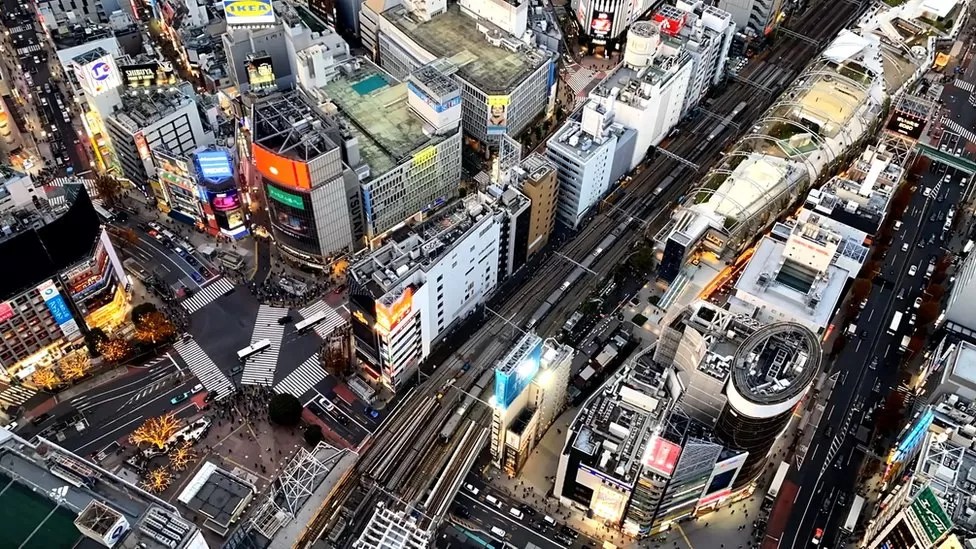
Rupert Wingfield-Hayes, the BBC’s Tokyo correspondent, on the riddle of Japan…
This is the world’s third-largest economy. It’s a peaceful, prosperous country with the longest life expectancy in the world, the lowest murder rate, little political conflict, a powerful passport, and the sublime Shinkansen, the world’s best high-speed rail network.
America and Europe once feared the Japanese economic juggernaut much the same way they fear China’s growing economic might today. But the Japan the world expected never arrived. In the late 1980s, Japanese people were richer than Americans. Now they earn less than Britons.
For decades Japan has been struggling with a sluggish economy, held back by a deep resistance to change and a stubborn attachment to the past. Now, its population is both ageing and shrinking.
Japan is stuck…
His diagnosis and his prognosis: “Japan was the future but it’s stuck in the past,” @wingcommander1 in @BBCWorld.
* Japanese proverb
###
As we ponder progress, we might recall that it was on this date in 2011 that three reactors at the Fukushima Daiichi Nuclear Power Plant exploded and released radioactivity into the atmosphere a day after the 2011 Tōhoku earthquake and tsunami.
The radiation releases forced the evacuation of 83,000 residents from towns around the plant. The meltdown caused concerns about contamination of food and water supplies, including the 2011 rice harvest, and also the health effects of radiation on workers at the plant. Scientists estimate that the accident released 18 quadrillion becquerels of caesium-137 into the Pacific Ocean, contaminating 150 square miles of the ocean floor.

You must be logged in to post a comment.