Posts Tagged ‘Monopoly’
“Our people are good people; our people are kind people. Pray God some day kind people won’t all be poor”*…

For a singular image of the Great Depression and the roughness of those years, it’s hard to do much better than Dorothea Lange’s 1936 photograph of Florence Owens Thompson, two of her children tucking their faces over her shoulders, a baby in her lap.
Where that image comes from, there are many, many more: around 175,000 surviving portraits of America between 1935 and 1945 taken by the photographers of the government’s Farm Security Administration. The Library of Congress, which houses the collection, has, remarkably, digitized all the negatives and tagged the records with loads of data, such as who took the picture and where it was taken.
Now, thanks to a new project known as Photogrammar from Yale University, viewers will have a much easier time exploring the photographs. There’s a map that displays the images by county and another that shows where each picture was taken and by which photographer. There’s also an interactive that allows viewers to sort the photos by theme (e.g. “war” or “religion”) and then browse from there. Other tools are still in the works…

Agricultural workers bound for upstate New York in time for the harvest
More at “Seeing the Great Depression.”
* John Steinbeck, The Grapes of Wrath
###
As we go West, we might recall that it was on this date in 1935 that Parker Brothers purchased the patent for “The Landlord’s Game” from Elizabeth Magie, a Quaker political activist who had used the theories of the economist Henry George to create the game to illustrate the way in which monopolies impoverish (“bankrupt”) the many while concentrating extraordinary wealth in one or few. Parker Brothers had released a copy– Charles Darrow’s “Monopoly”– which was (to put it politely) closely modeled on “The Landlord’s Game”; when Darrow’s version became a hit in 1933, Parker Brothers bought “The Landlord’s Game” as insurance against a intellectual property suit– and subsequently paid Ms. Magie $500 for her patent to avoid a (completely justified) claim from her that “Monopoly” was, in effect, stolen. It is estimated that over a billion people have played “Monopoly” over the years.

“The Landlord’s Game” board, from Magie’s original patent application
“The score never interested me, only the game”*…

In 1913, when he was 20, Clayton Hudson wrote Harry Houdini, daring him to escape from a special crate that Hudson had designed. Houdini warmed to Hudson, choosing his challenge from the myriad he received, and with £100 at stake, found a way out. 26 years later, Hudson put his expensive lesson to work– using Monopoly sets to help World War II prisoners of war escape…
At around the time that Monopoly was starting to make a name for itself – and to achieve the kind of fame that would make it such a central part of prison life in Stalag XXB – Clayton Hutton was beginning to worry about the fate of Europe. As the 1930s drew to a close, a war was clearly looming, and he wanted to get involved.
Despite service as a pilot during the First World War, Clayton Hutton was not a career military man. Instead, he had left the service to work in journalism here and there and as a publicity director for the movie business. He had also become increasingly eccentric – a fact that, along with his age, may explain why he was swiftly turned down when in 1939 he applied to join the Royal Air Force.
Luckily, British military intelligence was currently looking for “a showman with an interest in escapology” – the kind of man, perhaps, who had once been publicly humiliated by the greatest magician that ever lived.
These were busy times for the intelligence services. MI9 had been newly formed under Brigadier Norman Crockatt; its objective was to facilitate the escape of any allied soldiers captured by the enemy during the coming war, and return them safely to the UK. This sort of thing required some pretty unusual thinking – and some pretty unusual thinkers. Following a short interview with Crockatt – in which the story of the Houdini challenge played a crucial role – Clayton Hutton was employed by MI9 as a technical officer…
Read the whole extraordinary story– and see photos of Hudson’s handiwork– at “Inside Monopoly’s secret war against the Third Reich.”
* Mae West
###
As we bake a hacksaw into a cake, we might recall that it was on this date in 1944 that Helen Duncan became the last person to be charged under the British Witchcraft Act of 1735. In the event, her real offense was a form of espionage, a violation of the Official Secrets Act: she’d held public seances purportedly with victims of the torpedoed of HMS Barham, the loss of which was classified. (It was demonstrated at her trial that she’d had the opportunity to learn of the ship’s loss from crew members’ families.) Rather than amplify the leak, the authorities prosecuted her under the Witchcraft statute, which made falsely claiming to procure spirits a crime. She served nine months in prison, and was barred from further “practice”… though she was caught in the act and arrested again in 1956 (this time under the Fraudulent Mediums Act of 1951, which replaced the Witchcraft Act).

“Economics is a subject that does not greatly respect one’s wishes”*…

From “Macroeconomic policy and the optimal destruction of vampires” (1982) by Dennis Snower
A not-so-dismal look at the “science” of economics: “the world’s first and only stand-up economist” Yoram Bauman reviews the weirdest and most wonderful papers ever published in economics journals… Consider, e.g.,
“Japan’s Phillips Curve looks like Japan” (2008) by Gregor Smith
Smith’s webpage used to link to a version of the paper with this note: “The title is also the abstract and, frankly, most of the text.”
Japan’s Phillips Curve is shown in the right-hand panel of Figure 1. The data are monthly from January 1980 to August 2005.
For ease of viewing, the left-hand panel of Figure 1 rotates the Phillips Curve around the vertical axis so that minus the unemployment rate now is on the horizontal axis. Clearly visible are the islands of Hokkaido and Honshu, though it is somewhat difficult to separately distinguish the southern islands of Kyushu and Shikoku. The Noto-Hanto Penninsula is evident to the north of the southern end of the main island of Honshu. Tokyo Bay is also visible. The data point to the far left in Figure 1 is the island of Fukue-Jima.
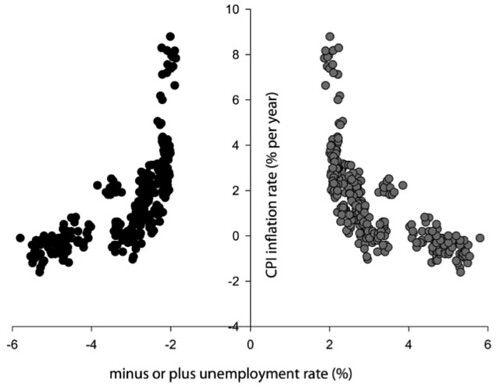
Ten others– including Bauman’s own hysterical take-down of Gregory Mankiw and “On the efficiency of AC/DC? Bon Scott versus Brian Johnson,” featured here in pre-blog times– at “Top 11 Funniest Papers in the History of Economics.”
* Nikita Khrushchev (widely attributed)
###
As we search for one-armed economists, we might spare a thought for Charles Darrow; he died on this date in 1967. It was Darrow who took a Quaker game that inveighed against acquisitiveness and turned it into the monopoly that is Monopoly.

“I think it’s wrong that only one company makes the game Monopoly”*…

The game Monopoly was created in the early 1930s as “The Landlord Game” by a Quaker anxious to illuminate the dangers of unbridled acquisitiveness. But by 1935, when it was acquired by Parker Bros., it had been copied, re-titled, and remade into the paean to aspirational capitalism that’s been a huge success ever since.
But times have changed; the methods of wealth accumulation have morphed… and now there is a new set of rules to reflect this new reality.
It would be hard to simplify capitalism further than Monopoly. The game attempts to express the ruthlessness of raw capitalism by declaring that whoever has the most money at the “end” is the winner. While it’s true our culture proclaims the rich as our greatest heroes, the method of financial gain in Monopoly is not a system that allows for any creativity. Roll the dice, buy a property, pay rent, pass go, and collect $200. Repeat.
Simple models have long been used to help understand complex ideas. With a few small changes Monopoly can be a space where we can play at being in control of the economic system. All it takes is a few new rules.
Rule Change #1: The Banker
In the original rules the role of the banker is simply a chore–the board game equivalent of taking out the trash. But in real life the banker is no passive entity. The banker is the center of the universe.
The Libor scandal, the UBS money laundering scandal, the SAC Capital scandal, FINRA suing Wells Fargo and Bank of America, TD Bank paying to settle charges of a ponzi scheme, Galleon Group’s insider trading scandal. This list could go on. The point is that banking is
exciting work!The role of the banker is special. The banker should have no piece on the Monopoly board, but this person is in charge of the bank’s money. The success of the banker is judged the same as any other player: Whoever accumulates the most wealth is the winner. Of course, as in life, the banker has some advantages (like control of all the money)…
Read the rest of the new rules at “Rethinking the game of Monopoly“… then roll the dice.
Playing this version of Monopoly won’t help you understand the details of a banking scandal. But you’ll have experience with a simplified model of the financial system that generates regular “scandals.” A game where arguing and backstabbing are part of the rules and the winner is hard to determine. This simple model recreates the same results found in the real world.
* Stephen Wright
###
As we wonder why no one’s done time, we might recall that it was on this date in 1882 that the San Francisco Stock and Bond Exchange was formed; it later merged with with Los Angeles Oil Exchange to become the Pacific Stock Exchange. In 1999 it became the first stock exchange in the U.S. to demutualize, and in 2003, closed its trading floors and went to electronic transactions. The PSX, as it was known, merged into the New York Stock Exchange in 2006.

The San Francisco home of the Pacific Stock Exchange from 1930 to 2003
Tilt!…
From Popular Mechanics, “11 Things You Didn’t Know About Pinball History,” e.g.:
7. Pinball Has a Surprise Best-Seller
The best-selling pinball machine of all time is still “The Addams Family,” which came out in 1991.

and…
11. Just One Company Still Makes Pinball Machines
And it does it in the U.S. Every new pinball machine comes from a single Stern Pinball factory in the Chicago suburbs, where factory workers assemble several thousand parts, largely by hand.

Readers will find the other nine nuggets at “11 Things You Didn’t Know About Pinball History.”
As we limber up our flipper fingers, we might recall that it was on this date in 1935 that Parker Brothers purchased the patent for “The Landlord’s Game” from Elizabeth Magie, a Quaker political activist who had created the game to illustrate the way in which monopolies impoverish (“bankrupt”) the many while concentrating extraordinary wealth in one or few. Charles Darrow’s “Monopoly” was (to put it politely) closely modeled on “The Landlord’s Game”; when it became a hit in 1933, Parker Brothers bought it– and subsequently paid Ms. Magie $500 for her predecessor patent to avoid a (completely justified) claim from her that “Monopoly” was, in effect, stolen. It is estimated that over a billion people have played “Monopoly” over the years.
“The Landlord’s Game” board, from Magie’s original patent application (source)
You must be logged in to post a comment.